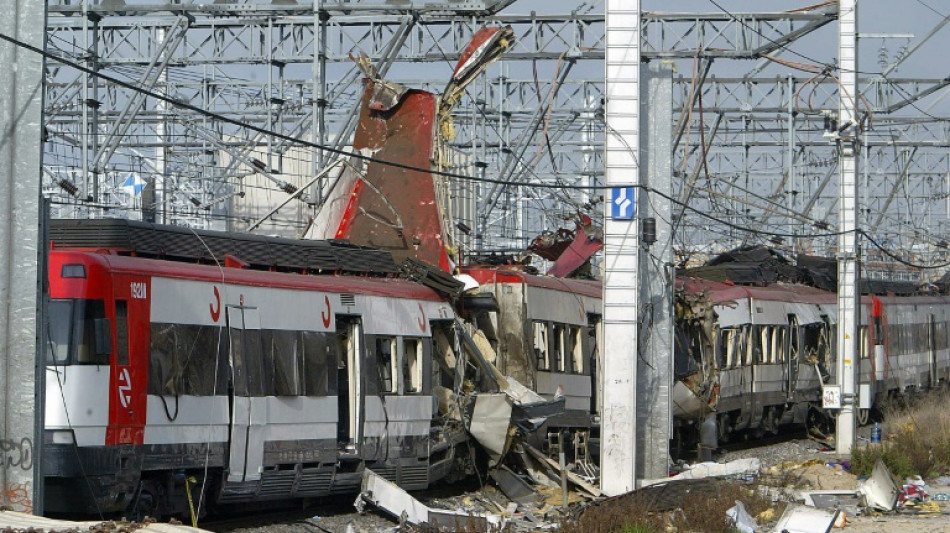
Two decades after Madrid attacks, jihadist threat to Spain changed / Photo: Pierre-Philippe MARCOU - AFP/File

 NBA close to picking new $12-13bn Vegas team owners: report
 LA28 Olympics torch relay to visit all 50 states
 Spain brush aside Croatia in Nations League, England down Czechs

 Trump hails 'morally binding' AI self-regulation pledge

 Yamal inspires Spain to Croatia romp on World Cup homecoming

 UN to hold fourth informal poll of secretary-general candidates
 Who are the Emiratis behind crisis-hit Manchester City?

 Singer Angelique Kidjo urges Africans to 'create together'

 Alleged Rihanna mansion shooter mentally fit for trial, says judge

 Mystery over UK airbase scare as police find petrol not explosives

 OpenAI unveils low-cost AI model, a day after shelving Astra upgrade
 Premier League confirms Man City guilty of serious financial breaches

 Brazil's Lula turns to Bad Bunny tune to criticise Trump ahead of polls

 Nigerian dancer eyes world record after seven-day marathon

 Swiss regulator concludes Julius Baer bank probe

 Brazil's patron saint pulled into latest election scrap

 Football overload leaves players near 'breaking point', warns Tebas
 Paris Eiffel Tower says chief to step down after uproar over removing women staff

 Amaze Holdings (NYSE: AMZE) Executes Binding LOI to Acquire BullionFX | Alchemy, a Decentralized Gold-Backed Financial Ecosystem for Valued at US$155 Million

 Clashes between French teens, police as school blockades intensify

 Stocks move sideways despite oil moving lower

 African leaders to gather in Egypt for business summit

 UK decides against charging foreign visitors for museums

 Dallaglio to sell England World Cup winners' medal

 Brazil come from behind to beat Australia 4-2 in friendly

Twenty years ago, a large, well-organised terror cell planned and staged the deadly Madrid train bombings, but today the jihadist threat facing Spain comes from lone wolves and small self-radicalised groups.
On March 11, 2004, 10 bombs were placed on four suburban trains heading for the capital's Atocha station.
They exploded within minutes of each other, killing 192 people and injuring nearly 2,000 in Europe's worst jihadist attack.
The attacks were carried out by a large cell made up mainly of first-generation Moroccan immigrants.
Three weeks later, seven suspected members of the cell blew themselves up when police surrounded the place where they were hiding on the outskirts of Madrid.
Another 18, mostly Moroccans but also several Spaniards, a Syrian and an Egyptian, were jailed over the attacks.
Two decades on, Spain's latest annual national security report found that "the greatest (jihadist) threat" facing Spain and the West is posed by "lone wolf attackers and self-radicalised cells".
It was now "more difficult to carry out a complex act of terror in Spain" given that the capacity of the Islamic State (IS) group and Al Qaeda to stage such attacks in Europe "has decreased considerably".
Even so, Spain remains at the second highest of its five levels of alert.
- 'Individual, emotional' jihad -
Spain's last major attack, in 2017, left 16 dead in Barcelona and the nearby seaside town of Cambrils.
But the most recent jihad-inspired violence were three individual operations in 2018, 2019 and 2023, which claimed two lives.
Each attack appeared to be motivated by an outburst of madness, mental health issues or revenge, with barely any advance preparation. None of them involved the use of guns.
"We're seeing a more individual, emotional approach to jihad," said Carola Garcia-Calvo, senior researcher for radicalisation and global terrorism at Madrid's Real Instituto Elcano think tank.
"But at the end of the day, it is still used... to justify acts carried out in line with the directives of jihadist groups," she told AFP.
"We must not drop our guard, because one of the characteristics of the global jihadist movement and its inherent terrorist threat is its huge capacity to mutate and adapt to new contexts," she said.
And a new mobilising element had emerged in the last few months with the Israel-Hamas war, she added. It was playing out in "a very sensitive area".
Fernando Reinares, a jihadism expert who wrote three books about the Madrid train bombings said that for Spain, the threat remained "considerable", speaking during a roundtable hosted by the Real Instituto Elcano last week.
Spain, he pointed out, was "among the three European countries that systematically carried out the most anti-jihad terror operations and arrested most jihadist suspects".
- More than 1,000 arrests -
At the time of the 2004 attacks, Spain was also dealing with the threat posed by ETA, the armed separatist group that laid down its weapons in 2011 and disbanded seven years later.
That allowed the security forces to focus their attention on Islamic radicalism. In the two decades since the train bombings, Spain has arrested 1,047 suspects in 408 operations, official figures show.
And during that period, the profile of the would-be jihadist has changed. They tend to be younger, often born in Spain and are in contact with fellow extremists online rather than in person.
"Firstly, those who are radicalised are younger," wrote Alvaro Vicente, an analyst with the Real Instituto Elcano think tank.
"And the under-18s are the only demographic that has grown among jihad militants over the last decade," he added.
"Secondly, virtual spaces have been established as the main place where (radicalisation) happens."
W.Mansour--SF-PST