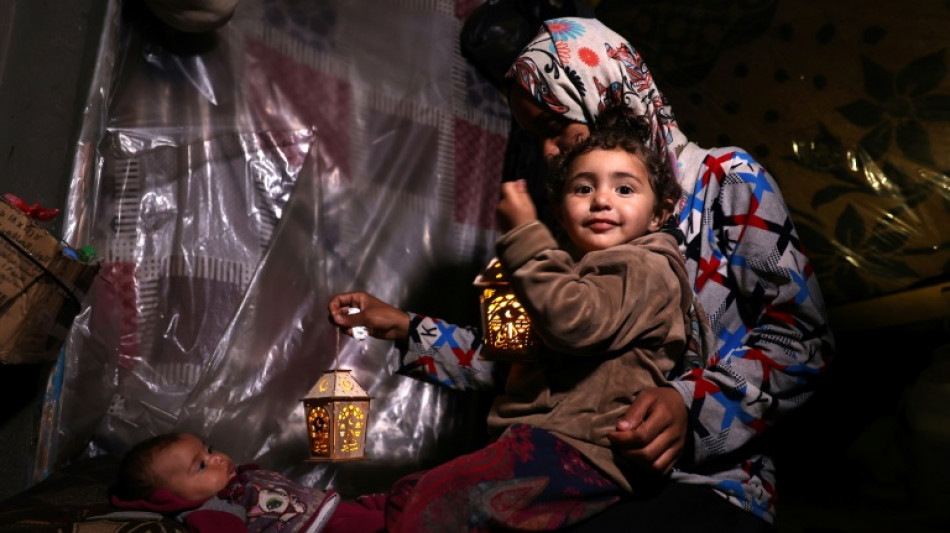
'It hurts': Gaza war robs Muslim world of Ramadan joy / Photo: SAID KHATIB - AFP

 NBA close to picking new $12-13bn Vegas team owners: report
 LA28 Olympics torch relay to visit all 50 states
 Spain brush aside Croatia in Nations League, England down Czechs

 Trump hails 'morally binding' AI self-regulation pledge

 Yamal inspires Spain to Croatia romp on World Cup homecoming

 UN to hold fourth informal poll of secretary-general candidates
 Who are the Emiratis behind crisis-hit Manchester City?
 Singer Angelique Kidjo urges Africans to 'create together'

 Alleged Rihanna mansion shooter mentally fit for trial, says judge
 Mystery over UK airbase scare as police find petrol not explosives
 OpenAI unveils low-cost AI model, a day after shelving Astra upgrade

 Premier League confirms Man City guilty of serious financial breaches
 Brazil's Lula turns to Bad Bunny tune to criticise Trump ahead of polls
 Nigerian dancer eyes world record after seven-day marathon
 Swiss regulator concludes Julius Baer bank probe
 Brazil's patron saint pulled into latest election scrap

 Football overload leaves players near 'breaking point', warns Tebas
 Paris Eiffel Tower says chief to step down after uproar over removing women staff
 Amaze Holdings (NYSE: AMZE) Executes Binding LOI to Acquire BullionFX | Alchemy, a Decentralized Gold-Backed Financial Ecosystem for Valued at US$155 Million
 Clashes between French teens, police as school blockades intensify
 Stocks move sideways despite oil moving lower
 African leaders to gather in Egypt for business summit
 UK decides against charging foreign visitors for museums

 Dallaglio to sell England World Cup winners' medal

 Brazil come from behind to beat Australia 4-2 in friendly

For Muslims worldwide, Ramadan is a time of prayer, reflection and joyful evening meals, but all Gazans wish for this year is an end to five months of war and suffering.
It is a hope shared widely across the Islamic world, where the thoughts of many are with Gaza ahead of the fasting month which starts with the sighting of the crescent moon on Sunday or Monday.
The war sparked by Hamas's October 7 attack against Israel has devastated Gaza, killed tens of thousands of Palestinians and triggered violence elsewhere in the Middle East, from Lebanon to the seas off Yemen.
Amid the ruins of southern Gaza, Nevin al-Siksek sat recently outside her makeshift tent, distracting her young daughter from the carnage around them with a plastic Ramadan lantern.
The colourful fanous lanterns are an iconic symbol of Ramadan, the ninth month of the Islamic calendar marked by dawn-to-dusk fasting and, in better times, festive evening iftar meals with family and friends.
Across Gaza this year, the lights are among the few signs signalling the coming holy month, amid dire warnings of mass starvation.
While international mediators were hoping for a truce in time for Ramadan, no breakthrough had come by Friday.
Much of the territory of 2.4 million people has become a hellscape of bombed-out neighbourhoods, emaciated children and mass graves dug in the sand.
Siksek and her family, instead of tucking into lamb and sweets at the home they had to flee in northern Gaza, will break their fast in the bare-bones tent they share with other displaced civilians.
If they can find anything to eat, that is.
"We do not have any food to prepare," Siksek said as her husband, Mohammed Yasser Rayhan, nodded in agreement.
In the past during Ramadan, which commemorates the beginning of the Koranic revelation to the Prophet Mohammed in the seventh century, "there was life, joy, spirit, decorations and a beautiful atmosphere", Rayhan said.
"Now Ramadan is coming and we have war, oppression and famine."
- 'A prayer for our brothers' -
The Gaza war erupted after Hamas staged an unprecedented attack on southern Israel that resulted in the deaths of around 1,160 people, mostly civilians, according to an AFP tally based on official Israeli figures.
Israel's retaliatory military campaign has killed at least 30,800 people so far, the vast majority women and children, according to Hamas-run Gaza's health ministry.
Other parts of the Islamic world may be grappling with their own challenges, from conflicts to high inflation. But many Muslims say their thoughts are with Palestinians this year.
"Every time I pray, I always send a prayer for our brothers and sisters in the Palestinian territory," said Indonesian housewife Nurunnisa, 61, in Aceh province in the west of the country with the world's largest Muslim population.
"I can't help them with anything so I can only help them with prayer. I pray the war will be over soon. The people there are suffering so much."
The reports of looming famine in Gaza, where desperate residents have taken to eating slaughtered horses and even leaves, also weigh heavily on Jordanian father-of-five Saif Hindawi, he said as he shopped for rice and oil in Amman.
"Imagine in Jordan, there are high prices, but there is still the ability to buy what is available," said the 44-year-old.
In Gaza, he said, "they have used animal fodder to make bread".
The war has had a severe impact on southern Lebanon, where Iran-backed Hezbollah militants have exchanged near-daily strikes with Israel and tens of thousands have been displaced on both sides of the border.
Retired teacher Maryam Awada, now living in a school-turned-shelter in the city of Tyre, said she would be unable to fast this Ramadan because of the stress.
"God will not force me to fast here in this hall we're living in," she said.
In Yemen, Iran-backed Huthi rebels began firing missiles at vessels linked to Israel in November.
The Huthis' campaign has won them fans abroad, but within Yemen it has worsened a humanitarian crisis brought on by a nearly decade-long civil war.
In the port city of Hodeida, an area targeted by anti-Huthi US strikes, restaurant manager Ali Mohammad said he was bracing for a lean month.
"When the air strikes began, business suddenly collapsed," he said. "If the situation continues... our only option will be to close down."
In Somalia's capital, trader Abdirahim Ali said he worried the Red Sea crisis would drive up prices, something that "affects people during Ramadan" especially.
- 'Tired and drained' -
Muslims in Israeli-annexed east Jerusalem worry about violence at the Al-Aqsa mosque compound, a regular flashpoint.
The site is Islam's third-holiest and Judaism's most sacred, known to Jews as the Temple Mount.
During Ramadan, Muslims in their tens and even hundreds of thousands pray at the compound's iconic Dome of the Rock.
But in February, Israel's hard-right National Security Minister Itamar Ben Gvir argued that Palestinian residents of the occupied West Bank "should not be allowed" entry to Jerusalem during Ramadan.
Prime Minister Benjamin Netanyahu's office said on Tuesday that worshippers would be allowed to enter the mosque "in similar numbers" to past years.
That did little to reassure Ahlam Shaheen, 32, who works at a community centre near Al-Aqsa.
When Israeli police stormed the mosque in 2021, Shaheen saw women praying next to her get shot with rubber bullets, and she fears it could happen again.
"We're living with the war for five months now," she said. "We're really tired and drained."
In Cairo, the most festive of cities during Ramadan, a Gazan student who asked not to be named feared the holy month this year would be unbearable.
"For the first time in my life, I can't stand the idea of Ramadan," she said. "It hurts every time I see a fanous," she said about the lanterns that festoon the city's streets.
"My brothers and sisters can't even eat once a day, and we're supposed to have a fast-breaking meal like everything is normal?"
az-burs-rcb/jd/fz/jsa/smw
I.Saadi--SF-PST