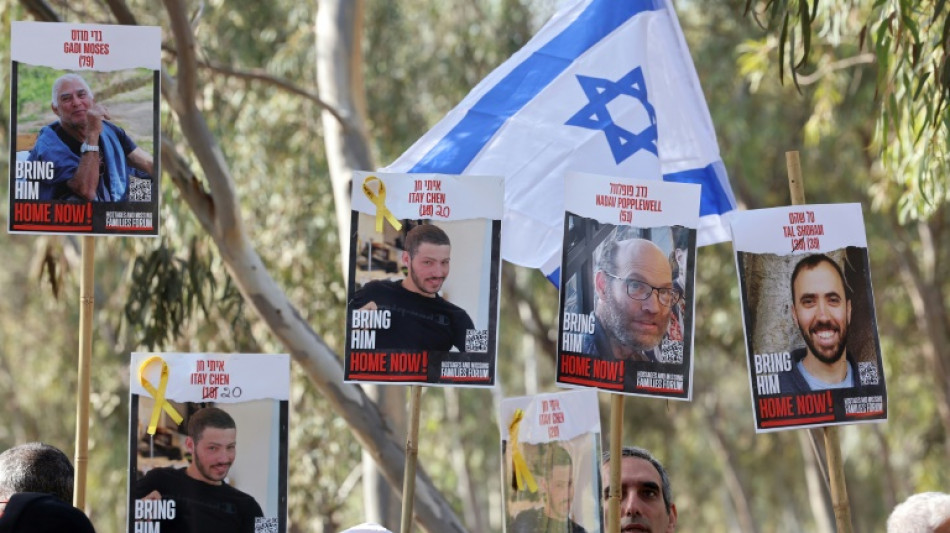
Gaza hostages risk lasting psychological trauma: experts / Photo: JACK GUEZ - AFP

 One third of world population exposed to harmful air pollution: monitor

 North Korea denies South's claim it was apparently behind DMZ mine blasts

 West Bank's violent settlers part of a new generation fuelled by ideology

 US-led coalition ends mission in Iraq
 Pope-backed White Sox join Braves with MLB playoff wins

 NBA close to picking new $12-13bn Vegas team owners: report
 LA28 Olympics torch relay to visit all 50 states
 Spain brush aside Croatia in Nations League, England down Czechs

 Trump hails 'morally binding' AI self-regulation pledge

 Yamal inspires Spain to Croatia romp on World Cup homecoming

 UN to hold fourth informal poll of secretary-general candidates
 Who are the Emiratis behind crisis-hit Manchester City?

 Singer Angelique Kidjo urges Africans to 'create together'

 Alleged Rihanna mansion shooter mentally fit for trial, says judge
 Mystery over UK airbase scare as police find petrol not explosives

 OpenAI unveils low-cost AI model, a day after shelving Astra upgrade
 Premier League confirms Man City guilty of serious financial breaches
 Brazil's Lula turns to Bad Bunny tune to criticise Trump ahead of polls

 Nigerian dancer eyes world record after seven-day marathon

 Swiss regulator concludes Julius Baer bank probe

 Brazil's patron saint pulled into latest election scrap

 Football overload leaves players near 'breaking point', warns Tebas
 Paris Eiffel Tower says chief to step down after uproar over removing women staff

 Amaze Holdings (NYSE: AMZE) Executes Binding LOI to Acquire BullionFX | Alchemy, a Decentralized Gold-Backed Financial Ecosystem for Valued at US$155 Million

 Clashes between French teens, police as school blockades intensify

If and when the hostages held by Hamas in Gaza are released under any deal, they face the risk of lasting psychological trauma, experts warned, citing the suffering of people freed previously.
"There are some that are living dead. As if they were frozen in time and place in Gaza, and haven't returned," said Merav Roth, a clinical psychologist who treated some of those former hostages and their families.
Israel launched an assault to destroy Hamas after the group's unprecedented attack on southern Israel on October 7. The hostages' possible release is one of the points at stake in truce talks under way in Egypt.
Hamas's attack resulted in the deaths of about 1,160 people, mostly civilians, according to an AFP tally of official figures, and saw some 250 hostages taken, most of them Israelis.
Israel's retaliatory bombardment and ground offensive have killed more than 30,700 people, most of them women and children, according to the territory's Hamas-run health ministry.
- 'World of chaos' -
Some hostages were released under a week-long truce in November but around 130 others remained in the hands of Hamas in Gaza.
"We're going to have to immediately take care of these hostages... to help them overcome their fear and their stupor and bring them back to real life," Marilyne Baranes, a psychologist who specialises in post-traumatic stress disorder (PTSD), told AFP.
Of the approximately 100 Israeli hostages freed under the earlier truce, half are undergoing treatment or therapy, the country's government said.
Those who were kept in more dangerous or traumatic conditions, experience "more severe symptoms of anxiety, depression", Roth said.
"But among them all, there's great difficulty in returning to functionality."
Christine Roulliere-Le Lidec, a PTSD specialist, told AFP that survivors need both physical and psychological support in order to move on from a "world of chaos, of hell, to the world of life."
"I've seen cases of people who... supported of course by the health care teams and their families, can finally get through it... to be able to finally find meaning in your life when you've been living in nonsense and barbarism and chaos."
- Limited research -
Research indicates it is difficult to measure the risk of mental illness in different hostages after their release.
While some former hostages have suffered severely -- French journalist Brice Fleutiaux took his own life in 2001 after being held hostage in Chechnya -- others appeared to overcome their trauma.
Briton Terry Waite, who spent four years detained in Lebanon in the 1980s, has dedicated his life to helping hostages and their families.
A 2009 study in the Journal of the Royal Society of Medicine concluded: "As yet there is no clear delineation of all factors which conduce to an adverse outcome following being taken hostage."
- Post-release monitoring difficult -
The study found evidence that those facing worse after-effects included women, people with little education but also those held for long periods -- as is the case with the hostages in Gaza.
However, the findings are dated and research is difficult to carry out.
"For ethical and practical reasons, particularly if children are involved, the follow-up of hostages on release is difficult," the study said.
"Thus, the scientific and clinical database is relatively modest."
Many studies are based on autobiographies by former hostages which gives a limited point of view.
Experts agree that a lot depends on the first few hours after a hostage is released.
"You can get over this type of thing, but you won't go back to the way you were," psychologist Baranes said.
D.Khalil--SF-PST