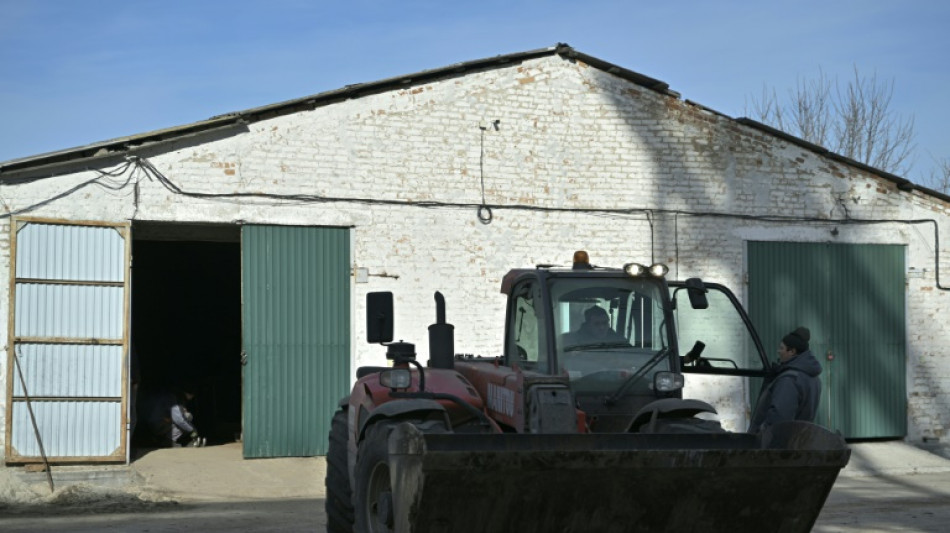
'Can't sell': the Polish blockade, another blow for Ukraine's farmers / Photo: Genya SAVILOV - AFP

 One third of world population exposed to harmful air pollution: monitor
 North Korea denies South's claim it was apparently behind DMZ mine blasts

 West Bank's violent settlers part of a new generation fuelled by ideology

 US-led coalition ends mission in Iraq
 Pope-backed White Sox join Braves with MLB playoff wins

 NBA close to picking new $12-13bn Vegas team owners: report
 LA28 Olympics torch relay to visit all 50 states
 Spain brush aside Croatia in Nations League, England down Czechs
 Trump hails 'morally binding' AI self-regulation pledge
 Yamal inspires Spain to Croatia romp on World Cup homecoming

 UN to hold fourth informal poll of secretary-general candidates
 Who are the Emiratis behind crisis-hit Manchester City?
 Singer Angelique Kidjo urges Africans to 'create together'

 Alleged Rihanna mansion shooter mentally fit for trial, says judge
 Mystery over UK airbase scare as police find petrol not explosives

 OpenAI unveils low-cost AI model, a day after shelving Astra upgrade
 Premier League confirms Man City guilty of serious financial breaches
 Brazil's Lula turns to Bad Bunny tune to criticise Trump ahead of polls
 Nigerian dancer eyes world record after seven-day marathon
 Swiss regulator concludes Julius Baer bank probe
 Brazil's patron saint pulled into latest election scrap

 Football overload leaves players near 'breaking point', warns Tebas
 Paris Eiffel Tower says chief to step down after uproar over removing women staff
 Amaze Holdings (NYSE: AMZE) Executes Binding LOI to Acquire BullionFX | Alchemy, a Decentralized Gold-Backed Financial Ecosystem for Valued at US$155 Million
 Clashes between French teens, police as school blockades intensify
In a field in the Kyiv region, Lyudmyla Martyniuk was standing by silos filled with grain that should be heading for export, but for a blockade on the Polish border disturbing a market already impacted by Ukraine's war with Russia.
"We cannot sell," said Martyniuk, head of the farming company Kivshovata Agro.
Like other Ukrainian producers, Martyniuk was puzzled by the Polish blockade, which has lasted several weeks and received support from other farmers in the European Union.
"They do not understand the price we are paying for this grain," she told AFP.
Many EU farmers said that the influx of Ukrainian grain led to a collapse in prices and called on the EU to toughen import rules.
Martyniuk agreed that grain prices were much too low but rejected the idea that Ukraine is responsible.
Instead, she pointed to a series of issues, including Russia drowning the international market with cheaper grain.
She also complained of higher prices for spare parts, transport and fuel, saying grain prices only covered "half of the production costs".
As a result of the blockade, Martyniuk decided to suspend exports, which previously accounted for around 60 percent of her production.
- Harvesting 'under attacks' -
Martyniuk said she had no other choice and hoped that prices would rise again and that the border would reopen.
"We are very concerned, and waiting every day for this to end, like waiting for a breath of fresh air," said the producer, who exported around 40,000 tonnes of grain last year.
If she could, Martyniuk would tell Polish farmers that Ukrainians "are not a threat" to them and simply want their exports to be allowed to transit through Poland to other countries.
She would also warn them that they might have to "take up arms to defend their land" if Ukraine loses, after two years of grinding war with its much larger neighbour.
"Today it's us, tomorrow it will be you" potentially invaded by Moscow's troops, she said.
Amid a diplomatic spat between Warsaw and Kyiv because of the blockade, Ukraine has emphasised that Russia should be the common enemy.
"Only Moscow is rejoicing" about tensions between the two countries, Ukrainian President Volodymyr Zelensky said last month.
Ukraine's infrastructure minister Oleksandr Kubrakov pointed out the obstacles that farmers have faced since the start of the invasion.
Ukrainian producers were harvesting "under missile attacks and despite the danger of mines" left by the Russian army, he said.
- 'Find a solution' -
Ukraine has managed to establish a maritime corridor for its exports in the Black Sea despite the risk of Russian bombings after Moscow pulled out of a previous deal last year.
Around 90 percent of farming exports pass by sea, said Ukrainian authorities, who hoped to develop the route to get around the Polish blockade.
Even with the maritime corridor in place, the consequences of the blockade have been "enormous" for the Ukrainian economy, said Anna Derevianko, director of the European Business Association (EBA) lobby.
Companies that sell fresh produce, like cheese or fish, have been forced to "throw out" their cargo when they are stuck too long, said Derevianko, who represents several hundred companies.
"Of course, hundreds of businesses could think twice before doing business with Ukraine" because of logistical difficulties, she said.
Derevianko said she understood that the protests were linked to "fear of competition" as Ukraine planned to join the EU.
Production costs and norms remained very different in Ukraine compared to its EU neighbours, and its average production far greater.
"But at the same time, you cannot completely exclude Ukraine either," Derevianko said.
"It exists and we simply have to find a solution to this situation."
S.Abdullah--SF-PST