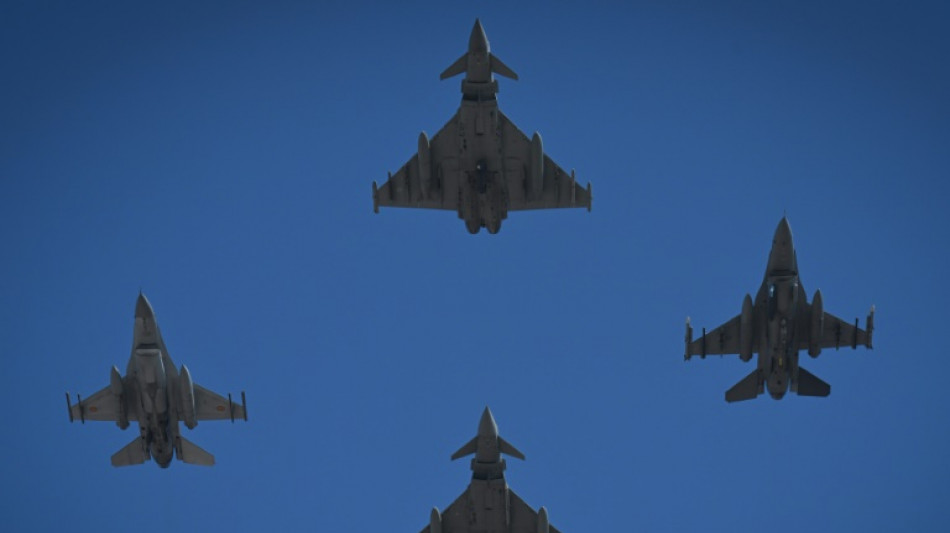
EU proposes vast defence boost, spurred by Russian war in Ukraine / Photo: Daniel MIHAILESCU - AFP/File

 One third of world population exposed to harmful air pollution: monitor

 North Korea denies South's claim it was apparently behind DMZ mine blasts

 West Bank's violent settlers part of a new generation fuelled by ideology
 US-led coalition ends mission in Iraq
 Pope-backed White Sox join Braves with MLB playoff wins

 NBA close to picking new $12-13bn Vegas team owners: report
 LA28 Olympics torch relay to visit all 50 states
 Spain brush aside Croatia in Nations League, England down Czechs
 Trump hails 'morally binding' AI self-regulation pledge
 Yamal inspires Spain to Croatia romp on World Cup homecoming

 UN to hold fourth informal poll of secretary-general candidates
 Who are the Emiratis behind crisis-hit Manchester City?
 Singer Angelique Kidjo urges Africans to 'create together'
 Alleged Rihanna mansion shooter mentally fit for trial, says judge
 Mystery over UK airbase scare as police find petrol not explosives

 OpenAI unveils low-cost AI model, a day after shelving Astra upgrade
 Premier League confirms Man City guilty of serious financial breaches
 Brazil's Lula turns to Bad Bunny tune to criticise Trump ahead of polls

 Nigerian dancer eyes world record after seven-day marathon
 Swiss regulator concludes Julius Baer bank probe
 Brazil's patron saint pulled into latest election scrap

 Football overload leaves players near 'breaking point', warns Tebas
 Paris Eiffel Tower says chief to step down after uproar over removing women staff
 Amaze Holdings (NYSE: AMZE) Executes Binding LOI to Acquire BullionFX | Alchemy, a Decentralized Gold-Backed Financial Ecosystem for Valued at US$155 Million
 Clashes between French teens, police as school blockades intensify
EU officials on Tuesday unveiled an ambitious proposal to massively boost weapons production and procurement in the bloc to shift from a reliance on US arms and in reaction to Russia's invasion of Ukraine.
The European Commission says the 27-nation bloc is facing a new "security paradigm" with an expansionist Russia operating a wartime economy as it presses into year three of the conflict with Kyiv.
"To counter the return of high-intensity war on our border, we have decided to kick up a gear," EU internal market commissioner Thierry Breton told reporters in announcing the new initiative.
The European Defence Industrial Strategy aims, over the long term, to give incentives to European arms manufacturers to invest more, make their production more agile and -- for the first time -- to collectively catalogue what they have available.
"We must take more responsibility for our own security, while, of course, remaining fully committed to our NATO alliance," said European Commission Vice President Margrethe Vestager.
"We need to get that transatlantic balance right, irrespective of electoral dynamics in the US," she told reporters, in a nod to Republican White House hopeful Donald Trump casting doubt on the US commitment to its NATO allies should he win reelection.
"An improved ability to act will make us a stronger ally," Vestager said.
The question of financing the ambitious initiative is problematic for a continent that has trimmed defence investment for decades following the collapse of the Soviet Union.
- Funding questions -
Breton has spoken of an ultimate need for some 100 billion euros ($110 billion) for the European Union to rival the Pentagon and US defence industry.
To kickstart the project, the commission plans to set aside 1.5 billion euros from the EU's current budget that runs to 2027 -- an amount Vestager acknowledged "is not a lot of money" given the scale of the initiative.
"But it can still work as an incentive, as a bonus... because the real funding for a stronger defence comes from member states and that funding will increase over the years to come," she said.
Some countries, such as France, back an idea of EU bonds to finance a buy-European weapons production base, similar to what was done to finance economic recovery from the Covid pandemic.
But "frugal" countries such as Germany are against that, concerned it will centralise budget power in Brussels and override national sovereignty over defence issues.
There is also a debate over using money generated from frozen Russian assets in the EU to help fund the initiative, though the bloc's foreign policy chief Josep Borrell said that "is still not decided and there are different views" among member states.
- 'Kick up a gear' -
While the EU and member countries have supported Ukraine financially and with military weapons and equipment, arms production has come up short with the bloc missing a target to give Kyiv a promised one million artillery shells.
Breton said the bloc was now providing Ukraine around 80,000 shells per month.
The EU's 27 member countries spent more than 100 billion euros on defence purchases between Russia's February 2022 invasion of Ukraine and June last year, Vestager said.
"Almost 80 percent of that was spent outside of the European Union, and the US alone accounted for more than 60 percent of this spending. This is no longer sustainable," she said.
The EU's proposed strategy aims to have trade of weapons within the bloc reaching 35 percent of total value of the EU defence market by 2030.
Member states will also be encouraged to procure European weapons to a level of at least 50 percent of their defence budgets by 2030 and 60 percent by 2035.
A defence industrial readiness board would be created to bring together member countries, the commission and the EU's top diplomat, currently Borrell, to coordinate.
One mechanism would be set up for common arms procurement across the bloc, and another to support defence cooperation including through potential tax breaks.
Importantly, Ukraine would be treated as a "quasi member" of the initiative, which would open the way for it to more easily purview and tap arms production and supplies in the EU -- should its war against Russian troops be ongoing then.
E.Qaddoumi--SF-PST