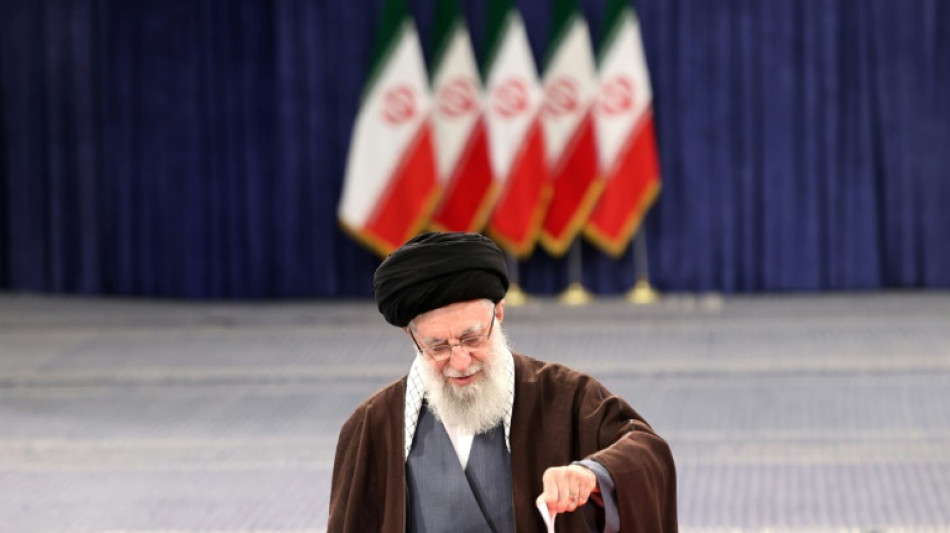
Iranians vote in elections as conservatives expected to dominate / Photo: ATTA KENARE - AFP

 Dangote to launch $16bn refinery in Kenya
 North Korean leader 'extremely obese': Seoul spy agency
 Yankees and pope-backed White Sox start MLB playoffs with wins
 Malaysia's ex-PM Mahathir in hospital for observation
 'No limits': Marathon world record holder Sawe chasing history
 Countdown begins to biggest-ever Rugby World Cup
 Bangladesh women lose ground after quota reform
 Vietnam admits 'differing opinions' on Hanoi development
 Stocks temper gains as oil pares heavy losses, US data in focus
 New Zealand denies breaching climate commitments to EU

 Albert becomes youngest US scorer in 4-2 win over Chile
 Pirate island's plunging population shows Greece's demographic decline
 With elections ahead, Latvia's Russian-speakers reject Moscow's help
 Brazil football clubs face massive sponsorship blow from betting ban
 ChatGPT maker wants to be the App Store for AI as safety concerns grow
 Women fight fires and sexism in Indonesian Borneo

 Forsling's OT blast lifts Florida over Carolina in NHL opener

 Hurricane Polo sweeps over Mexico's Pacific coast, heads inland
 Grynspan pulls ahead in race to lead UN: diplomat

 Trump touts AI boss pledge to self-regulate
 Oil down, but stocks lower as bond yields rise
 England break down stubborn Czechs to claim first Nations League win
 UN Security Council extends Haiti anti-gang force by 6 months

 Manchester City guilty of Premier League charges: What comes next?
 Man City chief Soriano slams Premier League 'conspiracy theory'
Iranians voted on Friday in elections for parliament and a key clerical body, amid fears of a low turnout and with conservatives expected to tighten their grip on power.
Supreme leader Ayatollah Ali Khamenei, who has called for a strong turnout, was the first to cast his ballot, at a polling station in central Tehran, state television reported.
Since the last elections, Iran has been badly affected by international sanctions that have led to an economic crisis. It has also been rocked by widespread protests and drawn into escalating regional tensions over the Israel-Hamas war.
More than 61 million people out of Iran's 85-million population are eligible to vote for members of parliament as well as the clerics of the Assembly of Experts, the body in charge of selecting Iran's supreme leader.
A low turnout is expected, however, after a state TV poll found more than half of respondents were indifferent about the elections.
"Suppose that I vote: what would it change?" said a 21-year-old from western Kurdistan province who only gave her name as Hanna, out of fear of reprisals. "They (the elected officials) do not respect their promises."
Her comments were echoed by Hashem, a 32-year-old from the southwestern province of Khuzestan. "The problem with the elections is that people are not happy with this system because of the political and economic situation," he said.
Another voter, Moradiani from southern Tehran, said she would heed Khamenei's call to vote.
"The leader said that participating in the elections is an obligation," she said, "just as it is obligatory for us to pray."
Iran's last parliamentary elections in 2020 had a voter turnout of 42.57 percent -- the lowest since the 1979 Islamic Revolution.
- Candidates vetted -
Khamenei had on Friday appealed for people to vote, saying "onlookers from all over observe the affairs of our country; make (Iran's) friends happy and ill-wishers disappointed".
The supreme leader had previously warned that Iran's "enemies want to see if the people are present", adding that otherwise "they will threaten your security in one way or another".
Those watching, he said, included the United States, "most of the Europeans, evil Zionists, capitalists and big companies".
Iran considers the United States, its Western allies and Israel "enemies" of the state and accuses them of seeking to intervene in its internal affairs.
On the eve of the elections, the United States said they would be unfair.
"I have no expectation that Iran's elections will be free and fair, and I suspect that a great number of Iranians have no expectation that those elections will be free and fair," US State Department spokesman Matthew Miller told reporters in Washington.
Candidates for parliament are vetted by the Guardian Council, whose members are either appointed or approved by the supreme leader.
They have approved a total of 15,200 candidates, out of nearly 49,000 applicants, to run for seats in the 290-member parliament.
Conservatives and ultra-conservatives, who hold 232 out 290 seats in the 2020 parliament after reformist and moderate candidates were disqualified from running, are expected by analysts to dominate once again.
A coalition of parties called the Reform Front said it would not take part in "meaningless, non-competitive and ineffective elections".
- 'Far from free' -
Former Iranian president, the reformist Mohammad Khatami, was quoted in February by the conservative Javan daily as saying that Iran was "very far from free and competitive elections".
Conservatives are also expected to maintain a firm grip on the Assembly of Experts, an 88-member body exclusively made up of male Islamic scholars.
A total of 144 candidates are running but many hopefuls were disqualified, including former moderate president Hassan Rouhani.
Friday's elections are the first since Iran was rocked by mass protests triggered by the September 2022 death in custody of Mahsa Amini.
Amini, a 22-year-old Iranian Kurd, had been arrested for allegedly violating the Islamic republic's strict dress code for women.
Meanwhile, the Israel-Hamas war has sent tensions in the region soaring, with pro-Tehran groups in Lebanon, Iraq, Syria and Yemen all involved in clashes with either Israel or its Western allies.
The elections also take place amid crippling international sanctions and mounting economic hardship in Iran, where inflation has hovered around 50 percent and the rial has sharply declined against the dollar.
"The prices are extremely high and continue to increase," Masoumeh, a 40-year-old housewife, told AFP in Tehran's Grand Bazaar ahead of the vote.
"I don't think that the representatives who will be elected will be able to improve this situation."
Voting will run until 6:00 pm (1430 GMT) and "will be extended if necessary", the interior ministry said in a statement.
P.Tamimi--SF-PST