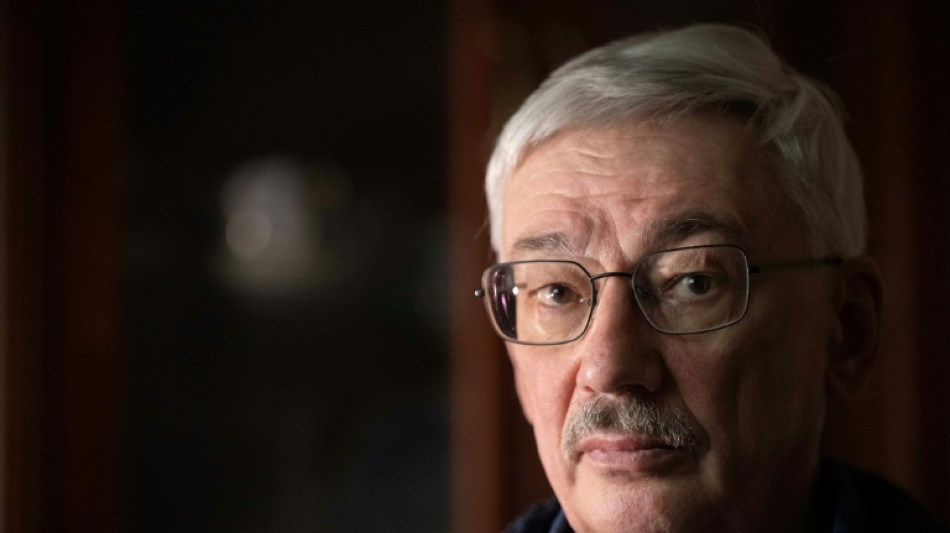
Oleg Orlov: A tenacious dissident since Soviet times / Photo: Natalia KOLESNIKOVA - AFP

 What we know about the North Korean POW dispute
 Most equities rise after oil price plunge, US data in focus
 Polar oceans transformed as warming melts ice habitats: research
 Lost shark becomes viral star in South Korea
 Dangote to launch $16bn refinery in Kenya
 North Korean leader 'extremely obese': Seoul spy agency
 Yankees and pope-backed White Sox start MLB playoffs with wins
 Malaysia's ex-PM Mahathir in hospital for observation
 'No limits': Marathon world record holder Sawe chasing history
 Countdown begins to biggest-ever Rugby World Cup
 Bangladesh women lose ground after quota reform
 Vietnam admits 'differing opinions' on Hanoi development
 Stocks temper gains as oil pares heavy losses, US data in focus
 New Zealand denies breaching climate commitments to EU
 Albert becomes youngest US scorer in 4-2 win over Chile
 Pirate island's plunging population shows Greece's demographic decline
 With elections ahead, Latvia's Russian-speakers reject Moscow's help
 Brazil football clubs face massive sponsorship blow from betting ban
 ChatGPT maker wants to be the App Store for AI as safety concerns grow
 Women fight fires and sexism in Indonesian Borneo

 Forsling's OT blast lifts Florida over Carolina in NHL opener

 Hurricane Polo sweeps over Mexico's Pacific coast, heads inland
 Grynspan pulls ahead in race to lead UN: diplomat

 Trump touts AI boss pledge to self-regulate
 Oil down, but stocks lower as bond yields rise
Veteran Russian dissident Oleg Orlov, who was sentenced on Tuesday to two and a half years in prison, has been a campaigner since the Soviet invasion of Afghanistan in 1979.
The 70-year-old stayed on in Russia to fight for human rights and protest against the offensive in Ukraine even as other campaigners fled the growing repression.
"I'm more useful here," Orlov, a leading member of the Nobel Prize-winning rights group Memorial, told AFP in an interview earlier this month.
A court on Tuesday found him guilty of "discrediting" the Russian army under legislation the Kremlin has used to stifle critics of the Ukraine offensive.
The repression has intensified since Russian President Vladimir Putin ordered troops into Ukraine two years ago.
The bespectacled dissident -- previously unknown outside activist circles -- became one of the loudest critics of the offensive and of the Kremlin.
Orlov even used his own first trial, between June and October 2023, as a platform against the conflict in Ukraine, denouncing a "war that destroys the future" during hearings.
The Kremlin branded him a foreign agent earlier this month, a label reminiscent of the term "enemies of the people" of the Soviet era.
- No regrets -
"I regret none of it," said Orlov, speaking in a slightly trembling voice in court on the eve of the verdict.
Perseverance was the trademark of the dissident who has denounced the authoritarian drift of his country ever since Soviet troops were sent to Afghanistan more than four decades ago.
"Repent? Admit my guilt in front of the judges? It would be like denying my whole life," he said.
He said he felt a duty to resist, just like the "illustrious predecessors" who inspired him and led him to activism.
Born in 1953 to an engineer father and philologist mother, Orlov studied biology at Moscow State University.
He soon delved into political activism and handed out leaflets opposing the Soviet offensive in Afghanistan.
In the late 1980s he joined the then-fledgling organisation Memorial.
The NGO was documenting and preserving the memory of millions of victims of Soviet repression to keep Russia from repeating the same mistakes.
In parallel, it was also investigating human rights violations in the chaos of the 1990s.
As part of that mission, Orlov was an observer of many of the conflicts that spilled over when the USSR collapsed, including in Moldova, Central Asia and in the Caucasus.
- Taken hostage -
He was particularly active in Chechnya, where Moscow's troops and Chechen separatists waged two wars between 1994 and 2000.
In 1995, he volunteered to take the place of nearly 2,000 people held hostage by Chechen separatists in a hospital in southwest Russia.
The hostage crisis marked a turning point in the first Chechen war of 1994-1996.
Orlov was taken hostage again by a group of masked gunmen in Ingushetia, bordering Chechnya, in 2007.
The captives, including Orlov, were beaten and threatened with execution in a field on the edge of town, then left barefoot in the snow.
He spent the following years at Memorial, trying to preserve its work despite an increasingly hostile Russian state.
Just a few weeks before the attack on Ukraine, Memorial was dissolved by the Russian courts.
Orlov vowed to continue the fight even if, by his own admission, his employees now had to work "in semi-clandestinity".
While awaiting the verdict, he had already packed a bag with basic necessities for life behind bars.
He said he was calm, living an ordinary life in the north of Moscow, between medical visits, trips to the gym and outings with his wife, fellow activist Tatyana.
W.AbuLaban--SF-PST