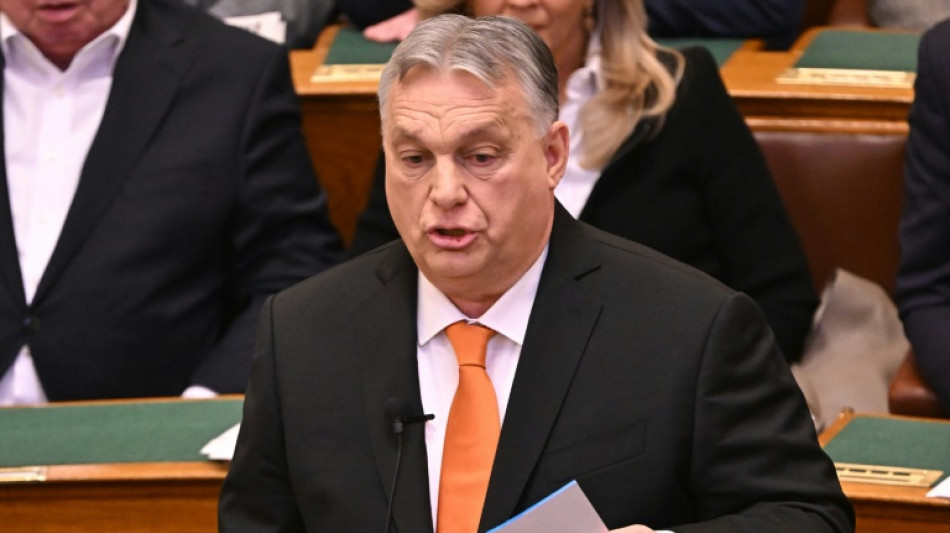
Last holdout Hungary approves Sweden's NATO bid / Photo: ATTILA KISBENEDEK - AFP

 What we know about the North Korean POW dispute
 Most equities rise after oil price plunge, US data in focus
 Polar oceans transformed as warming melts ice habitats: research

 Lost shark becomes viral star in South Korea
 Dangote to launch $16bn refinery in Kenya

 North Korean leader 'extremely obese': Seoul spy agency
 Yankees and pope-backed White Sox start MLB playoffs with wins

 Malaysia's ex-PM Mahathir in hospital for observation
 'No limits': Marathon world record holder Sawe chasing history
 Countdown begins to biggest-ever Rugby World Cup

 Bangladesh women lose ground after quota reform
 Vietnam admits 'differing opinions' on Hanoi development

 Stocks temper gains as oil pares heavy losses, US data in focus

 New Zealand denies breaching climate commitments to EU

 Albert becomes youngest US scorer in 4-2 win over Chile

 Pirate island's plunging population shows Greece's demographic decline
 With elections ahead, Latvia's Russian-speakers reject Moscow's help
 Brazil football clubs face massive sponsorship blow from betting ban
 ChatGPT maker wants to be the App Store for AI as safety concerns grow

 Women fight fires and sexism in Indonesian Borneo

 Forsling's OT blast lifts Florida over Carolina in NHL opener

 Hurricane Polo sweeps over Mexico's Pacific coast, heads inland
 Grynspan pulls ahead in race to lead UN: diplomat

 Trump touts AI boss pledge to self-regulate
 Oil down, but stocks lower as bond yields rise
Hungary's parliament on Monday ratified Sweden's bid to join NATO, clearing the final obstacle for an enlargement of the military alliance spurred by Russia's invasion of Ukraine.
The vote ends more than a year of delays that left fellow NATO partners furious as Ukraine battled Russian troops.
Swedish Prime Minister Ulf Kristersson hailed a "historic day", while NATO chief Jens Stoltenberg said Sweden will make the alliance "stronger and safer".
Russia's February 2022 invasion prompted Sweden and neighbouring Finland to apply to join the bloc, ending a long-standing stance of non-alignment in both countries.
But while Finland became the 31st member of the US-led defence alliance in April last year, Sweden's bid was held up. Turkey only ratified it last month.
On Monday, Hungary finally followed, with 188 members of parliament voting in favour and six against Sweden's accession.
- 'Historic day' -
"Today is a historic day... Sweden stands ready to shoulder its responsibility for Euro-Atlantic security," Kristersson said in a statement on X.
Stoltenberg welcomed Sweden as the 32nd NATO ally, saying its "membership will make us all stronger and safer."
People in Sweden also cheered the approval.
Jimmy Dahllof, 35, said Sweden would be "safer... bringing us closer to our European neighbours."
Earlier Monday, Hungary's Prime Minister Viktor had asked fellow lawmakers to approve Sweden's bid.
"The Swedish-Hungarian military cooperation and Sweden's accession to NATO will strengthen Hungary's security," Orban told parliament.
Only the far-right Our Homeland movement were against the ratification.
Now that parliament has approved the Nordic nation's bid, the president is expected to sign it in the coming days.
Sweden will then be invited to accede to the Washington Treaty and officially become NATO's 32d member.
In the case of Finland, Turkey was the last to give the green light on March 30, 2023, and Finland became a NATO member on April 4.
- 'Confrontational behaviour' -
Though repeatedly saying it supported Swedish membership in principle, Hungary kept prolonging the process by asking Stockholm to stop "vilifying" the Hungarian government.
Budapest accused Swedish officials of being "keen to bash Hungary" on rule-of-law issues.
After a meeting on Friday between Orban and Kristersson in Budapest, the nationalist Hungarian leader announced that the two had clarified "our mutual good intentions".
Hungary also signed a deal to acquire four Swedish-made fighter jets, expanding its existing fleet of 14 Jas-39 Gripen fighters.
After Russia's invasion of Ukraine, most NATO members were keen to quickly approve the membership bids of both Finland and Sweden.
For Sweden, Ankara cited security concerns, before moving ahead with the ratification.
In Hungary's delay, some experts saw a strategy to wring concessions from Brussels to unlock billions of euros in frozen funds.
Others argued it underlined Orban's closeness to the presidents of Russia and Turkey.
For analyst Mate Szalai of Venice's Ca' Foscari University, Orban was simply playing to his domestic audience.
"Orban wanted to go as far as he could without causing serious problems to the Transatlantic community while proving that Hungary is a power to be reckoned with," he told AFP.
While Hungary's "confrontational behaviour" did not reap any tangible results, it might have "been beneficial domestically for the ruling Fidesz party", he added.
"Many initiatives of the Hungarian government are designed to provoke a backlash in Europe," said Szalai.
"And most criticism expressed towards the Orban government (from outside Hungary) actually helps Fidesz to maintain its popularity in the country."
burs-ros-jza/jm
G.AbuHamad--SF-PST