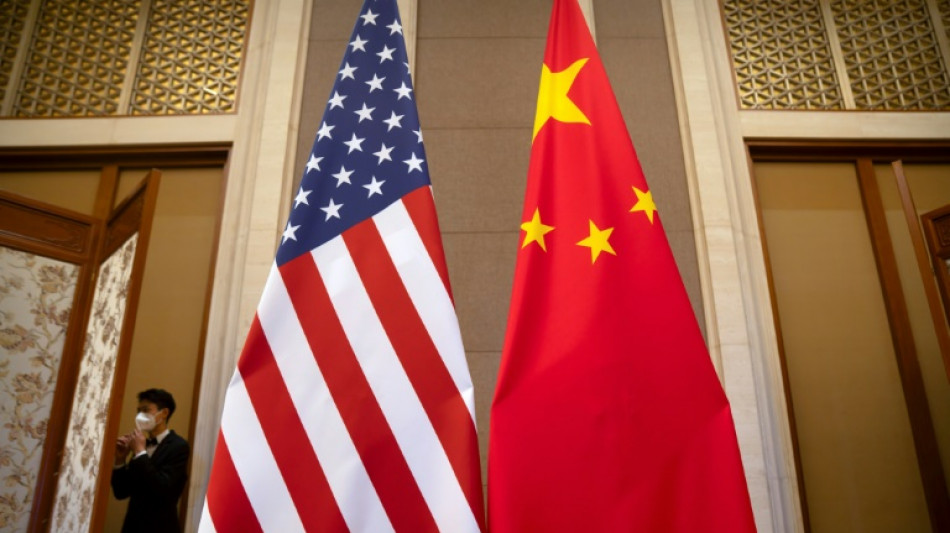
Biden or Trump, hawkish economic approach on China to intensify / Photo: Mark Schiefelbein - POOL/AFP/File

 Energy costs spark inflation surges in France, Italy

 South Korea break China hearts to reach Asian Games football final

 Eala storms into Asian Games semi-finals to thrill adoring fans

 Turkey freezes ex-minister's assets as fund crisis grows

 What we know about the North Korean POW dispute

 Most equities rise after oil price plunge, US data in focus
 Polar oceans transformed as warming melts ice habitats: research

 Lost shark becomes viral star in South Korea

 Dangote to launch $16bn refinery in Kenya

 North Korean leader 'extremely obese': Seoul spy agency

 Yankees and pope-backed White Sox start MLB playoffs with wins

 Malaysia's ex-PM Mahathir in hospital for observation
 'No limits': Marathon world record holder Sawe chasing history

 Countdown begins to biggest-ever Rugby World Cup

 Bangladesh women lose ground after quota reform

 Vietnam admits 'differing opinions' on Hanoi development

 Stocks temper gains as oil pares heavy losses, US data in focus

 New Zealand denies breaching climate commitments to EU

 Albert becomes youngest US scorer in 4-2 win over Chile

 Pirate island's plunging population shows Greece's demographic decline
 With elections ahead, Latvia's Russian-speakers reject Moscow's help

 Brazil football clubs face massive sponsorship blow from betting ban

 ChatGPT maker wants to be the App Store for AI as safety concerns grow

 Women fight fires and sexism in Indonesian Borneo

 Forsling's OT blast lifts Florida over Carolina in NHL opener

In a shift from tit-for-tat tariffs and strong-arm tactics to tech restrictions and investment curbs, US policy towards China has become more targeted under President Joe Biden -- though still hardline.
Despite differences between Democrats and Republicans, analysts expect Washington's approach to Beijing will only become tougher, whether Biden or former president Donald Trump wins another White House term.
"I think the direction of pressure in Washington is absolutely in one direction, which is more hawkishness," said Joshua Meltzer, senior fellow at Brookings Institution.
Already, Biden has largely maintained Trump-era tariffs, rolled out export control restrictions to curtail Beijing's ability to buy and make certain high-end chips, and unveiled an order to curb outbound investments to China.
Officials are also seeking to boost self-reliance in key areas including clean energy supply chains, while further action on data flows is expected.
Meltzer told AFP: "There is currently congressional pressure to do more."
- Policy, not partisan split -
With citizen concerns over trade, business and manufacturing cutting across party lines, the preferred degree of toughness on China tends to be a policy rather than partisan divide, said Jamieson Greer, partner at law firm King & Spalding.
Greer, formerly US Trade Representative chief of staff during the Trump administration, believes there are two camps in Washington.
One views China as an existential threat to the economy, national security or both, therefore justifying strong and broad protection measures.
The other is cautious about overestimating the China threat, and concerned with imposing tough trade and economic measures.
But both groups assume risks associated with China -- a shift that became prominent nearly a decade ago.
"It became big during the 2016 presidential election cycle, when candidate Donald Trump was very, very vocal about trade issues and China in particular," Greer said.
Trump gave voice to something many people "agreed with on both sides of the aisle" but were unwilling to say aloud, he added.
- Different policies -
But experts agree that a second Biden or Trump administration would diverge on policies.
The Biden administration does not expect to "reach a deal with China, where they're going to make these major reforms and changes," Meltzer said.
"It's really about, how do you adjust to the reality of China? How do you bring allies along?"
There is a "notion of derisking from a security perspective as well," he added.
But the Trump administration favored using US leverage to broker a deal changing China's behavior, Meltzer said, referring to the Phase One trade agreement culminating from a truce in the escalating tariffs war.
Should Trump be elected, some expect to see higher tariffs targeting China, given his proposal of more than 60 percent levies on Chinese goods.
The move could draw Chinese retaliation, stalling trade between the world's top two economies.
"I think we'd see a lot more return to tariffs, I think we'd also see a lot less cooperation with allies," Meltzer said. "The US would be more isolated on some of these issues."
Biden has shown willingness to maintain existing measures on China while being narrow and focused in future moves, and this is unlikely to change, Greer added.
A second Biden administration could also seek cooperation with China on issues like climate and have more room to engage -- given reduced pressure to appear tough on Beijing to deflect criticism from Trump, analysts believe.
- Domestic policies -
Ongoing efforts to maintain a US lead in tech will probably continue, no matter who wins the election.
But a Trump administration could show less support for onshoring advanced semiconductor manufacturing via initiatives like the CHIPS Act, or for major investments in onshoring electric vehicle and other critical mineral supply chains, said Paul Triolo, associate partner for China at Albright Stonebridge Group.
But he added: "It is likely that regardless of who wins in November, the US administration would continue to implement existing technology controls, and expand controls into other technology sectors."
These include biotechnology, electric and smart vehicles.
Last month, Commerce Secretary Gina Raimondo warned that Chinese-made EVs bring security risks, given the vast amounts of data collected.
Washington would also likely tighten restrictions on transfers of certain types of data to companies and organizations in China, Triolo said.
K.Hassan--SF-PST