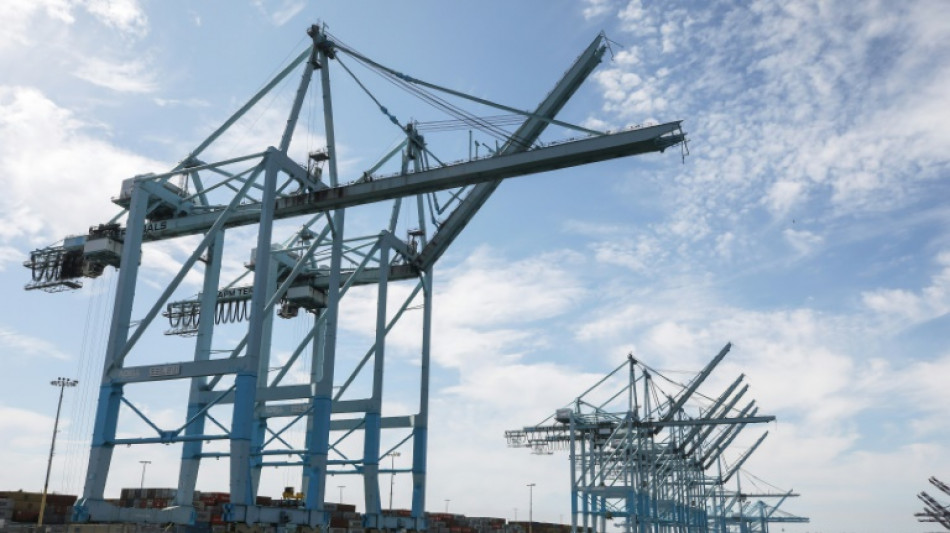
US-China economic flashpoints at a glance / Photo: MARIO TAMA - GETTY IMAGES NORTH AMERICA/AFP/File

 Energy costs spark inflation surges in France, Italy

 South Korea break China hearts to reach Asian Games football final

 Eala storms into Asian Games semi-finals to thrill adoring fans

 Turkey freezes ex-minister's assets as fund crisis grows

 What we know about the North Korean POW dispute

 Most equities rise after oil price plunge, US data in focus

 Polar oceans transformed as warming melts ice habitats: research

 Lost shark becomes viral star in South Korea

 Dangote to launch $16bn refinery in Kenya

 North Korean leader 'extremely obese': Seoul spy agency

 Yankees and pope-backed White Sox start MLB playoffs with wins

 Malaysia's ex-PM Mahathir in hospital for observation

 'No limits': Marathon world record holder Sawe chasing history

 Countdown begins to biggest-ever Rugby World Cup

 Bangladesh women lose ground after quota reform

 Vietnam admits 'differing opinions' on Hanoi development

 Stocks temper gains as oil pares heavy losses, US data in focus

 New Zealand denies breaching climate commitments to EU

 Albert becomes youngest US scorer in 4-2 win over Chile

 Pirate island's plunging population shows Greece's demographic decline

 With elections ahead, Latvia's Russian-speakers reject Moscow's help

 Brazil football clubs face massive sponsorship blow from betting ban

 ChatGPT maker wants to be the App Store for AI as safety concerns grow

 Women fight fires and sexism in Indonesian Borneo

 Forsling's OT blast lifts Florida over Carolina in NHL opener

From a trade imbalance to technological competition, a host of economic flashpoints are boosting tensions between Washington and Beijing -- and these are among areas in which both Republicans and Democrats can agree.
What's behind these concerns?
- American debt -
Republicans in particular are worried about this issue, concerned that China holds too much American debt.
The fear is that Beijing could use this to pressure Washington by threatening to resell its bonds, bringing down the value of holdings.
While the American debt exceeds $34 trillion, only around $8 trillion is held abroad.
China is a key holder of US debt, accounting for $816 billion and just over $1 trillion when Hong Kong is included, according to Treasury Department figures.
But it is the second biggest foreign holder behind Japan -- which holds $1.1 trillion -- and ahead of Britain.
- Tech race -
US President Joe Biden has focused on tech, noting its importance to ensuring national security.
Be it in semiconductors, artificial intelligence or electric vehicles, Washington is seeking to stay ahead or catch up with Beijing in various areas -- including to prevent advanced tools from falling into the hands of the Chinese military.
A major target during former president Donald Trump's term was telecoms giant Huawei, which the United States sought to keep out of its 5G networks and those of allies.
Restrictions grew under the Joe Biden administration, especially involving cutting-edge semiconductors necessary in AI development.
The goal, said Commerce Secretary Gina Raimondo in October, is to limit Chinese access to advanced chips that could fuel breakthroughs in AI and sophisticated computers that are critical to military applications.
In the field of critical minerals, of which Beijing has ample supplies, Washington has also been seeking to circumvent China.
- Trade -
While China is no longer the top source from which the United States imports goods, the perceived trade imbalance between the world's two biggest economies remains a concern.
Trump's tariffs on Chinese goods and attempts to secure a deal to rebalance trade has failed to turn the tide, and the Biden administration has largely maintained levies while pursuing efforts in "friendshoring" -- or diversifying supply chains across allies and partners.
There appears to be some impact with US-China trade growing less quickly, although a deeper look shows that some Chinese products are simply routed through other countries.
- Currency war? -
The question of exchange rates and the use of currency for political and commercial purposes has been a recurring issue, too.
For years, Washington has accused Beijing of maintaining the yuan at a deliberately lower rate against the dollar in order to promote exports.
In November, the US Treasury flagged China's "lack of transparency" in its exchange rate mechanism, saying this warranted monitoring.
The concern now centers on the internationalization of the yuan, with the Chinese currency still little present in commercial exchanges.
As of end-2023, fewer than 3.5 percent of payments via the SWIFT international electronic transfer system were made in yuan -- compared with nearly 19 percent in euros and more than 50 percent in dollars.
China wants the yuan to establish itself, especially in trade, as a safeguard against potential US sanctions. Beijing in turn believes that Washington is weaponizing the dollar.
Q.Jaber--SF-PST