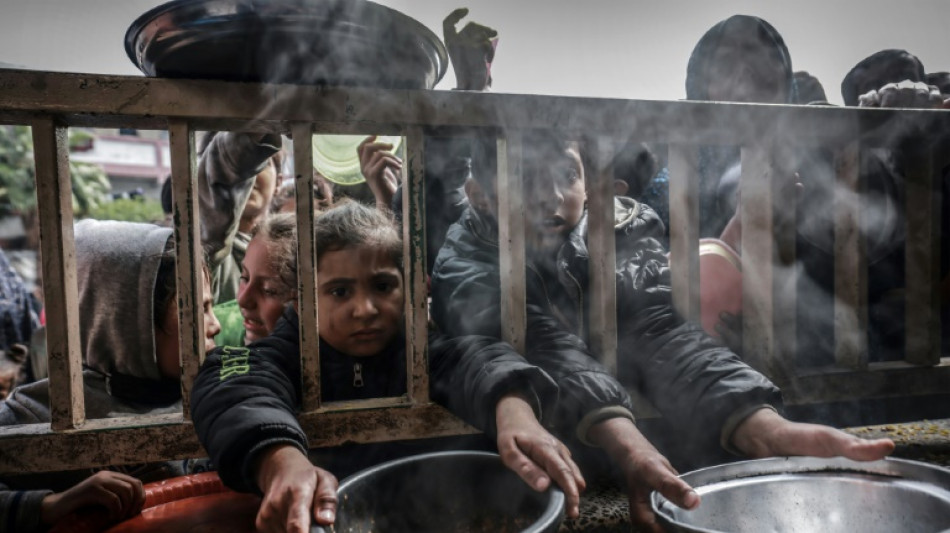
Dead horses, scraps, leaves: Gaza's hungry get desperate / Photo: MOHAMMED ABED - AFP/File

 Energy costs spark inflation surges in France, Italy

 South Korea break China hearts to reach Asian Games football final

 Eala storms into Asian Games semi-finals to thrill adoring fans

 Turkey freezes ex-minister's assets as fund crisis grows

 What we know about the North Korean POW dispute

 Most equities rise after oil price plunge, US data in focus

 Polar oceans transformed as warming melts ice habitats: research

 Lost shark becomes viral star in South Korea
 Dangote to launch $16bn refinery in Kenya
 North Korean leader 'extremely obese': Seoul spy agency

 Yankees and pope-backed White Sox start MLB playoffs with wins
 Malaysia's ex-PM Mahathir in hospital for observation

 'No limits': Marathon world record holder Sawe chasing history
 Countdown begins to biggest-ever Rugby World Cup

 Bangladesh women lose ground after quota reform
 Vietnam admits 'differing opinions' on Hanoi development
 Stocks temper gains as oil pares heavy losses, US data in focus
 New Zealand denies breaching climate commitments to EU

 Albert becomes youngest US scorer in 4-2 win over Chile
 Pirate island's plunging population shows Greece's demographic decline
 With elections ahead, Latvia's Russian-speakers reject Moscow's help
 Brazil football clubs face massive sponsorship blow from betting ban
 ChatGPT maker wants to be the App Store for AI as safety concerns grow
 Women fight fires and sexism in Indonesian Borneo

 Forsling's OT blast lifts Florida over Carolina in NHL opener

At the Jabalia refugee camp in northern Gaza, Abu Gibril was so desperate for food to feed his family that he slaughtered two of his horses.
"We had no other choice but to slaughter the horses to feed the children. Hunger is killing us," he told AFP.
Jabalia was the biggest camp in the Palestinian territories before the war, which began after Hamas fighters attacked southern Israel on October 7, leaving some 1,160 dead, based on Israeli figures.
Gibril, 60, fled there from nearby Beit Hanun when the conflict erupted. Home for him and his family is now a tent near what was a UN-run school.
Contaminated water, power cuts and overcrowding were already a problem in the densely populated camp, which was set up in 1948 and covers just 1.4 square kilometres (half a square mile).
Poverty, from high unemployment, was also an issue among its more than 100,000 people.
Now food is running out, with aid agencies unable to get in to the area because of the bombing -- and the frenzied looting of the few trucks that try to get through.
The World Food Programme this week said its teams reported "unprecedented levels of desperation" while the United Nations warned that 2.2 million people were on the brink of famine.
On Friday, the health ministry in Hamas-run Gaza said a two-month-old baby died of malnutrition in hospital in Gaza City, seven kilometres (just over four miles) away from Jabalia.
Overall, at least 29,606 people have been killed in Gaza in the war, the ministry said Saturday.
- Scavenging and begging -
In the camp, bedraggled children wait expectantly, holding plastic containers and battered cooking pots for what little food is available.
With supplies dwindling, costs are rising. A kilo of rice, for example, has shot up from seven shekels ($1.90) to 55 shekels, complains one man.
The UN children's agency UNICEF has warned that the alarming lack of food, surging malnutrition and disease could lead to an "explosion" in child deaths in Gaza.
One in six children aged under two in Gaza was acutely malnourished, it estimated on February 19.
Residents have taken to eating scavenged scraps of rotten corn, animal fodder unfit for human consumption and even leaves to try to stave off the growing hunger pangs.
"There is no food, no wheat, no drinking water," said one woman.
"We have started begging neighbours for money. We don't have one shekel at home. We knock on doors and no one is giving us money".
- 'Dying from hunger' -
Tempers are rising in Jabalia about the lack of food and the consequences. On Friday, an impromptu protest was held involving dozens of people.
One child held up a sign reading: "We didn't die from air strikes but we are dying from hunger."
Another held aloft a placard warning "Famine eats away at our flesh", while protesters chanted "No to starvation. No to genocide. No to blockade."
In Beit Hanun, Gibril used two horses to harvest a parcel of land. But the conflict destroyed that, along with his house, leaving him with nothing.
Over the weeks and months, Israel's relentless bombardment has left Gaza largely a place of shattered concrete and lives.
Gibril kept the radical decision to slaughter his horses to himself, boiling the meat with rice, and giving it to his unwitting family and neighbours.
Despite the necessity, he said he was still wary of their reaction. "No one knows they were in fact eating a horse."
Y.Shaath--SF-PST