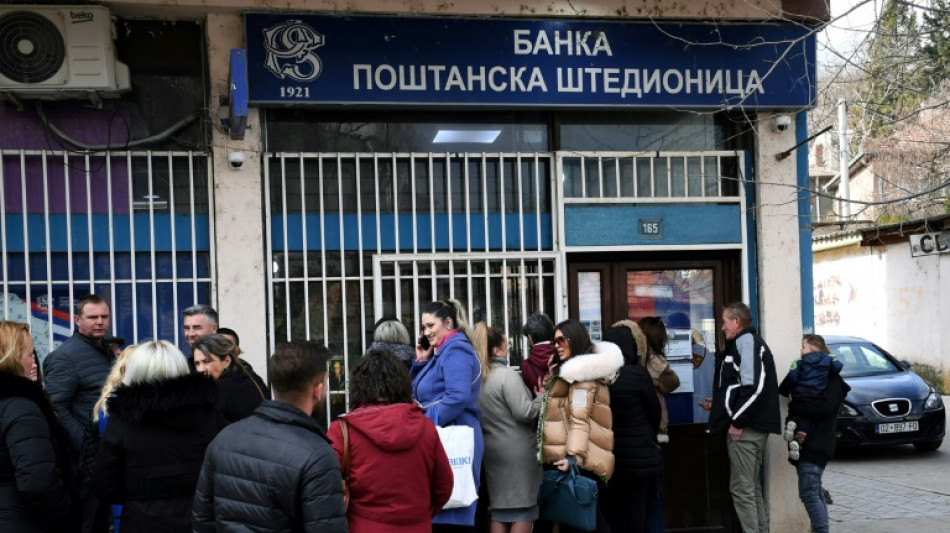
Kosovo's Serbs hit by lines, limited withdrawals after currency ban / Photo: STRINGER - AFP

 In Manchester, people say City scandal is 'shame for football'
 Stocks lacklustre as inflation data weighs on sentiment
 Israel-bound plane rerouted, pilots wounded in reported fight
 Truth commission on Sweden's Sami people seeks redress

 Energy costs spark inflation surges in France, Italy

 South Korea break China hearts to reach Asian Games football final
 Eala storms into Asian Games semi-finals to thrill adoring fans

 Turkey freezes ex-minister's assets as fund crisis grows
 What we know about the North Korean POW dispute
 Most equities rise after oil price plunge, US data in focus
 Polar oceans transformed as warming melts ice habitats: research

 Lost shark becomes viral star in South Korea
 Dangote to launch $16bn refinery in Kenya
 North Korean leader 'extremely obese': Seoul spy agency
 Yankees and pope-backed White Sox start MLB playoffs with wins
 Malaysia's ex-PM Mahathir in hospital for observation
 'No limits': Marathon world record holder Sawe chasing history
 Countdown begins to biggest-ever Rugby World Cup
 Bangladesh women lose ground after quota reform
 Vietnam admits 'differing opinions' on Hanoi development
 Stocks temper gains as oil pares heavy losses, US data in focus
 New Zealand denies breaching climate commitments to EU
 Albert becomes youngest US scorer in 4-2 win over Chile
 Pirate island's plunging population shows Greece's demographic decline
 With elections ahead, Latvia's Russian-speakers reject Moscow's help
Long lines snaked around banks in northern Kosovo on Wednesday, as ethnic Serbs waited to receive salaries and pensions in limited tranches following a government regulation targeting Serbia's dinar currency.
The disruption comes weeks after a new rule entered into force in Kosovo on February 1 that made the euro the only legal currency for payments in commercial transactions and effectively banned the use of the dinar.
On Wednesday, Kosovo's Serbs working for government institutions in Serbia and pensioners were set to receive salaries in northern Kosovo, where many in the community are dependent on the payments.
Worries have been mounting for days over fears that cash was running short in the area, following the blocking of two deliveries of dinars after officials stopped cars transporting the currency at the border.
Serbia's central bank said the shipments were set to pay salaries, pensions, social benefits and other payments to Serbs in Kosovo.
On Wednesday, account holders were only able to withdraw limited amounts of dinars, according to an AFP reporter on the ground, usually in tranches of 5,000 to 10,000 ($46 to $92).
"It is most likely the dinar will be abolished because that is Pristina's position. What are we left with?" one pensioner told AFP, speaking on condition of anonymity.
Others said they would be forced to cross the border and travel to Serbia to collect their salary in full.
"Tomorrow, I plan to go to Raska and pick up my salary there," said Milica Ivanovic, a 25-year-old working at a Serbian government institution in northern Kosovo, referring to a town in southern Serbia.
"I can afford it but there are others who can't," she added.
- Rising tensions -
Kosovo's roughly 100,000-member Serb community has held tight to the dinar since a brutal late-1990s war between Serbia and ethnic Albanian insurgents saw Serbian troops and government personnel withdraw from the breakaway province.
"I don't think there is a Serbian family in Kosovo that is not affected by this decision," Aleksandar Rapajic, who works for the Advocacy Center for Democratic Culture in Kosovo's northern city of Mitrovica, told AFP.
"The only effect this decision has is to make life miserable for the Serbian community and to make it difficult to send money from Serbia," he added.
The move has seen already tense relations between Serbia and Kosovo inflamed.
Earlier this month, Serbia's President Aleksandar Vucic and Kosovo's Prime Minister Albin Kurti sparred over the new regulation during an emergency meeting at the UN Security Council in New York.
Kosovo officials have introduced a three-month transitional period, allowing time to resolve issues.
Despite criticism from several Western countries, Kosovo's government has continued to defend the regulation.
"Money cannot come across the border in bags, as it cannot in any democratic state, but it can come through bank accounts, withdrawn in euros," said Kurti earlier this month.
Serbia has never acknowledged Kosovo's 2008 declaration of independence, with the rivals regularly locked in fierce disagreements over bureaucratic matters in the former breakaway province, such as a recent spat over licence plates.
Kosovo adopted the euro as its currency in 2002, despite not being a formal member of the eurozone or the European Union.
The currency regulation follows a tumultuous year in Kosovo that saw an armed standoff between Serb gunmen and police at a monastery near the Serbian border in September. At least four people were killed.
M.Qasim--SF-PST