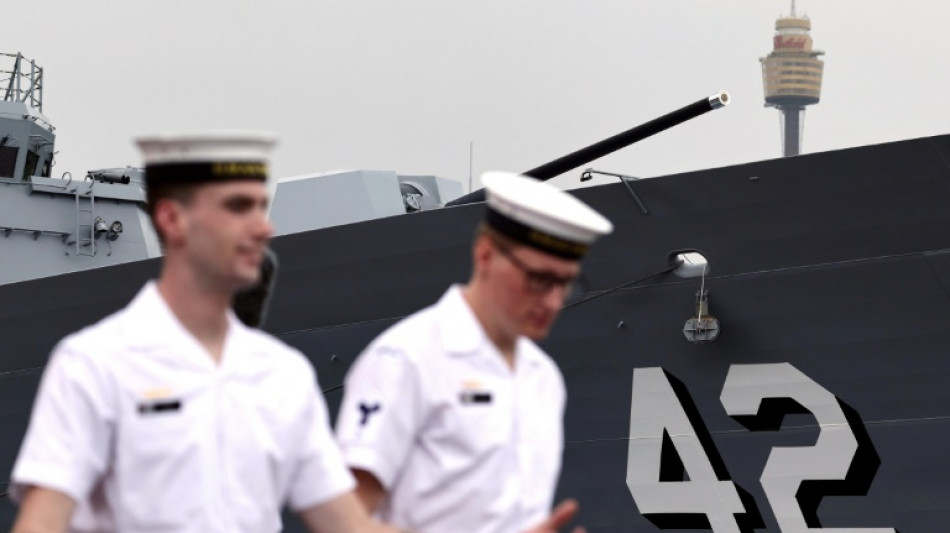
Australia says to build biggest navy since World War II / Photo: DAVID GRAY - AFP

 In Manchester, people say City scandal is 'shame for football'
 Stocks lacklustre as inflation data weighs on sentiment

 Israel-bound plane rerouted, pilots wounded in reported fight

 Truth commission on Sweden's Sami people seeks redress

 Energy costs spark inflation surges in France, Italy

 South Korea break China hearts to reach Asian Games football final
 Eala storms into Asian Games semi-finals to thrill adoring fans

 Turkey freezes ex-minister's assets as fund crisis grows

 What we know about the North Korean POW dispute

 Most equities rise after oil price plunge, US data in focus

 Polar oceans transformed as warming melts ice habitats: research

 Lost shark becomes viral star in South Korea

 Dangote to launch $16bn refinery in Kenya

 North Korean leader 'extremely obese': Seoul spy agency

 Yankees and pope-backed White Sox start MLB playoffs with wins

 Malaysia's ex-PM Mahathir in hospital for observation

 'No limits': Marathon world record holder Sawe chasing history
 Countdown begins to biggest-ever Rugby World Cup
 Bangladesh women lose ground after quota reform
 Vietnam admits 'differing opinions' on Hanoi development

 Stocks temper gains as oil pares heavy losses, US data in focus

 New Zealand denies breaching climate commitments to EU

 Albert becomes youngest US scorer in 4-2 win over Chile

 Pirate island's plunging population shows Greece's demographic decline

 With elections ahead, Latvia's Russian-speakers reject Moscow's help
Australia on Tuesday outlined a decade-long plan to double its fleet of major warships and boost defence spending by an additional US$7 billion, in the face of a quickening Asia-Pacific arms race.
Under the plan, Australia will get a navy of 26 major surface combatant ships, up from 11 today.
"It is the largest fleet that we will have since the end of the Second World War," said Defence Minister Richard Marles.
The announcement comes after a massive build-up of firepower by rivals China and Russia, and amid growing confrontation between nervous US-led allies and increasingly bellicose authoritarian governments.
Australia will get six Hunter class frigates, 11 general-purpose frigates, three air warfare destroyers and six state-of-the-art surface warships that do not need to be crewed.
At least some of the fleet will be armed with Tomahawk missiles capable of long-range strikes on targets deep inside enemy territory -- a major deterrent capability.
The plan would see Australia increase its defence spending to 2.4 percent of gross domestic product, above the two percent target set by its NATO allies.
Some of the ships will be built in Adelaide, ensuring more than 3,000 jobs, but others will be sourced from US designs and a still undecided design to come from Spain, Germany, South Korea or Japan.
- Change, or more of the same? -
In 2021, Australia announced plans to buy at least three US-designed nuclear-powered submarines, scrapping a years-long plan to develop non-nuclear subs from France that had already cost billions of dollars.
While the Virginia-class submarines will be nuclear-powered, they will not be armed with atomic weapons and are instead expected to carry long-range cruise missiles. They represent a step-shift for the country's open water capabilities.
Experts say that taken together, Australia is poised to develop significant naval capability.
But the country's major defence projects have long been beset by cost overruns, government U-turns, policy changes and project plans that make more sense for local job creation than defence.
Michael Shoebridge, a former senior security official and now independent analyst, said the government must overcome past errors and had "no more time to waste" as competition in the region heats up.
Shoebridge said there must be a trimmed-down procurement process, otherwise, it will be a "familiar path that leads to delays, construction troubles, cost blowouts -- and at the end, ships that get into service too late with systems that are overtaken by events and technological change".
Wooing specific electorates with the promise of "continuous naval shipbuilding" cannot be the priority, he said.
"This will just get in the way of the actual priority: reversing the collapse of our Navy's fleet."
L.AbuAli--SF-PST