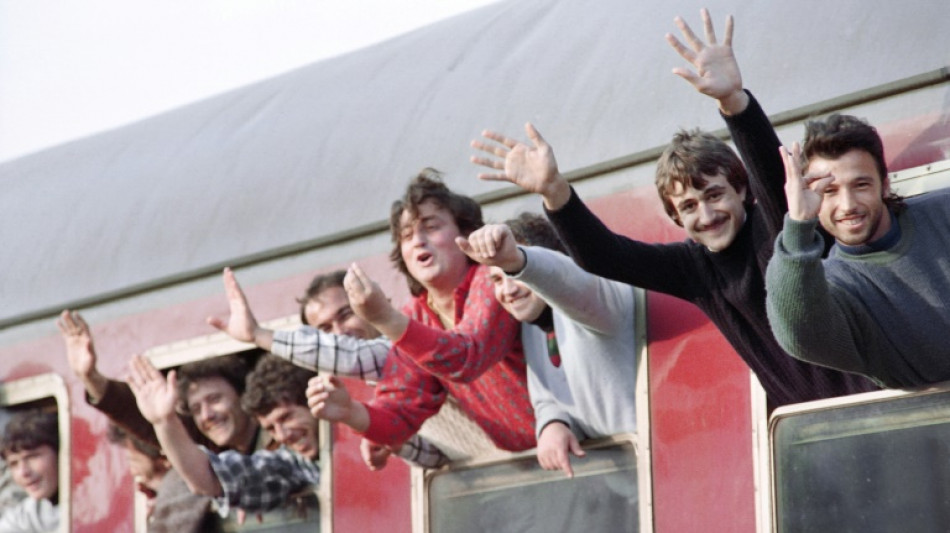
Solidarity or rejection: Albanian migration to Italy / Photo: Gerard FOUET - AFP/File

 In Manchester, people say City scandal is 'shame for football'
 Stocks lacklustre as inflation data weighs on sentiment
 Israel-bound plane rerouted, pilots wounded in reported fight

 Truth commission on Sweden's Sami people seeks redress

 Energy costs spark inflation surges in France, Italy

 South Korea break China hearts to reach Asian Games football final
 Eala storms into Asian Games semi-finals to thrill adoring fans

 Turkey freezes ex-minister's assets as fund crisis grows

 What we know about the North Korean POW dispute

 Most equities rise after oil price plunge, US data in focus

 Polar oceans transformed as warming melts ice habitats: research

 Lost shark becomes viral star in South Korea
 Dangote to launch $16bn refinery in Kenya
 North Korean leader 'extremely obese': Seoul spy agency

 Yankees and pope-backed White Sox start MLB playoffs with wins
 Malaysia's ex-PM Mahathir in hospital for observation
 'No limits': Marathon world record holder Sawe chasing history
 Countdown begins to biggest-ever Rugby World Cup
 Bangladesh women lose ground after quota reform
 Vietnam admits 'differing opinions' on Hanoi development

 Stocks temper gains as oil pares heavy losses, US data in focus
 New Zealand denies breaching climate commitments to EU

 Albert becomes youngest US scorer in 4-2 win over Chile

 Pirate island's plunging population shows Greece's demographic decline
 With elections ahead, Latvia's Russian-speakers reject Moscow's help
On February 20, 1991, demonstrators in Tirana pulled down the immense statue of Albanian dictator Enver Hoxha, marking the end of the communist regime and sparking an emigration wave towards Italy.
Three decades later, Albanian Prime Minister Edi Rama says the "solidarity" Italy showed to his compatriots at the time is why he signed up to a controversial migration deal with Rome in November.
The Albanian community in Italy today is large -- the second biggest from a non-EU country -- and well-integrated.
But it has not always been, and critics accuse Rama of rewriting history.
Hajri Kurti, who emigrated to Italy to escape poverty, says "integration was very difficult".
"You were an illegal immigrant, you had no rights, you worked illegally. Sometimes I didn't get paid", the 50-year-old told AFP.
"You had to be invisible. I was afraid when I saw a policeman in the street," he said.
Now a partner in a maintenance company, it took the married father-of-one years to win the right to stay.
"There are prejudices, there is racism" in Italian society, he said.
- Betrayal -
Italy, barely 70 kilometres (40 miles) across the Adriatic Sea from Albania, was seen as a Western country rich in opportunities.
Thousands of Albanians who arrived in March 1991 in the southern Italian port of Brindisi were welcomed warmly, said Edmond Godo, head of the Albanian cultural association Besa.
The 57-year-old recalls how many locals left food for the new arrivals outside their front doors, including one young woman who opened her home to him.
"She invited me and my two friends to lunch, and after hearing the history of my country, she and her husband invited us to stay and sleep at their place," he told AFP.
But some 20,000 other Albanians who arrived in August of the same year in Bari, a port just north of Brindisi, were not so lucky.
The desperate migrants crowded onto their boat, the Vlora, were front-page news and the government feared more mass arrivals would follow.
After being detained for several days in a stadium in the city, the vast majority of them were repatriated.
The Albanians had been told they were being sent to another Italian city, and their forced return instead was seen as a betrayal.
By 1997, Italy had imposed a naval blockade on Albania, and Italian navy boats patrolled its waters.
The same year, more than 80 Albanians died or went missing after a Albanian ship carrying more than 120 people collided with an Italian navy vessel.
- 'Advertising gimmick' -
These are not memories Italian Prime Minister Giorgia Meloni or Rama want to dwell on.
Hard-right Meloni, elected in 2022 on an anti-migrant ticket, has pledged to slash the number of migrant boats arriving in Italy and needs to be seen to be tackling the issue, though these days the boats are no longer coming from Albania but mainly from North Africa.
Rama wants Rome to help speed up Albania's entry into the European Union.
Under the deal, Italy will open two centres in Albania to process people intercepted as they attempt to cross the central Mediterranean.
The centres will only be able to accommodate up to 3,000 people at a time while their asylum requests are being evaluated -- often a lengthy process.
That is but a fraction of yearly arrivals. In 2023, over 150,000 people crossed from North Africa to Italy.
The plan has also been criticised by migrant rescue charities as likely to infringe international law.
For Albanian emigrant Kurti, the deal is little more than "an advertising gimmick", intended to "mask the incapacity of the Italian government" to manage migrant flows.
V.AbuAwwad--SF-PST