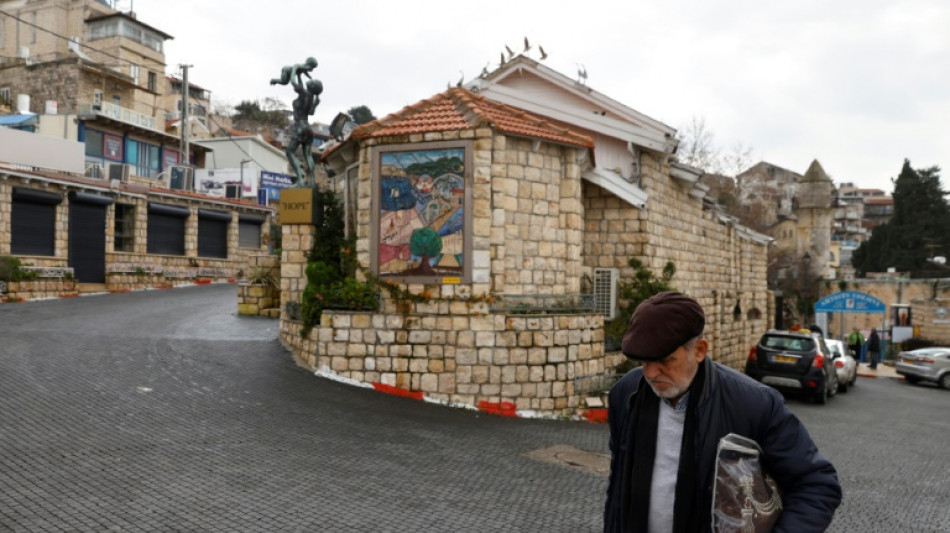
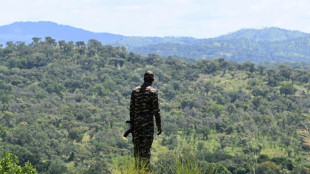
In Israel's northern hills, all eyes look to Lebanon / Photo: Jalaa MAREY - AFP

 Europe's surging inflation spreads gloom in stock markets
 Truth commission demands compensation for Sweden's Sami people

 Japan win marathon penalty shootout to set up South Korea gold-medal clash
 Djokovic grinds out opening-round win at China Open
 Northern Ireland police probe blockade of disputed parade
 UK PM Burnham reopens divisive debate on rejoining EU
 Man City future in doubt after guilty verdict

 'Do something,' begs Iranian woman after death sentence over protests
 China extends 52-year unbeaten record as Games organisers say sorry
 In Manchester, people say City scandal is 'shame for football'
 Stocks lacklustre as inflation data weighs on sentiment
 Israel-bound plane rerouted, pilots wounded in reported fight
 Truth commission on Sweden's Sami people seeks redress

 Energy costs spark inflation surges in France, Italy

 South Korea break China hearts to reach Asian Games football final
 Eala storms into Asian Games semi-finals to thrill adoring fans

 Turkey freezes ex-minister's assets as fund crisis grows
 What we know about the North Korean POW dispute

 Most equities rise after oil price plunge, US data in focus

 Polar oceans transformed as warming melts ice habitats: research

 Lost shark becomes viral star in South Korea
 Dangote to launch $16bn refinery in Kenya
 North Korean leader 'extremely obese': Seoul spy agency
 Yankees and pope-backed White Sox start MLB playoffs with wins
 Malaysia's ex-PM Mahathir in hospital for observation
On a clear day, the view south from Safed, high in the mountains of northern Israel, stretches uninterrupted across orange groves and orchards to the Sea of Galilee.
But all eyes in the historic city have been trained more recently on the jagged hills just a few kilometres (miles) away to the north -- and the border with Lebanon.
On Wednesday, an Israeli soldier was killed in a rocket strike in Safed, prompting retaliatory air strikes inside Lebanon that left at least 15 dead, including 10 civilians.
It was the worst single-day civilian death toll in Lebanon since cross-border hostilities began in October, stoking fears of a broader conflict between Israel and the Lebanese militant group Hezbollah.
On Thursday, Israeli jets roared overhead, unseen in heavy cloud, as Safed's Artists' Colony in the city's old Arab quarter slowly opened for business.
Further up the valley, locals nervously glanced at the skies, rumbling with thunder and flashes of lightning. Then an explosion echoed over the hills.
Israel's military later said it had hit a "Hezbollah military structure" in southern Lebanon.
Wrapped up against the cold in Safed -- also known as Israel's "City of Air" -- about 900 metres (3,000 feet) above sea level, Arie Buznah said he was used to the flurry in military activity.
"Here in Israel... we're not living a full, relaxing, peaceful, human, normal life," the 66-year-old tour guide explained.
"You have to be ready. You have to be alert, 24 hours a day, 365 days a year," he told AFP.
This week's attack -- and the reprisal -- was a clear sign, said Buznah. "The war is escalating," he said.
Nearby, Abbi Shachar nodded in approval. "People have been saying to me for weeks upon weeks that it's about to happen," she said.
On Wednesday, she was with the youngest of her two daughters, aged seven and 10, when sirens sounded for the incoming rocket attack, sending them to safety in a shelter.
The 47-year-old gallery owner who moved to Safed 30 years ago from Westchester, New York, said she hoped a wider conflict can still be averted.
"I just believe in my heart that something will stop it maybe but if not we'll have to deal with it," she added.
- No 'choice' -
Safed is about 250 kilometres (155 miles) from the Gaza Strip, where Israel is waging war with the Palestinian militant group Hamas after its deadly October 7 attack against Israel.
Hamas is an ally of Hezbollah, and both are backed by Israel's arch-foe Iran.
For Buznah, too, the Hamas attack has a particular resonance. It resulted in the deaths of at least 1,160 people, according to an AFP tally based on Israeli figures, and around 250 people taken hostage.
Nearly 50 years ago, in May 1974, Buznah was a 16-year-old schoolboy on a hiking trip in Maalot, western Galilee, when Palestinian militants took him and dozens of his classmates hostage.
Israeli commandos eventually stormed the school where they were being held, killing the hostage-takers but not before more than 20 people, most of them children, were killed.
Buznah, his knee grazed by a bullet, escaped through a window.
The latest hostage drama has brought memories flooding back for Buznah but also convinced him of the need to settle the conflict once and for all -- both with Hamas in Gaza and Hezbollah in Lebanon.
"In the Gaza Strip, I would give it (Israeli military action) three to five months, maybe half a year, six months," he said of the war that has left nearly 29,000 dead, according to the health ministry in the Hamas-run territory.
"Then we are going to come to Lebanon... We don't have any other choice."
Like Shachar, Buznah remembers 2006, when Israel fought Hezbollah in the north until a United Nations-brokered ceasefire brought an uneasy peace.
Lebanon and Hezbollah had not respected UN Security Council Resolution 1701 that halted the war, and instead moved back into the buffer zone on the border within weeks, he said.
The time for negotiating is over, he said. "It's not going to work, simple as that," he added.
W.Mansour--SF-PST