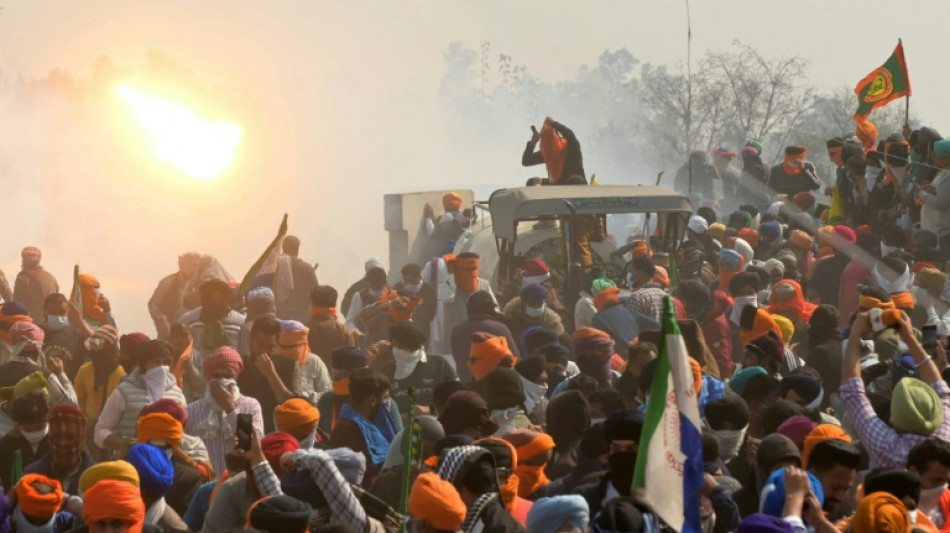
Furious protesting Indian farmers stalled but defiant / Photo: Narinder NANU - AFP

 Turkey says news site closed for 'LGBTQ propaganda'
 Oil companies close in on Venezuela despite hurdles

 Turkey freezes ex-minister's assets as fund scandal grows

 Guardiola backs Man City after bombshell guilty verdicts
 G20 trade ministers open talks under strain of Trump tariffs

 France in talks with UK to end 2025 migrant accord: ministry

 Europe's surging inflation spreads gloom in stock markets

 Truth commission demands compensation for Sweden's Sami people

 Japan win marathon penalty shootout to set up South Korea gold-medal clash

 Djokovic grinds out opening-round win at China Open

 Northern Ireland police probe blockade of disputed parade

 UK PM Burnham reopens divisive debate on rejoining EU
 Man City future in doubt after guilty verdict

 'Do something,' begs Iranian woman after death sentence over protests

 China extends 52-year unbeaten record as Games organisers say sorry
 In Manchester, people say City scandal is 'shame for football'
 Stocks lacklustre as inflation data weighs on sentiment

 Israel-bound plane rerouted, pilots wounded in reported fight

 Truth commission on Sweden's Sami people seeks redress

 Energy costs spark inflation surges in France, Italy

 South Korea break China hearts to reach Asian Games football final
 Eala storms into Asian Games semi-finals to thrill adoring fans

 Turkey freezes ex-minister's assets as fund crisis grows

 What we know about the North Korean POW dispute

 Most equities rise after oil price plunge, US data in focus

The line of tractors stretches nearly far as one can see -- thousands of protesting Indian farmers heading to the capital New Delhi, determined to bring their anger and woes to politicians.
Many have driven on slow-moving tractors across India's northern Punjab state to demand guaranteed crop prices, waving flags, honking horns and chanting protest slogans.
But they have been stalled halfway to New Delhi by a fortress-like wall of concrete.
Hundreds of baton-wielding riot police guard thick lines of barricades across the highway.
They are as determined to stop the farmers as the farmers are to smash through, using their tractors to push away the heavy concrete blocks.
From behind rolls of razor wire, police alternate between raking the crowds with water cannon and dropping tear gas from overhead by drone.
On Wednesday, the two sides stood uneasily watching each other from some 50 metres (55 yards) away, as government officials and farming union leaders talked.
"We work long hours in the fields and still struggle to make ends meet," said 40-year-old farmer Sandeep Kumar, from Punjab state's Mohali district.
"But when we demand something from the government, we are met with pellets and baton charges."
Heera Singh, 55, his bloody foot wrapped in white gauze, said he was hit by a tear gas canister -- but insisted he would not go home to recuperate.
- Kites against drones -
Dull thuds of tear gas canisters dropped from above punctuate protest chants, and the choking stench hangs heavy in the air long after the thick clouds disperse.
The farmers say they launched their "Delhi Chalo", or "March to Delhi" -- recalling a January 2021 protest when they smashed through barriers and rolled into New Delhi -- because politicians are not listening.
"We have written letters and sent petitions, but the government has failed to respond," said farmer Bhupinder Singh.
"We work so hard, but we don't save anything as input costs have gone up so much," Kumar added.
On their own, the farmers say they are ignored.
But together -- with two-thirds of India's 1.4 billion people drawing their livelihood from agriculture -- they pose a potentially powerful force, with the protests coming ahead of general elections expected in April.
Thousands of farmers have crammed into tractor trailers hoping to reach parliament.
As drones hover above, the farmers fly kites, saying they are using them to "distract" the police.
"We have no arms like them," said 36-year-old farmer Karnail Singh, from Punjab's Tarn Taran district.
Others have soaked sacks in water, ready to be thrown onto tear gas canisters to dampen their impact.
While demands vary, most farmers say the key issue is ensuring a legal guarantee of a minimum price for crops.
The government in Punjab already pays a minimum price for wheat and rice, but the "system is ad hoc", said 37-year-old farmer Maan Singh.
"What we want is a law that makes it binding for the government to give us MSP (minimum support price) for all of what we grow," Singh said.
"The government buys only what it wants, forcing us to sell most of our crop to middlemen at much lower prices."
K.Hassan--SF-PST