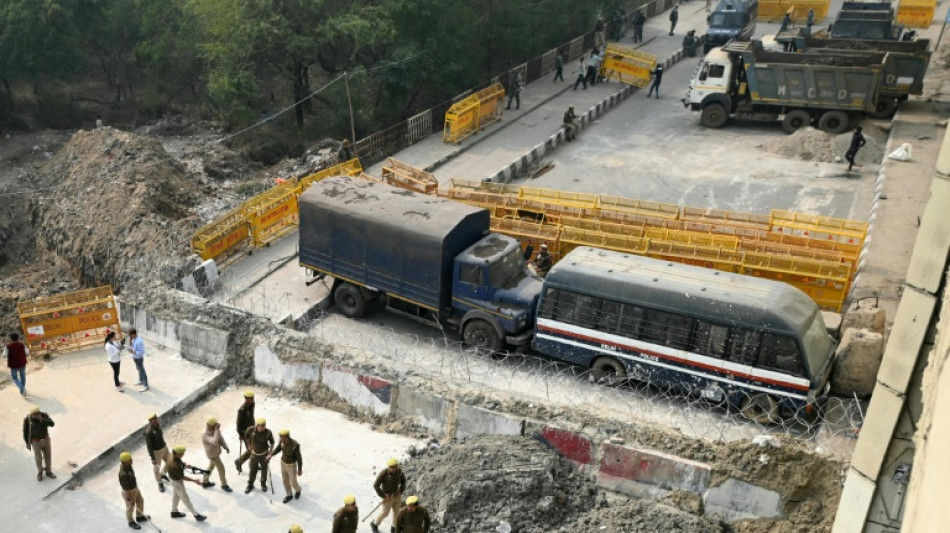
Indian police blockade capital from protesting farmers / Photo: Sajjad HUSSAIN - AFP

 Turkey says news site closed for 'LGBTQ propaganda'
 Oil companies close in on Venezuela despite hurdles

 Turkey freezes ex-minister's assets as fund scandal grows

 Guardiola backs Man City after bombshell guilty verdicts
 G20 trade ministers open talks under strain of Trump tariffs

 France in talks with UK to end 2025 migrant accord: ministry
 Europe's surging inflation spreads gloom in stock markets

 Truth commission demands compensation for Sweden's Sami people

 Japan win marathon penalty shootout to set up South Korea gold-medal clash
 Djokovic grinds out opening-round win at China Open
 Northern Ireland police probe blockade of disputed parade
 UK PM Burnham reopens divisive debate on rejoining EU
 Man City future in doubt after guilty verdict

 'Do something,' begs Iranian woman after death sentence over protests
 China extends 52-year unbeaten record as Games organisers say sorry
 In Manchester, people say City scandal is 'shame for football'
 Stocks lacklustre as inflation data weighs on sentiment

 Israel-bound plane rerouted, pilots wounded in reported fight

 Truth commission on Sweden's Sami people seeks redress

 Energy costs spark inflation surges in France, Italy

 South Korea break China hearts to reach Asian Games football final
 Eala storms into Asian Games semi-finals to thrill adoring fans

 Turkey freezes ex-minister's assets as fund crisis grows
 What we know about the North Korean POW dispute

 Most equities rise after oil price plunge, US data in focus

Indian riot police fired tear gas Wednesday at columns of farmers on tractors seeking to breach heavily guarded roadblocks and march on the capital to demand guaranteed crop prices.
Farmers in India this week launched the "Delhi Chalo", or "March to Delhi", in an echo of January 2021, when they broke through barriers and rolled into New Delhi on Republic Day during a then year-long protest.
But this time around, the lines of hundreds of tractors have been stalled by fearsome barricades of concrete blocks and lines of razor wire.
The farmers are demanding a law to fix a minimum price for their crops, in addition to a clutch of other concessions including waiving loans.
Tear gas was fired at Shambhu, about 200 kilometres (125 miles) north of the capital on the border between Punjab and Haryana states where the main group of farmers has been stopped, AFP reporters at the scene said.
"The police are treating us as if we have come from an enemy country," said Mohan Singh, a 65-year-old farmer from Punjab's Kapurthala district, some 415 kilometres by road from Delhi.
"All we want to do is go to Delhi and ask for our rights, but more than 150 of us have been injured."
Haryana state police said in a statement Tuesday night that "heavy stones" were hurled at police and 24 officers had been hurt.
Farmers in India have political influence due to their sheer numbers, and the renewed protests come ahead of national elections likely to begin in April.
Two-thirds of India's 1.4 billion people draw their livelihood from agriculture, accounting for nearly a fifth of the country's GDP, according to government figures.
- 'Break all the barriers' -
After first deploying tear gas on Tuesday, police fired fresh barrages on Wednesday, including dropping canisters from the air by drone as tractor-driving farmers tried to open the road by dragging barricades away.
"We are just waiting for the green signal from our leaders," said Santokh Singh, 65, from Ludhiana in Punjab. "Once that comes, we will break all the barriers."
But farm union leaders used microphones to call for restraint from supporters.
"We will win this battle and go to Delhi," one of them shouted. "But we cannot afford to get carried away."
Police have ringed the capital on three sides, blocking highways with metal spikes, blocks and steel barricades, while mobile internet services have been cut in parts of Haryana.
In places, ditches have been dug to stop the tractors, with some farmers trying to outflank barricades by driving across the fields.
Minister of Agriculture Arjun Munda said a law guaranteeing a minimum support price for crops "cannot be brought in a hurry", the Press Trust of India news agency reported Tuesday.
Talks with farmer unions continue, Munda said, while urging protesters to be "aware and alert" about those seeking to exploit demonstrations for "political benefits".
Protests by farmers against agricultural reform bills in November 2020 lasted for more than a year, forming the biggest challenge to Prime Minister Narendra Modi's government since it came to power in 2014.
Tens of thousands of farmers set up makeshift camps then, with at least 700 people killed during the protests.
In November 2021, a year after the protests began, Modi pushed through parliament the repeal of three contentious laws that farmers claimed would let private companies control the country's agriculture sector.
Thousands of Indian farmers die by suicide every year because of poverty, debt and crops affected by ever-more erratic weather patterns caused by climate change.
J.AbuHassan--SF-PST