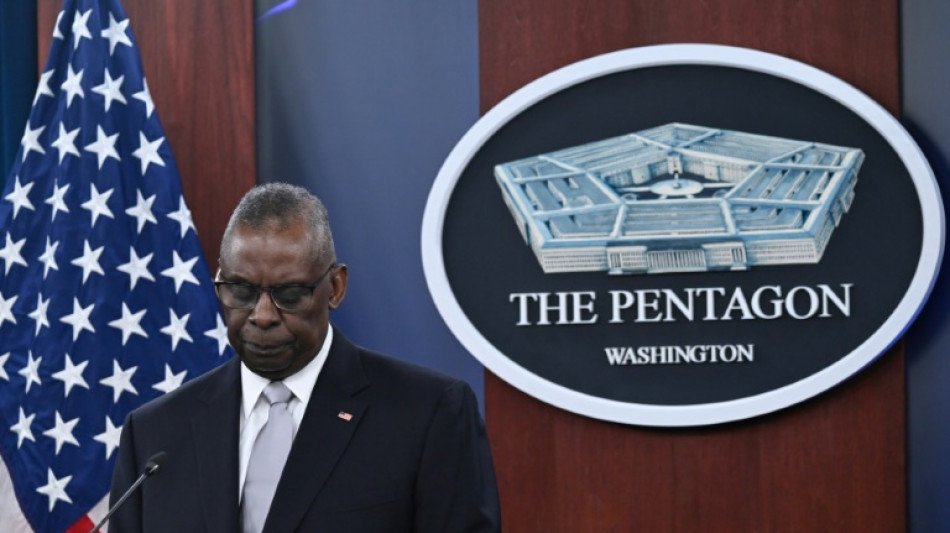
Hospitalized Pentagon chief hands duties to deputy / Photo: ANDREW CABALLERO-REYNOLDS - AFP

 Watchdog finds no criminal misconduct over US Fed renovations despite Trump probe

 In Manchester, City fans 'devastated' while rival fans call for relegation

 UK-France Channel migrant exchange deal scrapped: London

 Portugal boss denies 'incident' with Ronaldo

 Israel PM says one of the pilots of rerouted flight tried to crash plane

 Manchester City: Main points of damning judgement and possible sanctions

 Italy looking for 'identity' under Mancini says Scalvini

 The voices of Spain's housing camp protesters

 Romanian parliament rejects pro-EU PM candidate

 Court halts Tennessee's first execution of woman in 200 years

 Israelis march between once-closed West Bank settlements
 'Welcome back,' says Macron, as UK PM opens door to EU return

 Israel PM says pilot of rerouted flight tried to crash plane

 Demuro hopes to deliver Japan a 'magical' Arc victory

 'Devastated' AI scandal author Orelien returns to Quebec

 US reports firm Q2 economic growth, inflation steady

 Energy costs spark inflation surge across Europe

 Parma appoint Italy World Cup winner Gilardino

 West Indies pile up record 405-7 in second ODI against India

 Romanian parliament rejects pro-EU PM candidate amid political deadlock

 Passenger on rerouted flydubai flight says pilot tried to crash plane

 Russia targets Kyiv power supply as freezing winter approaches

 Haze pushes Kuala Lumpur, Singapore into world's most polluted cities

 Dangote's $16bn Kenya refinery 'new chapter' for Africa

 Ireland coach Hallgrimsson confirms second Israel game will go ahead

US Secretary of Defense Lloyd Austin, who is fighting prostate cancer, transferred his duties to his deputy hours after he was taken to hospital for "an emergent bladder issue," a spokesman said Sunday.
Deputy Secretary of Defense Kathleen Hicks "assumed the functions and duties" just before 5:00 pm (2200 GMT), Pentagon spokesman Pat Ryder said in a statement, adding that Austin was still receiving treatment and that the White House and Congress had been informed.
The announcement came weeks after it emerged that Austin, 70, had kept previous hospital stays secret and had not immediately informed US President Joe Biden of his cancer diagnosis, sparking criticism as the United States faces crises in the Middle East and Ukraine.
Austin effectively vanished from the public eye for treatment for prostate cancer in December and again in January after suffering complications from the procedure.
This time, the public was alerted around two hours after he was sent to the hospital on Sunday afternoon.
Austin "was transported by his security detail to Walter Reed National Military Medical Center," Ryder said in an earlier statement.
"The Deputy Secretary of Defense and the Chairman of the Joint Chiefs of Staff have been notified. Additionally, White House and Congressional notifications have occurred."
Initially Ryder noted that the defense chief brought along classified communications systems and would be retaining "the functions and duties of his office."
The announcement that Hicks would instead be taking over came just a few hours later, however.
After coming under heavy political fire for keeping the previous hospital stays secret, Austin apologized earlier this month.
"I should have told the president about my cancer diagnosis," he told journalists on February 1.
At the time, he said he was still in recovery, suffering from leg pain and using a golf cart for transportation inside the Pentagon.
The undisclosed absences -- as well as this current hospital stay -- come at a time when the United States faces a spiraling crisis in the Middle East, with American forces in Iraq and Syria facing near-daily attacks from Iran-backed militants in retaliation for Washington's steadfast support of Israel.
The top US defense official is also a key figure in attempts by the Biden administration to maintain support for Ukraine's fight against Russian invasion, as Republican members of Congress refuse to authorize new funding for military aid to Kyiv.
Various Republican lawmakers previously called for Austin to be sacked, but Biden, while lamenting the Pentagon chief's lapse in judgment, has said he remains confident in his defense secretary.
Austin -- a commanding presence at well over six feet tall -- is an intensely private person who eschews the spotlight, which he said played into his decision to keep the cancer diagnosis secret.
But he admitted that "taking this kind of job means losing some of the privacy that most of us expect. The American people have a right to know if their leaders are facing health challenges that might affect their ability to perform their duties, even temporarily."
L.AbuTayeh--SF-PST