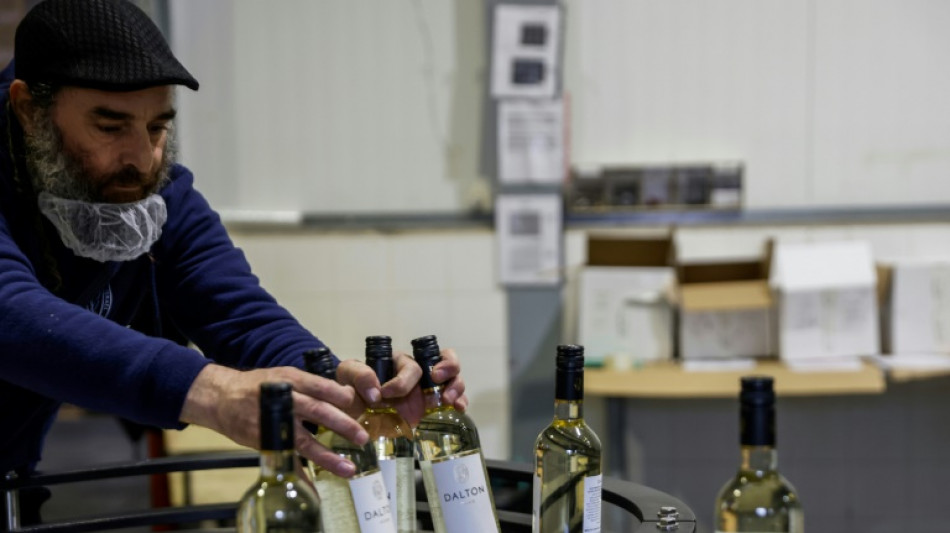
Israeli wineries near Lebanon fear ruined crop as war looms / Photo: jalaa marey - AFP

 Panic, anger, tears: Evan Gershkovich's uneasy journey after Russian jail

 UK PM says 'strong indications' Iran involved in airbase incident

 Google restricts access to new AI model over safety concerns

 Watchdog clears former US Fed chief Powell in renovation probe

 Israel PM hails Indian pilot of rerouted flight for averting disaster

 Fury, Joshua kick off 'battle of Britain' in good spirits

 Ronaldo leaves Portugal training camp after coach says he is dropped

 Florence Pugh stars in 'East of Eden' adaption on Netflix

 Watchdog finds no criminal misconduct over US Fed renovations despite Trump probe

 In Manchester, City fans 'devastated' while rival fans call for relegation

 UK-France Channel migrant exchange deal scrapped: London

 Portugal boss denies 'incident' with Ronaldo

 Israel PM says one of the pilots of rerouted flight tried to crash plane

 Manchester City: Main points of damning judgement and possible sanctions

 Italy looking for 'identity' under Mancini says Scalvini
 The voices of Spain's housing camp protesters

 Romanian parliament rejects pro-EU PM candidate

 Court halts Tennessee's first execution of woman in 200 years

 Israelis march between once-closed West Bank settlements

 'Welcome back,' says Macron, as UK PM opens door to EU return
 Israel PM says pilot of rerouted flight tried to crash plane

 Demuro hopes to deliver Japan a 'magical' Arc victory

 'Devastated' AI scandal author Orelien returns to Quebec

 US reports firm Q2 economic growth, inflation steady

 Energy costs spark inflation surge across Europe

Black clouds loom over grapevines in northern Israel on hills that stretch to the Lebanese border, where months of violence have raised fears of a wider war.
The tense border area -- where the Israeli army has traded deadly fire with the Hezbollah militant group for months -- can be seen from atop the Dalton Winery's fermentation vats.
Alex Haruni, the vineyard's owner, worries that if a full-scale war were to break out, it could also ruin the coming vintage.
"That's quite a lot of wine," he said.
The vines must be pruned before spring, and nature won't wait for peace.
"We have until March to get this done," Haruni said. "If not, the year is gone."
Israel has been at war in Gaza since the Palestinian militant group Hamas launched its October 7 attack, and has also traded fire with Lebanon's Iran-backed Hezbollah movement, a Hamas ally.
Almost four months of conflict have heaped new challenges on Israel's wine industry, including labour shortages and falling demand in the war-weary nation, a year after extreme heat caused a poor harvest.
Along the UN-patrolled border with Lebanon, where vineyards and orchards crowd the mountain slopes, the situation is particularly precarious ahead of the growing season, experts say.
Hezbollah has fired rockets and missiles almost daily since the Gaza war began, killing nine Israeli soldiers and six civilians, according to Israeli officials.
Israel's frequent retaliatory strikes have killed more than 200 people in southern Lebanon, most of them Hezbollah fighters, according to an AFP tally.
There are fears of worse to come. Israel and Hezbollah last fought a major war in 2006.
At the time, rockets rained down on Israel's north during the summer, but a ceasefire was struck in time for growers to harvest their grapes.
Defence Minister Yoav Gallant said on Sunday he had directed Israel's air force to "point the noses of the planes north and prepare for any harm that may come".
- 'Manpower crisis' -
Rami Na'aman, owner of a winery in Ramot Naftali, an Israeli village near the Lebanese border, said the fighting had forced him and thousands of others from their homes.
He can only reach his establishment twice a week, provided the military hasn't closed the roads.
The head of the Bank of Israel, Amir Yaron, warned last month that the war's "adverse economic impact... is substantial", especially on the construction and tourism industries.
Migal, an Israeli research institute, in November published a survey of 389 farmers, more than three quarters of whom projected an "average 35 percent drop in production and income".
The farming sector faces "the greatest manpower crisis since the state's founding" in 1948, the agriculture ministry said recently.
Thousands of foreign workers have fled Israel since the start of the war, and many agriculture labourers have been called up to the army as reservists.
The government has barred entry to tens of thousands of Palestinian labourers from the occupied West Bank and the besieged Gaza Strip.
Like other sectors, the wine industry has been hit by these problems.
Eyal Miles cultivates vines and cherries on the slopes around Kerem Ben Zimra, a farming hamlet home to four wineries just six kilometres (less than four miles) from Lebanon.
Miles, too, is worried about whether the pruning can be done by spring.
The field-hands he typically hires to help on his seven hectares (17 acres) of land, he said, are "afraid to work here due to the proximity to the border".
- Falling consumption -
At Dalton Winery, a Hezbollah projectile damaged vines in one plot near the frontier, forcing the business to issue field workers with helmets and flak jackets.
Around 10 percent of its vines are in closed military zones and inaccessible.
Visitor centres, usually a key source of revenue for northern wineries of all sizes, now lie empty with tourists steering clear of the region.
On top of these problems, the war has "clearly caused a decline in wine consumption" across Israel, said Haim Gan, a wine industry expert and founder of The Grape Man, a wine tasting emporium.
He blamed the call-up of more than 300,000 reservists, the postponement of weddings and other celebrations, and the generally "lifeless, unpleasant atmosphere" in the country.
At Dalton Winery, the slate of difficulties means that Haruni is considering laying off staff.
Miles, meanwhile, said a sharp drop in visits to his business has meant that "since October 7, the winery is closed", while online sales barely pick up the slack.
He remained optimistic, however, that despite the threat of a war in the north, "we will overcome this".
By the end of March, he predicted, "it will all be pruned and it will be ready for the coming harvest".
P.Tamimi--SF-PST