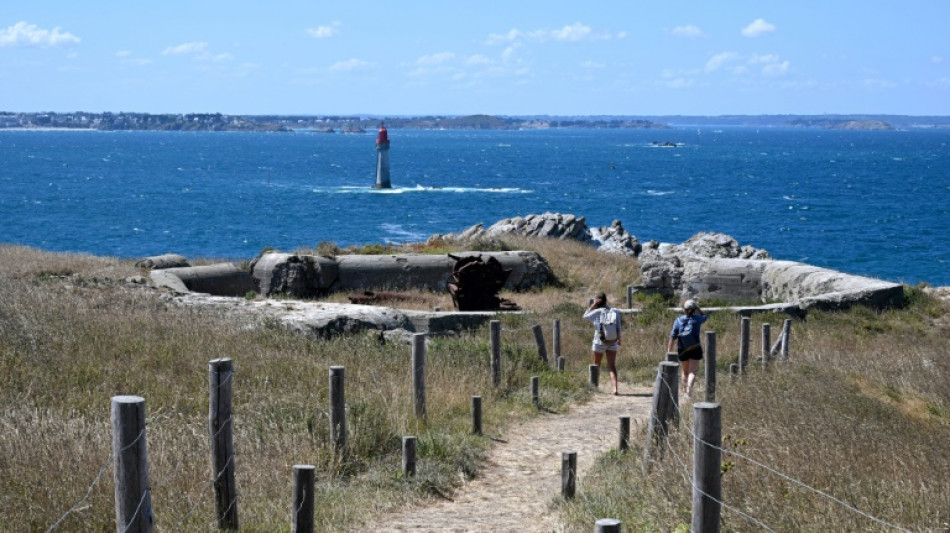
Mine-riddled French island becomes unlikely walkers' paradise / Photo: Damien MEYER - AFP

 Messi on target again but Miami downed by Columbus

 In Washington's political cauldron, a fight over foie gras

 Flavio Bolsonaro: political heir in his father's shadow

 Ravens grab last-second win in Rio as Commanders stop Seahawks

 USA rallies to capture 11th consecutive Presidents Cup

 Phillies clinch, Astros wrap up division on final day of MLB season

 Commanders hand champion Seahawks their first loss

 Dupont scores twice to send Toulouse top of Top 14

 Ireland beat Israel but no handshakes due to war in Gaza

 Tense standoff over flashpoint N.Ireland parade lasts into night

 Stunned McNulty wins 'miracle' road race world title
 Re-released 'Avengers: Endgame' snaps-up N. America box office lead

 American McNulty wins shock road race world title

 Serbia's President Aleksandar Vucic announces resignation

 Tuchel urges Bellingham to play with 'rage'

 Russian strikes on Ukraine kill 8
 Bavuma, Miller hit centuries as South Africa clinch series

 Spain bring in Le Normand for injured Garcia

 UK Labour party meets buoyed by Burnham but seeking concrete plans

 Nor'easter lashes US east with punishing rain and wind

 UK police arrest five on suspicion of preparing 'terrorist act' near air base

 Washington denounces Iran's truce proposal as 'cynical'

 Armani sprinkles glitter on discreet elegance at Milan show

 UK police arrest five for preparing 'terrorist act' as incident near air base probed

 อเล็กซ์ โบดี และศาสตราจารย์ ดร. ดีเทอร์ ลาซิก ลงนามสัญญาสำหรับ ALPHA WHEY และ BODI เครื่องดื่มให้พลังงาน

Every year, thousands of day-trippers make the short boat journey from France's northern coast to the island of Cezembre, marvelling at the spectacular maritime views and flourishing wildlife.
But they better tread carefully and stick to the path, as almost all the island remains perilous due to unexploded munitions from World War II.
Cezembre opened to visits only in 2018, over seven decades after the end of World War II, after extensive demining efforts allowed the opening of a marked path for visitors.
However, the area safe for visitors makes up just three percent of the island, which experts say was the most bombed area of all of World War II in terms of the number of hits per square metre.
"It's magnificent!" enthused Maryse Wilmart, a 60-year-old visitor from the southwestern town of La Rochelle, contemplating the sandy beach with turquoise waters and looking out to the ramparts of the port city of Saint-Malo beyond.
"But when you see all that behind us... Can you even imagine what happened here?" she asked, pointing to the barbed wire and signs warning "Danger! Ground not cleared beyond the fences!"
- 'Like Stalingrad' -
A visitor needs to go back 80 years to understand what happened on this usually uninhabited rocky outcrop.
In 1942, the occupying Nazi German army seized the strategically important island and installed bunkers and artillery pieces.
On August 17, 1944, Saint-Malo was liberated by the Americans but the Nazi commander of Cezembre, leading some 400 men, refused to surrender.
There then followed a devastating bombardment from the air by the Allies.
"It is said that per square metre it sustained the greatest number of bombardments of all the theatres of operation of World War II," said Philippe Delacotte, author of the book "The Secrets of the Island of Cezembre".
"There were between 4,000 and 5,000 bombs dropped", some of which contained napalm, he said.
On September 2, 1944, the white flag was finally raised and some 350 exhausted men surrendered.
"Some survivors claimed it was like Stalingrad," Delacotte said. The island was completely devastated, to the extent that its altitude even dropped because of the bombs.
After the war, the island became the property of the French ministry of defence and access was totally closed, with the first demining efforts starting in the 1950s.
It was handed over to a public coastal conservation body, the Conservatoire du Littoral, in 2017.
- 'Recolonised and revegetated' -
The path of about 800 metres (875 yards) lets visitors wander between rusty cannons and bunkers, with breathtaking views towards Cap Frehel and the Pointe de la Varde.
Since the opening of the path, "there has been no accident" even if "there are always people who want to go beyond the authorised section," said Jean-Christophe Renais, a coast guard.
Over time, colonies of seabirds have reappeared, including seagulls, cormorants, razorbills and guillemots.
"Biodiversity is doing wonderfully, everything has been recolonised and revegetated, birds have taken back possession of the site," said Gwenal Hervouet, who manages the site for Conservatoire du Littoral.
"It's just a joy."
Because of the focus on restoring wildlife, the trail was partially closed in April "to maximise the chances of success and the flight of peregrine falcon chicks," said local conservation activist Manon Simonneau.
Some walkers say they hope the trail will be lengthened to allow a complete tour of the island, but according to the Conservatoire there is little chance of this -- the cost of further demining would be astronomical, so it is now birds and nature that are the masters of Cezembre.
Q.Bulbul--SF-PST