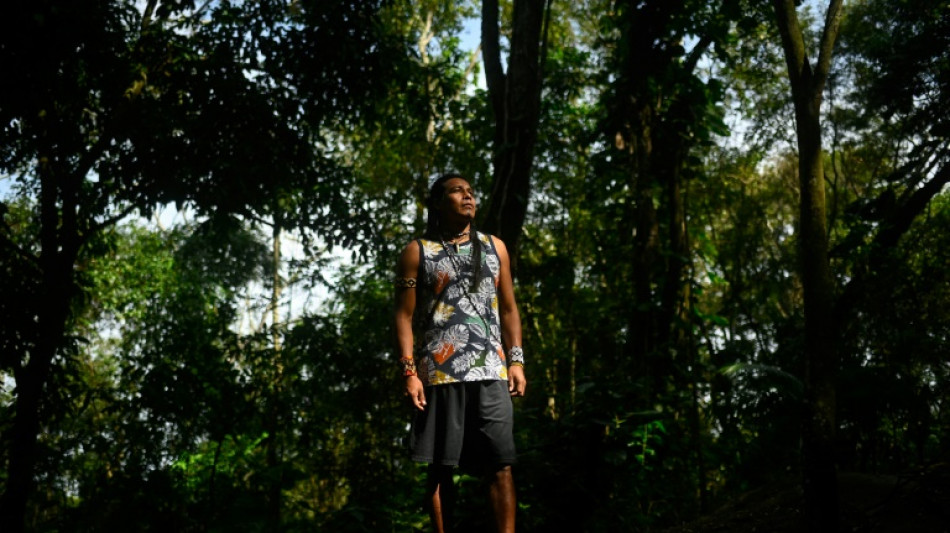
Seeking water, Brazil indigenous group finds new home / Photo: Andre BORGES - AFP

 Ravens grab last-second win in Rio as Commanders stop Seahawks

 USA rallies to capture 11th consecutive Presidents Cup

 Phillies clinch, Astros wrap up division on final day of MLB season

 Commanders hand champion Seahawks their first loss

 Dupont scores twice to send Toulouse top of Top 14

 Ireland beat Israel but no handshakes due to war in Gaza

 Tense standoff over flashpoint N.Ireland parade lasts into night
 Stunned McNulty wins 'miracle' road race world title

 Re-released 'Avengers: Endgame' snaps-up N. America box office lead

 American McNulty wins shock road race world title

 Serbia's President Aleksandar Vucic announces resignation

 Tuchel urges Bellingham to play with 'rage'

 Russian strikes on Ukraine kill 8

 Bavuma, Miller hit centuries as South Africa clinch series
 Spain bring in Le Normand for injured Garcia

 UK Labour party meets buoyed by Burnham but seeking concrete plans

 Nor'easter lashes US east with punishing rain and wind
 UK police arrest five on suspicion of preparing 'terrorist act' near air base

 Washington denounces Iran's truce proposal as 'cynical'

 Armani sprinkles glitter on discreet elegance at Milan show

 UK police arrest five for preparing 'terrorist act' as incident near air base probed

 อเล็กซ์ โบดี และศาสตราจารย์ ดร. ดีเทอร์ ลาซิก ลงนามสัญญาสำหรับ ALPHA WHEY และ BODI เครื่องดื่มให้พลังงาน

 China teen blows away the field for record-setting gold at 'sad' Games

 Alex Bodi och prof. dr. Dieter Lazik tecknar avtal om ALPHA WHEY och BODI Energidryck

 Alex Bodi i prof. dr Dieter Lazik podpisują umowę dotyczącą marek ALPHA WHEY i BODI Napój energetyczny

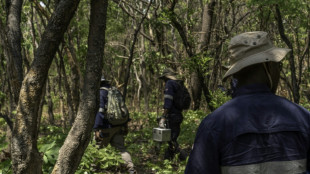
Clutching a machete and a cell phone, indigenous leader Vanderlei Weraxunu tours his community's future home, a swathe of tropical forest land north of Rio de Janeiro where his people will finally have water.
Weraxunu is one of around 50 members of the Mbya Guarani people who will soon establish a new home in the middle of what will be Brazil's first municipal nature reserve, where they plan to live according to their ancestral lifestyle.
The project promises to transform the lives of community members, who have been living in a settlement with no access to potable water in Marica county, in Rio de Janeiro state.
Hailing from different regions of Brazil, the community of Mbya Guarani moved there a decade ago and founded a village, Ceu Azul (Blue Sky) on a plot of land donated by a businessman.
But the land, a former coffee plantation, is too degraded to farm crops, and the village has to have water trucked in by the municipal government.
"A river ran through it 150 years ago. But then the former owner turned it into a coffee plantation and it was devastated," says the youthful, chiseled Weraxunu, sporting a beaded armband, traditional face paint and long black hair.
"They cut down the forest and that caused the river to dry up," he adds, as a black- and bronze-furred monkey playfully performs acrobatics on his arms and shoulders.
South America is home to an estimated 280,000 Guarani, divided into several subgroups including the Mbya.
They have a long history of conflicts with non-native farmers, who had often forced them from their ancestral land.
- 'Guardians of nature' -
After years of negotiations with the government, Weraxunu's community is now set to move in the coming months to a 50-hectare (125-acre) plot of public land about 35 kilometers (20 miles) away, donated by the municipality.
"We'll have more resources, we'll be able to plant (manioc and sweet potato) and gather medicinal herbs," says Weraxunu.
They also plan to bring back native crops such as Guarani maize, which they hold sacred, as well as bamboo for the handcrafts that are an important source of the community's income.
"Until now, we've had to bring in bamboo from other places" to make traditional baskets, says Maria Helena Jaxuka, a Guarani cacique, or chief.
"It will allow us to preserve nature, as well as our culture and way of life," says Weraxunu.
"The Guarani and all indigenous peoples are the guardians of nature, which gives us life."
O.Mousa--SF-PST