'Animals are thirsty': Dust and bones on Turkey's shrinking lake / Photo: ILYAS AKENGIN - AFP

 OpenAI cancels release of newest model due to safety concerns

 AI bosses head to White House as safety pressure builds

 Batista sacked as Costa Rica coach after six months
 Flooding, power cuts and evacuations as Hurricane Polo slams Mexico

 Dodgers eye three-peat, Red Sox face Yankees as MLB playoffs begin

 Certification of Boeing 737 MAX delayed by software bug

 Celine Dion wows Paris Fashion Week with surprise gig

 AMD buys firm founded by AI 'godmother' Fei-Fei Li

 Italy rebound in Turkey as France win late in Belgium

 Pope says concerns about AI 'should be taken seriously'

 Hurricanes to hoist title banner as NHL season begins

 Justice Alito steps aside from major US climate case

 Willis happy with England exile after retains Top 14 player award

 Spain housing protests keep heat on government as PM seeks new law

 Wissa spoils Zimbabwe homecoming as DR Congo win AFCON qualifier

 UK police release on bail five men held over airbase incident

 Ex-All Black Plummer 'sure' New Zealand will find Super Rugby solution

 Shein sees 1% revenue growth in first half of 2026
 Netherlands regrets Israel retaliation in settlements row

 Moscow seizes Russian assets of German food retailer Metro

 Bulgarian spirits inflamed by new rakia rules

 Documentary turns camera on architect Peter Zumthor

 UK police say releasing on bail five men held over airbase incident

 Trump admin finalizes reversal of US fuel economy standards
 US says no China arms sale plans after envoy cites Trump offer

Shepherd Ibrahim Koc recalls his youth with fondness as he grazes cattle on a barren field that was once lush with vegetation on the edge of Turkey's largest lake.
An occasional shrub marks the spots from where Lake Van has retreated over years of global heating and drought.
"The animals are thirsty," the 65-year-old lamented.
"There is no water," Koc said, echoing sentiments expressed by a growing number of Turks who have watched their mountains lose ice caps and their water reservoirs dry up.
A weather map of Turkey -- an agricultural superpower stretching from Bulgaria in the west to Iran in the east -- shows much of the country suffering from a prolonged drought.
Shrinking shorelines are exposing lakebeds that pollute the air with a salty dust. Scientists fear the problems could grow only worse.
"I think these are our good days," Faruk Alaeddinoglu, a professor at Van Yuzuncu Yil University, told AFP.
"We will witness the lake continuing to shrink in the coming years."
Lake Van covers approximately 3,700 square kilometres (1,400 square miles), reaching a maximum depth of 450 metres (1,475 feet).
Its surface area has shrunk by around 1.5 percent in recent years, according to measurements Alaeddinoglu carried out last autumn.
"That is a terribly large amount of water for a 3,700 square kilometre area," he said.
- 'Barren land'-
In the Celebibagi neighbourhood on the lake's northern shore, the waters have receded by around four kilometres.
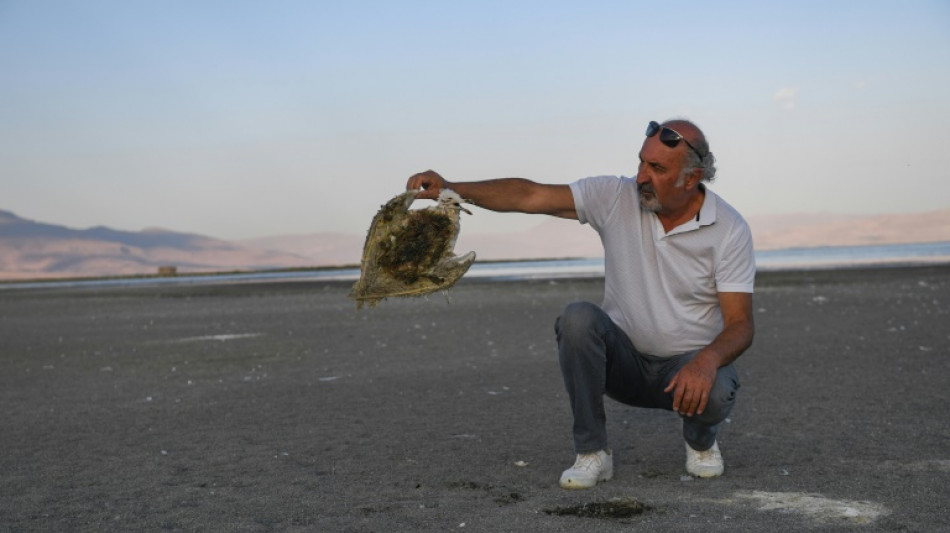
A long walk along the exposed lakebed is littered with bird bones, craggy bushes and dried dirt covered with sodium and other minerals.
"We are walking in an area which was once covered with the lake's waters," said Ali Kalcik, a local environmentalist.
"Now, it's a barren land without a living thing."
The sight of dazzling flamingos dancing in the air against the backdrop of mountains signals the spot where the lake finally begins.
Alaeddinoglu said the lake's size had changed in the past because of rifts in tectonic plates that make Turkey into one of the most active earthquake zones in the world.
But he blamed the ongoing water loss on rising temperatures that result in "less precipitation and excessive evaporation".
Almost three times as much of the lake's water evaporates than comes back down in the form of rain, Alaeddinoglu said.
Lush gardens of newly-built summer cottages are also draining water from the region, where President Recep Tayyip Erdogan has built a government retreat.
- 'Business is dying' -
The problem has become so severe that officials are urging local farmers not to grow crops requiring too much water.
This means farmer Kinyas Gezer can no longer afford to grow sugar beets, which are a particularly thirsty vegetable.
"All my labour has been wasted," the 56-year-old lamented, pointing to his shrivelled apricots.
"If it goes on like this, we will abandon farming. The business is dying."
The water's loss also exposes pollution, according to Orhan Deniz, a professor of Yuzuncu Yil University, whose campus sits on the lake's shore.
"Large patches of slime mixed with mud give off a bad smell and make human pollution more evident," he said.
"In the 1990s, we would swim during lunch break and then go back to university," he said, gazing at the lake from his office.
"Now it's not possible to step in the water, let alone swim in it," he said.
- 'A bird massacre' -
The lake is still popular with tourists and some locals swim along its more scenic parts.
Van Governor Ozan Balci said his office has spent 80 million lira ($3 million) cleaning up the lake.
"We are doing our best to protect the lake because of its cultural heritage and people's common memory," he told AFP.
In the shoreline village of Adir, some locals swam and others picnicked under a tree.
But dead gulls lying not too far from the vacationers betrayed the ecological problems facing the lake.
Experts say pearl mullets that form the basis of the gulls' diet migrated early this year because of the drought.
Deprived of food, the gulls simply starved to death.
"The remaining birds here have one more week. Then they will also die," local villager Necmettin Nebioglu, 64, said.
"In the past, the seagulls would follow us while we were swimming. Now look, it's a bird massacre," he said, pointing to a pile of carcasses on the shore.
I.Matar--SF-PST