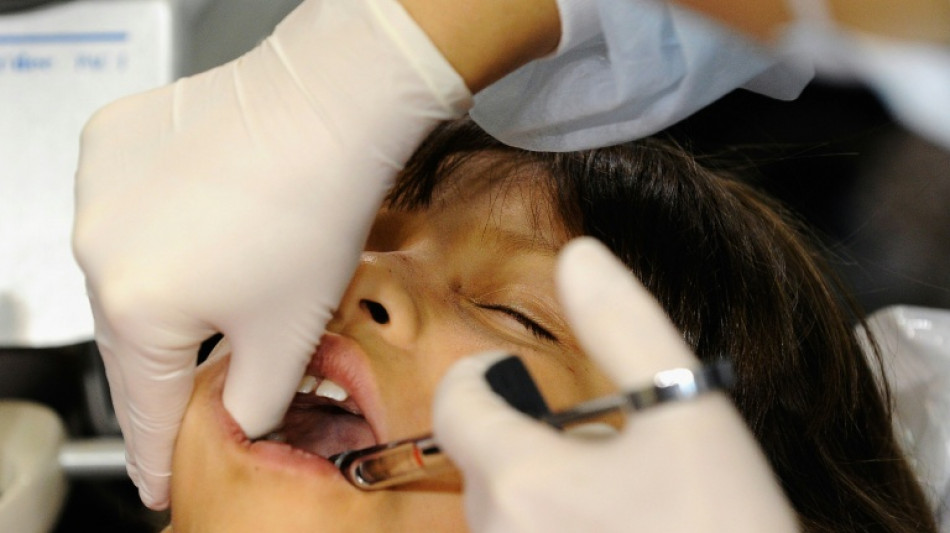
Countries agree to end mercury tooth fillings by 2034 / Photo: KEVORK DJANSEZIAN - GETTY IMAGES NORTH AMERICA/AFP/File

 Indonesian court hears 'negligence' complaint against state over fires, haze
 Rubio in Greece to urge against Western civilisation 'decline'

 Micron workers at Taiwan plant vote in favour of strike

 In 'The Social Reckoning,' Jeremy Allen White takes on Facebook's 'frightening' ambition
 Chip industry activists call for South Korea to recognise cancer cases

 Famine-scarred southern Madagascar braces for El Nino
 How the EU regulates lobbyists

 I.Coast refuge offers lifelong care for youngsters scorned as 'sorcerers'

 Indian central bank hikes rates for first time in more than 3 years

 Hotel Blacklist Launches New Accommodation Industry Risk Assessment Tool

 Bangladesh nuclear plant draws hope -- and worry

 US beat Canada 1-0 to wrap up four-win international break

 Turkey, Australia's joint COP31 leadership raises doubts

 For Turkish NGOs, COP31 offers rare space for action

 Sleep, appetite, gene-editing experts contend for Nobel chemistry prize
 Nobel Peace Prize haunted by the 'spectre' of Trump

 Africa launches own credit agency in bid for cheaper borrowing

 US, China, EU: three paths to regulating AI

 Australia's High Court rules against coal mine in landmark climate case
 Australia touts new funds for Pacific infrastructure at Fiji 'pre-COP'
 Eva Marie Saint, Oscar winner of Hollywood classics, dies at 102

 Australia probes app used in cheap smart glasses over privacy fears

 England needed to 'move on' from World Cup pain, says Tuchel

 O'Neill to stay at Celtic after period of "reflection"

 Kane marks 125th England cap with Wembley Nations League double

Countries agreed Friday to phase out the use of mercury-based dental amalgams in tooth fillings by 2034, in a move that will change how dentistry is done around the world.
At a conference in Geneva, signatories to a treaty aimed at protecting human health and the environment from mercury pollution decided to call time on mercury amalgams.
Nations agreed "to end the use of dental amalgam by 2034, marking a historic milestone in reducing mercury pollution", the conference announced in its closing statement.
The World Health Organization considers mercury one of the top 10 chemicals of major public health concern, calling it "toxic to human health".
Some countries have already banned its use in dental amalgam, a common filling material for treating tooth decay used for more than 175 years.
The Minamata Convention on Mercury is an international treaty to protect human health and the environment from the adverse effects of mercury and mercury compounds.
More than 150 countries are party to the convention, which was adopted in 2013 and came into force in 2017.
The sixth conference of parties to the treaty, held in Geneva this week, adopted amendments "establishing a global phase-out of dental amalgam by 2034", the closing statement said.
"This science-based, time-bound agreement marks a decisive step toward the total elimination of mercury use in dentistry and a safer future for all communities."
- African initiative -
The treaty already stipulated that signatories must take measures to phase out the use of mercury-based dental amalgams.
However, a bloc of African countries wanted to go further, with a ban on their production, import and export, starting in 2030.
In a video message as the conference opened on Monday, US Health Secretary Robert F. Kennedy Jr. asked why mercury was deemed "dangerous in batteries, in over-the-counter medications and make-up", but acceptable in dental fillings.
"It's inexcusable that governments around the world still allow mercury-based compounds in healthcare -- and safe alternatives exist," he said.
A few countries opposed the idea of a phase-out by 2030, including Iran and India, and Britain, which said it was too soon.
But countries came together and agreed a phase-out by 2034.
"We have just opened the door to another chapter of the mercury history book," said the convention's executive secretary Monika Stankiewicz.
"Mercury pollution is a scourge."
However, "by understanding one another and bridging our differences, we can make a difference in the lives of people everywhere, and indeed in the life of this beautiful planet we share".
The conference's president Osvaldo Alvarez Perez added: "We have set ambitious new goals, and left mercury a little further behind."
Overall, the conference adopted 21 decisions aimed at advancing the convention's objective of protecting human health and the environment from mercury pollution.
H.Darwish--SF-PST