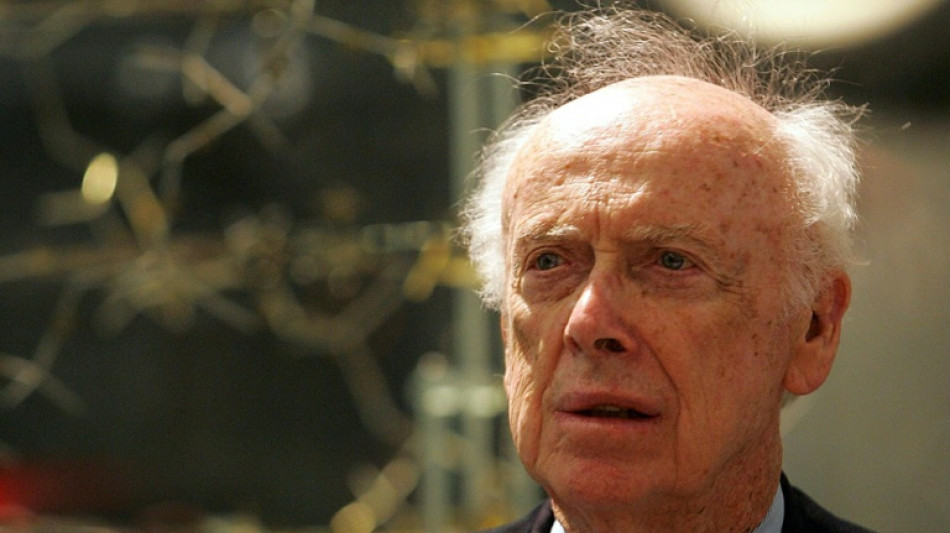
James Watson, Nobel prize-winning DNA pioneer, dead at 97 / Photo: ODD ANDERSEN - AFP

 Lyon down Palace in Europa League, Sunderland leave it late

 UniCredit says receives ECB green light for Commerzbank takeover

 New York City pension fund asks Anthropic to delay IPO

 Venezuela's Maduro denies US torture charges as 'false accusations'

 Somalia sets May presidential election despite insecurity

 Chelsea's Caicedo eager to be more of a leader

 Rahm reaches separation deal with LIV in bankruptcy court

 UN chief urges nations to end 'war on nature'
 Newcastle boss Jaissle says Fernandez-Pardo just needs a goal

 Infantino offers apology but 'no answers' at FIFA meeting over World Cup plan

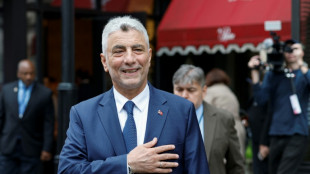 Don't exclude Turkey from 'Made in Europe' plan: minister to AFP

 French duo Justice to score 'GTA VI': game maker

 El Nino a 'terrifying' threat to coral reefs: UN biodiversity expert

 Barcola must get used to Liverpool highs and lows, says Iraola

 Versus Trade Wins Best ECN/STP Broker APAC 2026, Marking Third UF Awards Recognition

 Three dead as Istanbul sees heaviest rainfall in 80 years

 US producer prices see biggest jump since 2022 in added challenge to Trump

 Swiatek avoids seed exodus to breeze into Wuhan last eight
 PM condemns 'chaos' as violent protests grip Albania

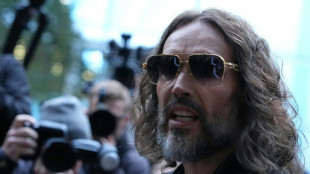 'I couldn't breathe', Russell Brand's alleged rape victim says

 Pope's cancer operation already reshaping papacy

 Zverev cruises past De Minaur to reach Shanghai semi-finals

 Ukraine's Zelensky defies Trump with Russian refinery strikes

 Holders Australia edge New Zealand 24-22 to open Rugby league World Cup

 'Ocarina of Time': Nintendo gives Zelda classic a modern makeover

James Watson -- the Nobel laureate co-credited with the pivotal discovery of DNA's double-helix structure, but whose career was later tainted by his repeated racist remarks -- has died, his former lab said Friday. He was 97.
The eminent biologist died Thursday in hospice care on Long Island in New York, announced the Cold Spring Harbor Laboratory, where he was based for much of his career.
Watson became among the 20th century's most storied scientists for his 1953 breakthrough discovery of the double helix with researcher partner Francis Crick.
Along with Crick and Maurice Wilkins, he shared the 1962 Nobel Prize for their work -- momentous research that gave rise to modern biology and opened the door to new insights including on genetic code and protein synthesis.
That marked a new era of modern life, allowing for revolutionary technologies in medicine, forensics and genetics -- ranging from criminal DNA testing or genetically manipulated plants.
Watson went on to do groundbreaking work in cancer research and mapping the human genome.
But he later came under fire and bowed out of public view for controversial remarks, including that Africans were not as smart as white people.
Watson told the British weekly The Sunday Times he was "inherently gloomy about the prospect of Africa" because "all our social policies are based on the fact that their intelligence is the same as ours -- whereas all the testing says not really."
- Twisting ladder -
Born on April 6, 1928 in Chicago, Illinois, at the aqe of 15 James Dewey Watson won a scholarship to the University of Chicago.
In 1947 he received a degree in zoology before attending Indiana University in Bloomington, where he received his Ph.D in zoology in 1950.
He became interested in the work of scientists working at the University of Cambridge in England with photographic patterns made by X-rays.
After moving to the University of Copenhagen, Watson began his investigation of the structure of DNA.
In 1951 he went to the Zoological Station at Naples, where he met researcher Maurice Wilkins and saw for the first time crystalline DNA's X-ray diffraction pattern.
Before long he'd met Francis Crick and started what would go down as a celebrated partnership.
Working with X-ray images obtained by Rosalind Franklin and Wilkins, researchers at King's College in London, Watson and Crick had started their historic work of puzzling out the double helix.
Their first serious effort came up short.
But their second attempt resulted in the pair presenting the double-helical configuration, a now iconic image that resembles a twisting ladder.
Their model also showed how the DNA molecule could duplicate itself, thus answering a fundamental question in the field of genetics.
Watson and Crick published their findings in the British journal "Nature" in April-May 1953 to great acclaim.
Watson taught at Harvard for 15 years before becoming director of what today is known as the Cold Spring Harbor Laboratory, which he transformed into a global hub of molecular biology research.
From 1988 to 1992, Watson was one of the directors of the Human Genome Project at the National Institutes of Health, where he oversaw the mapping of the genes in the human chromosomes.
But his comments on race and obesity -- he was also known to make sexist remarks -- triggered his retirement in 2007.
The lab severed all ties with him in 2020, including his emeritus status, after he once again made similar statements.
F.AbuShamala--SF-PST