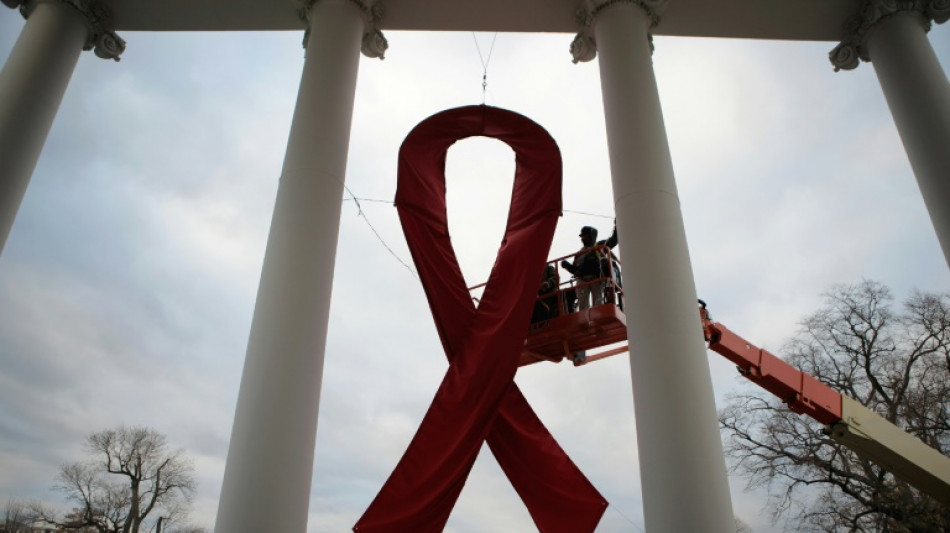
Norwegian effectively cured of HIV after transplant from brother / Photo: CHIP SOMODEVILLA - GETTY IMAGES NORTH AMERICA/AFP/File

 Two dead as Istanbul endures heaviest rainfall in 80 years
 After latest Nepal flood, survivors fear for future

 EU leaders clash over budget as spectre of French elections looms

 'No place to breathe': life in Indonesia's fire epicentre

 'Can't sleep': Spain's housing crunch upends lives

 Musk calls on Ukraine's Zelensky to 'go' after satellite slowdown row
 Still smiling at 117, Albanian may be world's oldest woman
 Pope has 'good night' in hospital: Vatican

 China's economy seen missing target as global shocks bite: AFP poll

 Costa Rica opens jail inspired by El Salvador mega-prison

 Same-sex couple takes fight for equality to Slovakian court
 'High hopes' as Indonesian women get a football league, again

 'Expectations high' for Bordeaux-Begles' Champions Cup hat-trick bid, says Depoortere

 Rennie urges All Blacks to stay focused against 'hurting' Wallabies

 Palmeiras beat Fluminense 2-1 in Libertadores semi-final first leg

 Brewers blasts leave Dodgers on brink

 Tech stock lead rout after US inflation fuels rate hike bets
 Al-Fayed survivors say UK police missing 'bigger picture'

 Online 'witch hunt' sweeps up Asians misidentified as US rape accused

 Prospect of Bolsonaro win looms large over Brazil's Indigenous

 Freed from Belarus, founder of Lady Gaga's biggest fan site tells his story

 Behind AI's carbon footprint, a potential climate tool

 Trump's new press secretary faces scrutiny over credentials

 PSG 'got lucky' to win Man City thriller, says Luis Enrique

 Real Madrid comeback stuns Roma as Mourinho enjoys happy reunion

A Norwegian man has been effectively cured of HIV after receiving a stem cell transplant from his brother, doctors announced on Monday.
The patient's brother happened to carry a rare, virus-blocking genetic mutation.
The 63-year-old man, dubbed the "Oslo patient", is the latest in around 10 people worldwide who have gone into long-term remission from HIV after receiving a transplant to treat unrelated blood cancer.
The high-risk procedure normally requires a donor to have a specific mutation of their CCR5 gene, which blocks HIV from entering the body's cells.
Only around one percent of people in northern Europe have the necessary mutation.
The Oslo patient, who had been living with HIV since 2006, was diagnosed with a fatal blood cancer called myelodysplastic syndrome in 2017.
His doctors searched for a donor who would help treat both. When they couldn't find one, they chose the man's elder brother.
However, on the day of the transplant in 2020, the doctors were stunned to discover that the brother carried the CCR5 mutation.
"We had no idea... That was amazing," doctor Anders Eivind Myhre of the Oslo University Hospital told AFP.
- 'Winning the lottery twice' -
The patient said "it was like winning the lottery twice", added Myhre, who was also the lead author of a study describing the case in Nature Microbiology.
Two years after the transplant, the patient stopped taking the anti-retroviral drugs which had been reducing the level of HIV in his body.
The researchers found no trace of the virus in samples of the man's blood, gut and bone marrow.
"For all practical purposes, we are quite certain that he is cured," Myhre said.
Now the Oslo patient, whose name was not revealed, is "having a great time" and has more energy than he knows what to do with, Myhre said.
The painful and potentially dangerous transplant procedure is for people who have both HIV and deadly blood cancer so is not a feasible option for the millions of people living with the virus across the world.
However, researchers believe that studying these rare cases will reveal more about how HIV works in the hope of finding a cure for all patients.
- 'No longer a patient' -
The Oslo patient is the first person to receive a transplant from a family member.
The patient's immune system had been "completely replaced" by the donor's, sqaid study co-author Marius Troseid of the University of Oslo.
It was the first time this had been observed in a cured patient's bone marrow and gut, he told AFP.
Even before the researchers found out the brother had a CCR5 mutation, they had some hope that the Oslo patient's HIV could be cured.
That is because in 2024 it was revealed that the so-called "next Berlin patient" entered long-term remission despite receiving a transplant that did not have two copies of the mutated gene.
The original Berlin patient, Timothy Ray Brown, was the first person declared cured of HIV back in 2008. Patients in London, New York, Geneva, Duesseldorf and elsewhere followed.
Given the Oslo patient's robust health, Troseid suggested that his nickname was no longer suitable.
"The Oslo patient is perhaps no longer a patient. At least he doesn't feel like it," Troseid said.
F.Qawasmeh--SF-PST