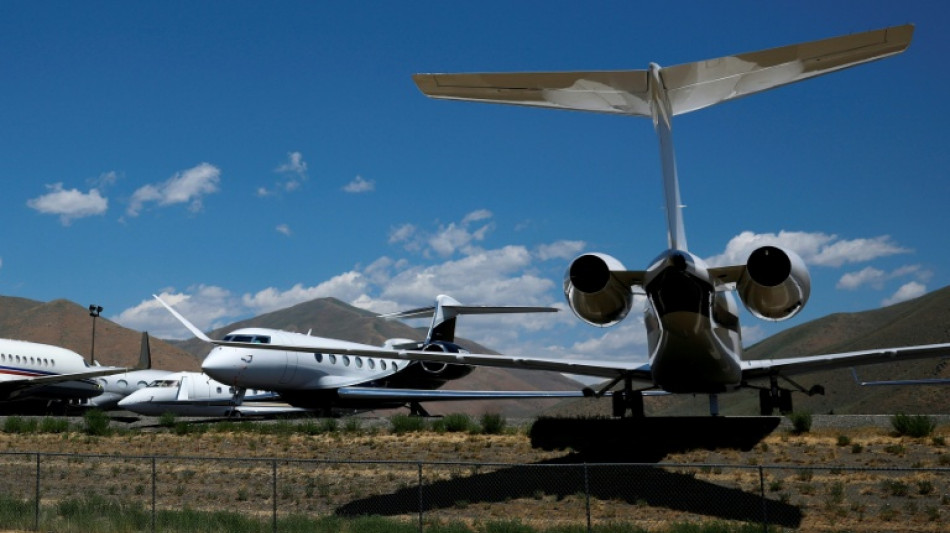
At COP30, nations target the jet set with luxury flight tax / Photo: Kevin Dietsch - GETTY IMAGES NORTH AMERICA/AFP/File

 مصلحة مياه القدس توحّد جهودها مع بلديات الرام ومخماس لتعزيز استدامة المياه

 Saudi PIF Retains Top Sovereign Wealth Fund Brand Title for Third Year

 Binance Secures $6.5 Billion Asset-Freezing Order from Abu Dhabi Court

 Malta PM Abela Refuses Parliamentary Question on Maritime Borders Amid Turkey-Libya Deal

 محافظ طولكرم يدعو لمبادرة مجتمعية لخفض تكاليف الأعراس وتعزيز التكافل
France, Spain and Kenya are among a group of countries spearheading a drive at the COP30 climate summit for a new tax on luxury air travel, a source close to the matter told AFP.
Rooted in the idea that a small elite of premium flyers should pay more for their outsized contribution to global warming, the proposal will likely pit them against the powerful aviation industry.
Diplomats from the coalition of more than 10 countries are pushing for more to come aboard.
"We want to expand the coalition and, in particular, bring in more European states," the source said.
Business and first-class seats carry roughly triple the planet-warming emissions footprint of an economy ticket, while private jets emit up to 14 times more per passenger-kilometre compared to commercial flights.
Countries that do not yet have such a tax would commit to imposing levies on business and first-class tickets as well as private jets.
Those that already do -- such as France -- are pledging greater ambition, with steeper and more progressive rates. In practice, that could mean a dedicated surcharge on first-class travel.
For private jets, the tax could be tied to kerosene consumption, though other mechanisms are under discussion.
The initiative is led by the Global Solidarity Levies Task Force, a group launched in 2023 and co-chaired by Barbados, Kenya and France.
They have chosen COP30, held in Brazil's Belem and billed as a moment for nations to move from climate pledges to action, as the runway to launch their proposal.
- 'It's only fair' -
"We need innovative and fair financing," French President Emmanuel Macron said Thursday at a leaders' summit ahead of COP30, which officially kicks off Monday.
"With Kenya, Spain, Somalia, Benin, Sierra Leone, and Antigua and Barbuda, we have made significant progress toward a greater contribution from the aviation sector to adaptation," he said. This group of countries also includes Djibouti and South Sudan.
"It's only fair that those who have the most, and therefore pollute the most, pay their fair share," Spanish Prime Minister Pedro Sanchez said Friday.
The move is likely to face headwinds from airlines, including Air France, which in March unveiled a new version of its "La Premiere" cabin -- the first update since 2014.
Designed for long-haul Boeing 777s, the "suites" will feature five windows, an armchair and a chaise longue that converts into a bed.
Proponents of the tax believe that demand for ultra-luxury travel is only weakly affected by price, and that the ultra-wealthy will keep flying even if tickets become slightly more expensive.
"Properly designed aviation taxes can raise predictable revenue for climate and development finance, while reinforcing fairness and solidarity," argues the coalition of countries, in a new document explaining the rationale.
Supporters cite the Maldives as an example. The tourism-dependent island nation charges steep departure taxes: $120 for business class, $240 for first class and $480 for private jets.
"There's no reason why other countries can't do the same," the source told AFP.
O.Salim--SF-PST



