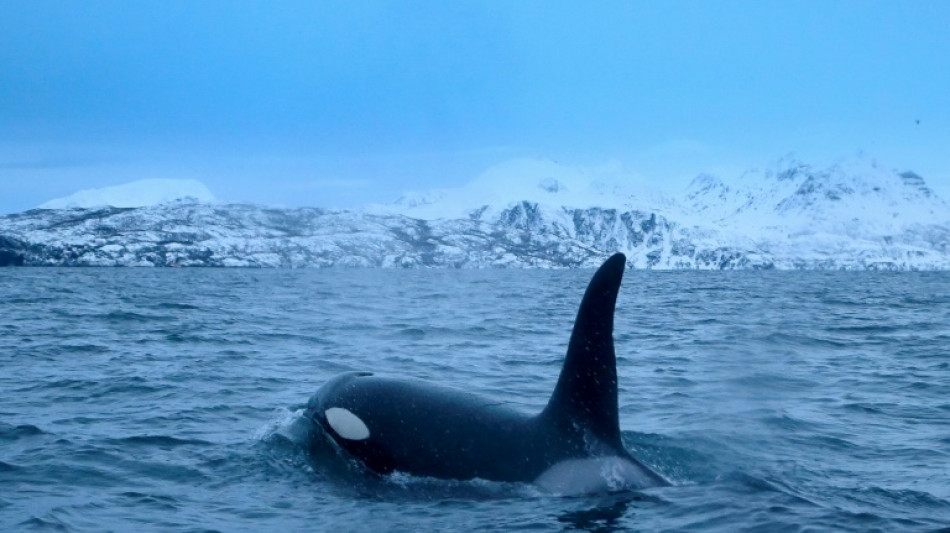
'Surgical' shark-killing orcas fascinate off South Africa / Photo: Olivier MORIN - AFP

 Oil up, Wall Street dips after Trump rejects Iran truce offer

 Gakpo withdraws from Netherlands squad

 SpaceX puts Starship megarocket in orbit for first time

 Iran denies link to suspected bomb plot at UK airbase used by US

 Ex-boss Mancini says City charges 'not my concern'

 Berlin Marathon winner Assefa finished race with torn Achilles

 Comedian convicted for Erdogan 'insult' but freed pending appeal

 French prosecutors seek two-year sentence for ex-minister Dati in graft case

 Eala makes fast start as weather and transport woes hit Asian Games

 Hurricane Polo approaches Mexico, threatens severe damage

 Energy markets rally after Trump rejects Iran truce offer

 Japanese convenience store enlists Lady Gaga to bolster recruitment

 Seoul summons Ukraine envoy in row over North Korean POWs

 Ireland 'raised awareness worldwide' in Israel game: Hallgrimsson

 Colombian police capture wife, daughter of Ecuador drug lord

 More Asian Games woes as bus takes Pakistan team to wrong venue

 Radio frequencies vital to Earth observation must be protected: UN

 Comedian on trial for insulting Erdogan in standup show

 Women's Fashion Week kicks off in Paris

 Pope arrives in French border city to speak on united Europe

 The wildfires choking Indonesia, sparking regional haze

 PU Prime Deepens Argentina Presence Through FX Expo Buenos Aires 2026

 Nothing to seal here: NZ police help stranded pup home

 White House releases list of products US, China could tax less

 'Pseudo-journalism': Partisan 'news' sites target US midterms

Scores of disembowelled sharks have washed up on a South African beach putting the spotlight on a pair of shark-hunting killer whales whose behaviour has fascinated scientists and wildlife enthusiasts.
Marine biologists were alerted to the find by beach walkers who stumbled upon the grim sight last week in Gansbaai, a small fishing port 150 kilometres (93 miles) south east of Cape Town.
"The dead sharks are torn open at the pelvic girdle, they have Orca teeth marks known as rake marks on their pectoral fins and their liver is missing," said Alison Towner, 37, a shark scientist with the Dyer Island Conservation Trust.
All evidence points to "Port" and "Starboard", an infamous pair of killer whales spotted off Gansbaai only three days earlier.
Recognisable by their twisted dorsal fins, the animals are well known to locals, who have developed a penchant for sharks.
"We found in total 20 sharks," said Ralph Watson, 33, a marine biologist with local conservation and diving group Marine Dynamics.
Victims included 19 broad nosed seven-gill and one spotted gully sharks, he added.
Towner said the slaughter was noticeable as it was the first time that Port and Starboard had hunted those species in the area and "so many of them washed out after one visit."
Yet, it wasn't the orcas' most daring hunt.
Experts credited the duo with having caused white sharks, one of the world's largest sea predators, to disappear from some of the waters near Cape Town.
Last year, Starboard and another four orcas were captured on camera chasing and killing a great white off Mossel Bay, a southern port town.
- Unusual behaviour -
The unusual behaviour had never been witnessed in detail before.
Orcas, the ocean's apex predator, usually hunt dolphins in these parts and have been known to prey on smaller shark species. But evidence of attacks on great whites was previously limited.
Port and Starboard were first spotted near Cape Town in 2015.
"They probably came from somewhere else. West Africa, east Africa, the Southern Ocean, we don't know," said 45-year-old Simon Elwen, who heads Sea Search, a scientific collective.
Unlike other killer whales, the pair likes to hunt near the coast -- something that has made their peculiar fins a common sight in the region.
"Within southern Africa, Port and Starboard have been seen from as far west as Namibia to as far east as Port Elizabeth," said Elwen.
The marine mammals' killing technique is "surgical", added Watson, explaining the pair targets sharks' liver, "a very nutritious organ, full of oils."
"They tear open the pectoral girdle chest area... then the liver flops out," said Watson.
The 2022 video showing Starboard in action has worried biologists, for it suggested the practice was spreading with studies having established that the black and white animals have the capacity to teach hunting techniques.
Some Antarctic orcas use the cunning tactic of hunting in packs and making waves to wash seals off floating ice, according to researchers.
In the Antarctic two orca populations -- not subspecies, but different groups that overlap at the margins -- used very different hunting techniques, taught across generations.
Such behaviour is not hard-wired, but learned -- one of the arguments for suggesting that whales have 'culture'.
In the clip, the other four orcas shown were not known to have attacked white sharks before.
"This is now an additional threat to shark populations on coastal South Africa," said Towner.
Elwen said it was "fascinating, and frustrating" to see "a rare, endangered animal killing another endangered species".
Still, the overall danger Port and Starboard posed to South Africa's shark population remained very limited.
Hundreds of thousands of sharks are fished out of the sea every year, said Watson.
"Two killer whales are not going to wipe out a species," Elwen said.
A.AlHaj--SF-PST