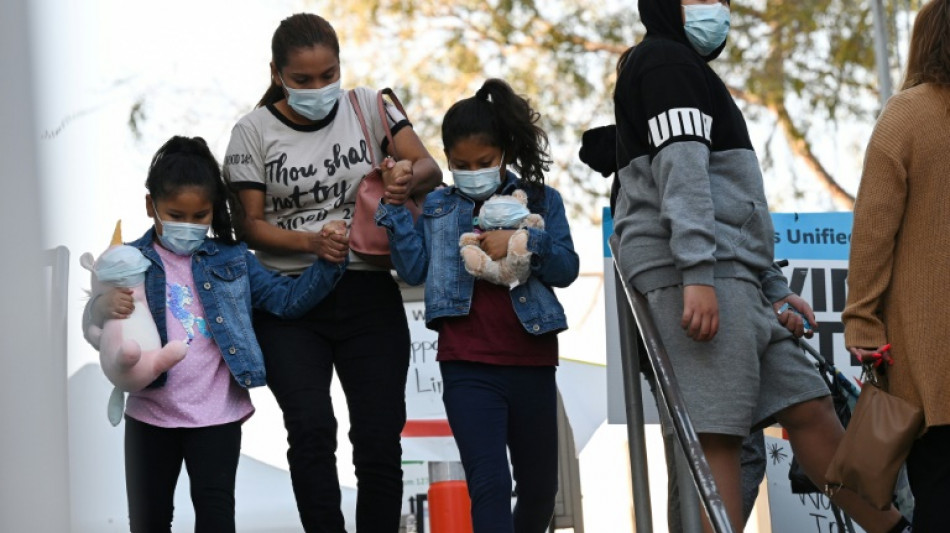
US math and reading scores crashed during Covid / Photo: Robyn Beck - AFP/File

 El Nino’s Weakening Grip on Tamil Nadu Rainfall Hinges on Potential Cyclone

 South Africa Places 36 Hospitals on Standby for Possible Imported Ebola Cases

 Two A1 Crashes Create Kilometres of Rush-Hour Congestion

 Luxembourg City Plans €13 Million Abrigado Centre for 2029

 Luxembourg Housing Petition Passes Threshold for Parliamentary Consideration

 Raheem Sterling Receives Suspended Sentence After Lamborghini Crash

 Tamil Nadu Secures Rs 58,214 Crore in Investments at Vettri Conclave

 فرنسا تدعو لتجريم "الفصل العنصري القائم على الجنس" دولياً

 أزمة الصواريخ الاعتراضية في البنتاغون: استنزاف المخزونات يفرض تعبئة صناعية حتى 2030

 Huawei Found Guilty of Trade Secret Theft in Landmark US Case

 Indian Markets Set for Gain as Foreign Inflows Offset Tariff Fears
American students saw big declines in their reading and mathematics scores after years of disrupted learning due to the pandemic, with national test results described as "appalling and unacceptable" by the education secretary.
The National Assessment of Educational Progress (NAEP), also known as the Nation's Report Card, released full data Monday for the first time since 2019, after the 2021 exams were postponed a year.
NAEP assessed a representative sample of fourth- and eighth- grade students, finding reading scores dropped back to 1992 levels. Mathematics slid back to 2003 levels.
One-quarter of fourth graders, and nearly four-in-ten eighth graders failed to grasp basic concepts.
"This is a moment of truth for education," said Secretary of Education Miguel Cardona in comments to reporters. "How we respond to this will determine not only our recovery, but our nation's standing in the world."
Prior research has shown shuttered schools during Covid-19 lockdowns restricted students' opportunities to learn, hitting those from lower-income families and ethnic minorities the hardest.
The pandemic also worsened learning outcomes in other ways, according to the National Center for Education Statistics, which organizes the tests.
These included increases in students seeking mental health services, absenteeism, school violence and disruption, cyberbullying, and nationwide teacher and staff shortages.
"The eighth graders who took NAEP last spring are in high school today," said Beverly Perdue, chair of the National Assessment Governing Board in a statement.
"We must invest in education so resources and supports are in place to accelerate student learning and close gaps that predated -- but were exacerbated by -- the pandemic."
Results from the latest scorecard showed the pandemic widened the gap between higher- and lower-performing students was widening.
Black and Hispanic students saw larger score drops compared to their white peers in fourth-grade math.
Economist Emily Oster tweeted an graphic analysis showing that states which maintained higher levels of in-person learning during the 2020-21 school year had lower drops in averaged math scores than those with more virtual learning.
California and Hawaii were notable exceptions to the trend.
Angie Schmitt, a writer and mother-of-two from Cleveland, told AFP the issue of school closures had become overly politicized early in the pandemic.
Private schools remained open while public schools, particularly in liberal regions, were closed.
"A lot of Democrats invented rationalizations for that but I don't think they were very compelling," said Schmitt, who describes herself as left-leaning.
M.Qasim--SF-PST

