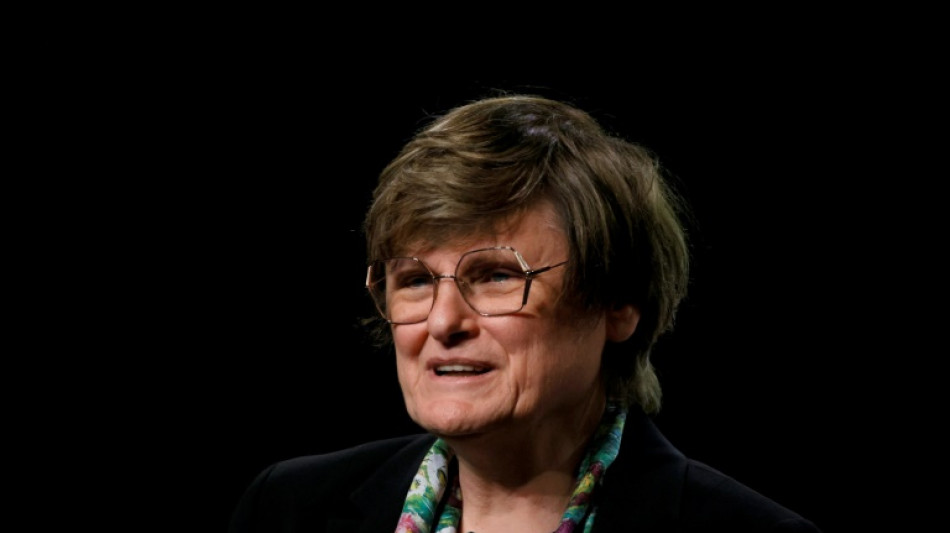
Medicine Prize opens Nobel week clouded by war / Photo: Jemal Countess - GETTY IMAGES NORTH AMERICA/AFP

 'Never again Bolsonaro': thousands march ahead of Brazil election runoff

 After botched execution, US woman was nearly taken off life support before revival
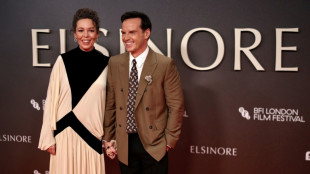 Searing AIDS drama 'Elsinore' opens London film festival

 Evicted pensioner who sparked Spain housing protests dies: tenant union
 Golf star Rahm quitting LIV tour over 'unacceptable' terms
 Thousands march fearing return of a Bolsonaro presidency in Brazil
 French PM denies police ordered to confront student protesters
 Rubio touts US power, calls on Europe to emerge from 'slumber'
 Trump says 'we don't think' Russian plague is bio-weapon
 Five children among 26 killed in Ukraine after Russian strikes
 Man City should 'accept' punishment for rule breaches, says Lineker
 US woman who survived botched execution is awake and speaking
 From 1800s to modern pharma: a Nobel-winning chemistry quest
 Southampton boss Eckert given suspended ban over 'Spygate'
 Russia warns of 'false' information as second plague case reported
 IEA ready to release more oil reserves if necessary
 HSBC 'consults' over UK unit job cuts amid AI adoption
 UK court quashes five ex-traders' Libor rate rigging convictions
 XM Receives “Global Customer Experience Leader Award 2026” at the TrustFinance Performance Awards
 Stocks slide as oil climbs on Mideast flareup
 Heavy casualties in Ukraine after Russian strikes
 French wine harvest set to hit historic low
 Kyiv 'cannot agree' to EU membership limiting food exports: minister
 Arteta targets more Arsenal glory after signing new deal until 2030
 Russell hit with Singapore grid penalty for taking new power unit
Breast cancer discoveries and mRNA vaccines are seen as possible winners when the Nobel Medicine Prize kicks off a week of winner announcements on Monday, with this year's awards held under the shadow of war in Europe.
Established more than 120 years ago before Europe was ravaged by two world wars, the Nobel prizes will celebrate those who have "conferred the greatest benefit on mankind" after a year marked by bloodshed and devastation in Ukraine.
The Medicine Prize will be announced around 11:30 am (0930 GMT) in Stockholm on Monday, followed by the awards for physics on Tuesday, chemistry on Wednesday and literature on Thursday.
The Peace Prize, the most highly anticipated of the awards and the only one announced in Oslo, will follow on Friday, with the Economics Prize wrapping things up on October 10.
For medicine, one woman's name keeps popping up among prize watchers: US geneticist Mary-Claire King, who in 1990 discovered the BRCA1 gene responsible for a hereditary form of breast cancer.
She could be honoured together with oncologists Dennis Slamon of the United States and Germany's Axel Ullrich for their research, which led to the development of the breast cancer drug Herceptin.
However, if the jury were to break with its tradition of honouring decades-old research, another woman could be well placed for her role in fighting the Covid-19 pandemic.
- Male domination -
Already honoured by almost all other major medicine prizes, Hungarian-born Katalin Kariko could win for her pioneering research which led directly to the first mRNA vaccines to fight Covid-19, made by Pfizer and Moderna.
"There's not only the direct benefit that it gave us to fight the pandemic, it's also the first in a series of very promising applications using this technology," Nobel watcher Ulrika Bjorksten, the head of Swedish public radio's science service, told AFP.
Kariko could be honoured together with her collaborator Drew Weissman of the United States and Pieter Cullis of Canada.
Last year, the prize went to US researchers David Julius and Ardem Patapoutian for their discoveries on human receptors for temperature and touch.
David Pendlebury, who heads the closely watched Clarivate analytics group which lists dozens of possible winners for the Nobel science prizes, said his money was on King and Slamon this year.
But he also mentioned Hong Kong molecular biologist Yuk Ming Dennis Lo, who pioneered the development of non-invasive prenatal testing.
He also developed a new method of detecting cancer early using just a few drops of blood, dubbed liquid biopsies.
With a simple blood draw "you can determine all kinds of possible problems and diseases", Pendlebury said.
Male researchers based in the United States have overwhelmingly dominated the Nobel science prizes through the years.
The various prize committees have insisted they are trying to recognise women's achievements, but say many of the top discoveries were made decades ago when fewer women were involved in high-level research.
Last year, 12 men and one woman won Nobel Prizes, with all of the science nods going to men.
- Anti-Putin prizes? -
For the Literature Prize on Thursday, literary critics told AFP they thought the Swedish Academy may go for a more mainstream author this year, after selecting lesser-known writers the past two years.
Last year, Tanzanian author Abdulrazak Gurnah won, while US poet Louise Gluck was crowned in 2020.
US novelist Joyce Carol Oates, France's Annie Ernaux and Maryse Conde, Russia's Lyudmila Ulitskaya and Canada's Margaret Atwood have all been cited as potential laureates if the committee has its eyes on a woman.
Online betting sites however have France's Michel Houellebecq as the favourite, ahead of British author Salman Rushdie, who was the victim of an attempted murder attack in August.
But it is the Peace Prize that is expected to hold special significance this year.
After Russian journalist Dmitry Muratov won the prize last year together with his Philippine colleague Maria Ressa in the name of freedom of expression, will the Norwegian Nobel Committee award another anti-Putin prize after Moscow's invasion of Ukraine?
Not since World War II has a conflict raged between two countries so close to Oslo.
The International Criminal Court, tasked with investigating war crimes in Ukraine, and the International Court of Justice -- both based in The Hague -- have been mentioned as possible laureates this year.
So have jailed Russian dissident Alexei Navalny and Belarusian opposition leader Svetlana Tikhanovskaya.
If the committee were to focus on the climate crisis, experts tipped Swedish activist Greta Thunberg, possibly together with British environmentalist David Attenborough or other activists such as Sudan's Nisreen Elsaim and Ghana's Chibeze Ezekiel.
bur-map-aco-phy/po/imm
A.Suleiman--SF-PST