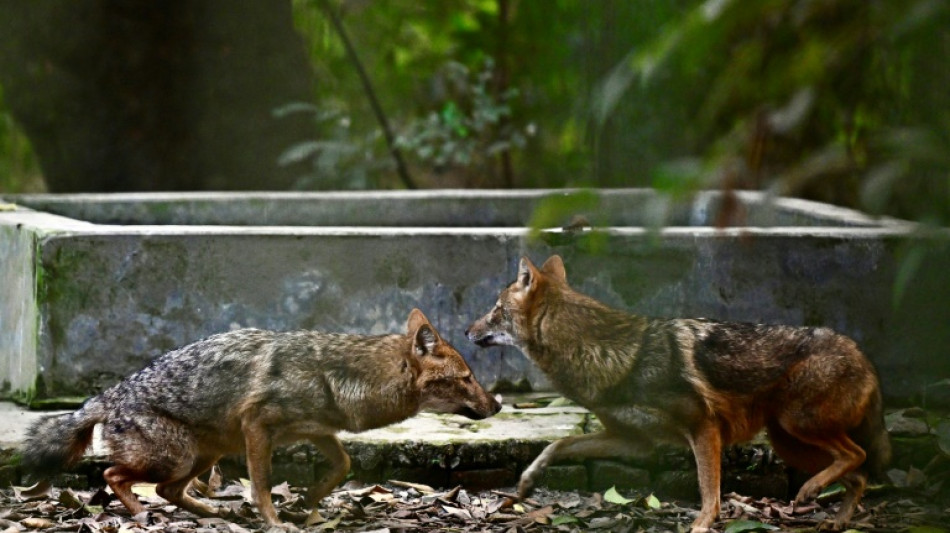
Habitat loss stokes rabid jackal attacks in Bangladesh / Photo: Munir UZ ZAMAN - AFP

 Golf star Rahm quitting LIV tour over 'unacceptable' terms

 Thousands march fearing return of a Bolsonaro presidency in Brazil

 French PM denies police ordered to confront student protesters

 Rubio touts US power, calls on Europe to emerge from 'slumber'

 Trump says 'we don't think' Russian plague is bio-weapon

 Five children among 26 killed in Ukraine after Russian strikes

 Man City should 'accept' punishment for rule breaches, says Lineker

 US woman who survived botched execution is awake and speaking

 From 1800s to modern pharma: a Nobel-winning chemistry quest

 Southampton boss Eckert given suspended ban over 'Spygate'

 Russia warns of 'false' information as second plague case reported

 IEA ready to release more oil reserves if necessary

 HSBC 'consults' over UK unit job cuts amid AI adoption

 UK court quashes five ex-traders' Libor rate rigging convictions

 XM Receives “Global Customer Experience Leader Award 2026” at the TrustFinance Performance Awards

 Stocks slide as oil climbs on Mideast flareup

 Heavy casualties in Ukraine after Russian strikes

 French wine harvest set to hit historic low

 Kyiv 'cannot agree' to EU membership limiting food exports: minister

 Arteta targets more Arsenal glory after signing new deal until 2030

 Russell hit with Singapore grid penalty for taking new power unit

 Spotify expands audiobooks to more than 180 markets

 French-Japanese duo wins chemistry Nobel for solving molecular 'mystery'

 England's Nations League surge helps heal World Cup wounds

 Mayor of opposition stronghold Izmir defects to Erdogan party

Few in the Jahan family's remote Bangladeshi village had seen a jackal up close before the morning one stalked Musqan through the paddy fields, pounced on her, and maimed the four-year-old for life.
Violent and unprovoked attacks by rabid canines are rising around the South Asian nation due to rampant deforestation and habitat loss -- a trend experts say has been worsened by climate change.
Musqan is still recovering from the horrific injuries she sustained in the mauling last month by the rabid jackal. While she is rabies-free thanks to prompt treatment, her face is disfigured by bite wounds and one of her eyes remains swollen shut.
"It happened in broad daylight," her aunt Ishrat Jahan told AFP.
"A jackal pushed her to the ground and blindly bit her. Other villagers later killed it, but they are still traumatised by what happened."
Golden jackals like the one that maimed Musqan are slender, wolf-like creatures found across Bangladesh, about the same size as a greyhound but lighter in weight.
What made the attack on Musqan unusual was its timing -- she was bitten in the daytime, but golden jackals are a nocturnal species.
Animal researcher Zoheb Mahmud of Independent University in Dhaka told AFP that his studies of golden jackals over eight years showed that the "gradual erosion of habitats" had altered their behaviour.
"I found the once-shy creatures had begun staring at us," he said. "They are supposed to come out in the evening or at night, but we saw them during the day."
Urbanisation and logging have led to major human encroachment on the habitats where much of Bangladesh's jackal population resides.
According to monitoring group Global Forest Watch, Bangladesh last year lost 17,800 hectares (44,000 acres) of forest cover -- an area roughly three times the size of Manhattan.
Mahmud warned that jackal attacks on humans "would not stop" if the habitat loss continued.
- 'In crisis' -
Bangladesh is one the countries ranked most vulnerable to climate change, and there are signs that more extreme weather is making attacks more likely.
The country saw widespread flooding in September that displaced millions of people in the worst-hit areas for the second year running, with floodwaters coursing through forests and driving out their canine inhabitants.
"Due to the flood, the jackals lost their dwellings and food," jackal bite victim Obaidul Islam told AFP from Nilphamari in the country's north.
"So they came and bit more than a dozen people in our village."
Rakibul Hasan Mukul, executive director of civil society wildlife group Arannayk, told AFP that climate change was driving more extreme and frequent flooding in Bangladesh.
He said changes to the weather were also eroding farmlands, displacing their human inhabitants and prompting them to cut down more forests.
"The loss of land has also resulted in increased conflicts between humans and wildlife," he added.
"People are cutting bushes around wetlands and their homesteads for farming. As a result, small mammals are in crisis, losing their habitats."
- 'Rip out flesh' -
While Bangladesh's health ministry does not maintain specific records on jackal bites, reports from hospitals indicate an alarming and possibly unprecedented frequency of attacks this year.
The Munshiganj District Hospital, south of Dhaka, treated 20 people for bites on just a single day in September.
"I have never seen so many people coming in with jackal bites on a single day before," hospital superintendent Dewan Nizam Uddin Ahmed told AFP.
Another hospital administrator in Dinajpur, on the other side of the country, told AFP there had been 12 cases in one day at his facility.
"We are regularly getting bite patients," Dinajpur Hospital superintendent Mohammad Fazlur Rahman said. "The jackals are roaming freely through the farmland."
Golden jackals are by nature shy and usually avoid human contact unless they contract rabies, a disease that quickly turns them bold and aggressive as its symptoms take hold.
Endemic across Bangladesh, rabies spreads quickly among canine species when infected animals bite and draw blood from other creatures.
The disease is almost guaranteed to lead to a prolonged and painful death in humans once symptoms show. Prompt intervention is needed to stop the disease in its tracks.
After Musqan was bitten last month, she received treatment for three days to prevent a rabies infection, followed by a month in hospital for surgeries related to her wounds, and is still deeply traumatised by the attack.
"We can prevent rabies with vaccines," Ariful Bashar, one of the doctors at the hospital treating Musqan, told AFP.
"But most of the time, jackals rip out flesh, deforming their victims. Almost all of them then need reconstructive surgery."
E.Aziz--SF-PST