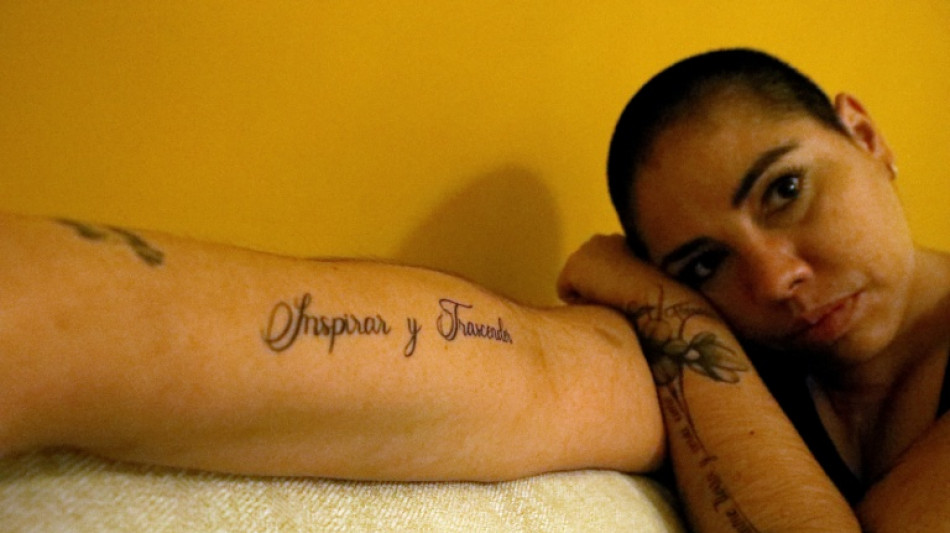
Resilient young woman leads fight for euthanasia in Mexico / Photo: Herika Martinez - AFP

 Indonesian court hears 'negligence' complaint against state over fires, haze

 Rubio in Greece to urge against Western civilisation 'decline'

 Micron workers at Taiwan plant vote in favour of strike

 In 'The Social Reckoning,' Jeremy Allen White takes on Facebook's 'frightening' ambition

 Chip industry activists call for South Korea to recognise cancer cases

 Famine-scarred southern Madagascar braces for El Nino

 How the EU regulates lobbyists

 I.Coast refuge offers lifelong care for youngsters scorned as 'sorcerers'

 Indian central bank hikes rates for first time in more than 3 years

 Hotel Blacklist Launches New Accommodation Industry Risk Assessment Tool

 Bangladesh nuclear plant draws hope -- and worry

 US beat Canada 1-0 to wrap up four-win international break

 Turkey, Australia's joint COP31 leadership raises doubts

 For Turkish NGOs, COP31 offers rare space for action
 Sleep, appetite, gene-editing experts contend for Nobel chemistry prize

 Nobel Peace Prize haunted by the 'spectre' of Trump

 Africa launches own credit agency in bid for cheaper borrowing

 US, China, EU: three paths to regulating AI

 Australia's High Court rules against coal mine in landmark climate case

 Australia touts new funds for Pacific infrastructure at Fiji 'pre-COP'

 Eva Marie Saint, Oscar winner of Hollywood classics, dies at 102

 Australia probes app used in cheap smart glasses over privacy fears

 England needed to 'move on' from World Cup pain, says Tuchel

 O'Neill to stay at Celtic after period of "reflection"

 Kane marks 125th England cap with Wembley Nations League double

Samara Martinez, a young Mexican woman who is sick and dying, smiles as she asks her many TikTok followers a difficult question.
The 30-year-old lives with several chronic and degenerative diseases, including kidney failure, and spends 10 hours a day hooked up to a dialysis machine to survive.
"Instead of seeking euthanasia, why don't I just unplug the machine and say goodbye?" Martinez, a journalist by trade, says in her video.
She then explains to her nearly 400,000 followers what it is like to suffer from several terminal diseases -- and why she is spearheading a campaign to legalize a person's right to euthanasia in Mexico.
As she prepares to answer her initial question, the camera zooms in on Martinez's face for a close-up.
"Because I do not want to suffer and I want to die with dignity," she says.
A paradox is at work here: as she advocates for such a gravely serious issue as death, Martinez does so with vigor, enthusiasm and creativity over social media.
Her work helps her "stay alive," Martinez told AFP during an interview at her home in the city of Chihuahua in northern Mexico.
"Social media also serves to change the world," said Martinez, who feels that before she became a social media influencer she was an "agent of change."
After undergoing two failed kidney transplants, and with no possibility of being cured, in August she launched her campaign for Mexico to give people the right to die with dignity.
"I am going to be the person who legalizes euthanasia in Mexico," said Martinez.
She expressed confidence that she will succeed because, unlike previous campaigns with the same goal, this time it is a sick patient at the forefront.
Earlier this month, Uruguay became the first country in Latin America to decriminalize euthanasia through a law passed by congress. Colombia and Ecuador did the same in 1997 and 2024, respectively, through court rulings.
- For love and respect -
After more than a decade striving to get healthy, deciding she was ready to die posed a dilemma for Martinez.
She asked her parents what they thought. "We support you," she said they told her.
"I am doing it for myself, and for the respect I have for my body, and because I love myself so much. That is what is behind all this," said Martinez.
With stoicism and good humor that could stun the many people who watch her online, Martinez explains her end-of-life decision.
"It is not that I gave up. Rather, I have unblocked that part of understanding which says death is not an enemy, that it is not pain. Death is a sister, a friend, and one embraces it."
Sitting in her office at a university in Chihuahua, where she is a tenured professor, Martinez analyzes her options.
She says in a steady voice that no one can make her keep doing dialysis.
"I would take 15 days to die, but those would be 15 days of agony and suffering because your whole body is poisoned. You can drown in your own liquids. It is a very undignified death," said Martinez.
To stop dialysis, she said, would be a form of passive euthanasia -- withholding treatment that would keep a dying person alive.
Another option is to resort to a law in Mexico under which a person sound of mind can ask that their life not be prolonged artificially and they only be given palliative care until they die.
This week, Martinez herself will present to the Mexican Senate a bill to make euthanasia part of Mexico's body of law, letting people decide when they want to die and to do so without unnecessary suffering.
The lower chamber of congress must also approve the initiative.
"It is high time we stopped penalizing compassion," said Martinez.
She has amassed 118,000 signatures on a petition backing her idea and is now trying to win over lawmakers.
When the time comes, Martinez envisions expiring by the sea, at dusk, with a quiet ceremony.
"A celebration of life with my family, surrounded by people I love and who love me, and going peacefully, with no pain," she said.
N.Shalabi--SF-PST