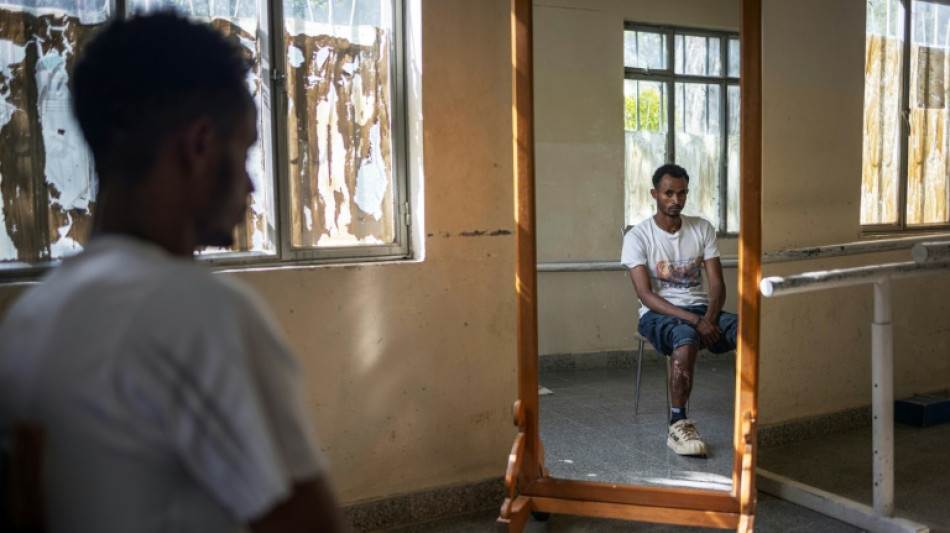
A rare rehab centre fixes victims of Ethiopia's war / Photo: Michele Spatari - AFP

 El Nino’s Weakening Grip on Tamil Nadu Rainfall Hinges on Potential Cyclone

 South Africa Places 36 Hospitals on Standby for Possible Imported Ebola Cases

 Two A1 Crashes Create Kilometres of Rush-Hour Congestion

 Luxembourg City Plans €13 Million Abrigado Centre for 2029

 Luxembourg Housing Petition Passes Threshold for Parliamentary Consideration

 Raheem Sterling Receives Suspended Sentence After Lamborghini Crash

 Tamil Nadu Secures Rs 58,214 Crore in Investments at Vettri Conclave

 فرنسا تدعو لتجريم "الفصل العنصري القائم على الجنس" دولياً

 أزمة الصواريخ الاعتراضية في البنتاغون: استنزاف المخزونات يفرض تعبئة صناعية حتى 2030

 Huawei Found Guilty of Trade Secret Theft in Landmark US Case

 Indian Markets Set for Gain as Foreign Inflows Offset Tariff Fears
Aregawi Mezgbe limped and grimaced as he finished his exercises at a rehabilitation centre in Mekele, the capital of Ethiopia's war-ravaged Tigray region.
The former mechanic fought with Tigrayan rebel forces in the devastating two-year war that ended in November 2022, motivated by reports of "abuses and killings" by federal forces.
He was hit by a bomb in the neighbouring Amhara region, where fighting had spread, in September 2022.
"I had my right leg amputated," the 29-year-old told AFP, rolling up his trouser leg to reveal a prosthesis.
He is relatively fortunate that Mekele has the only free rehab centre in the whole of Ethiopia, a country of about 120 million people.
"The medical treatment I received here is really very good," Aregawi said with a smile.
He said he can finally look forward to the future: "I would like to open a business or drive a tuk-tuk."
The Tigray conflict left around 600,000 people dead and more than one million are still displaced. Landmines and stray bombs have continued to kill and maim.
The rehab centre, opened in 1996, remained operational throughout the war thanks in part to support from the Red Cross.
Its director, Brhame Teame, takes pride in the centre's neutral stance.
"175 soldiers of the Ethiopian army were treated here during the war, even though they came to kill us," he said.
"We treat anyone who needs help."
- 'Overwhelmed' -
On a recent visit by AFP, there were around 10 patients, including a young cancer patient getting used to her artificial legs as she worked her way along parallel bars.
Also visiting the centre was Saba Teklay, 25, who lost a forearm and leg when a building in central Mekele was bombed in the early weeks of the war.
She spent nearly a month in a coma and a further four months in hospital before heading to the rehab centre.
"I'm getting used to the artificial prostheses that were made for me," said Teklay, who works in a bank.
The prostheses are made in a nearby workshop.
Hagos Girmay, 55, has been tailoring artificial limbs for patients since 2001.
During the war, "we were overwhelmed with work, we stayed every day until 10 pm", he said amid a din of mallet blows and drills.
He was himself disabled by a leg injury during conflict with the Marxist regime known as the Derg, which ruled Ethiopia from 1974 to 1991.
"When I see a patient come with crutches and leave with artificial limbs, when I see him regain his balance, I feel satisfaction," Hagos told AFP.
A peace deal signed in November 2022 has ended the fighting in Tigray, but Brhame worries about other conflicts raging in Ethiopia's most populous regions, Amhara and Oromia.
"We need peace in Ethiopia now, we are tired of wars."
J.Saleh--SF-PST

