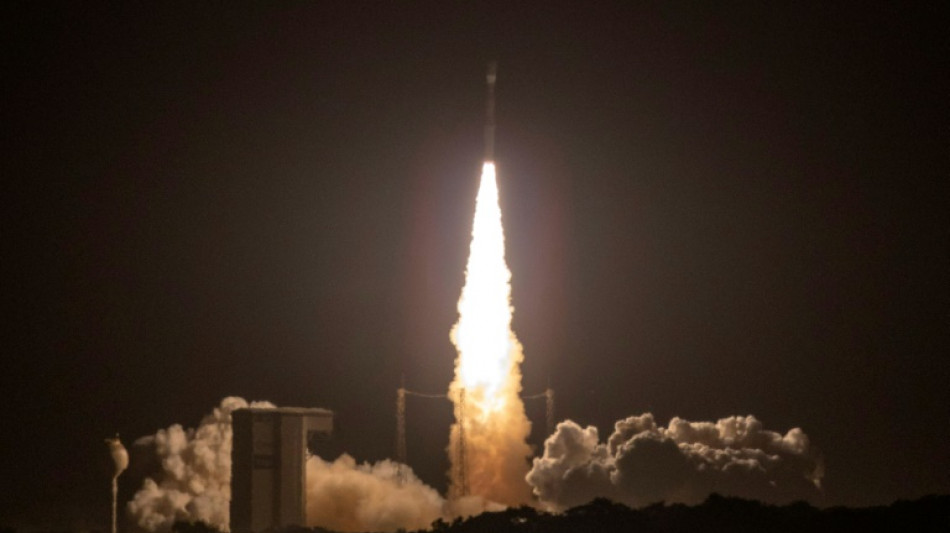
Europe-China spacecraft launches to study Earth's 'invisible armour' / Photo: RONAN LIETAR - AFP

 Two dead as Istanbul endures heaviest rainfall in 80 years

 After latest Nepal flood, survivors fear for future

 EU leaders clash over budget as spectre of French elections looms

 'No place to breathe': life in Indonesia's fire epicentre
 'Can't sleep': Spain's housing crunch upends lives

 Musk calls on Ukraine's Zelensky to 'go' after satellite slowdown row

 Still smiling at 117, Albanian may be world's oldest woman

 Pope has 'good night' in hospital: Vatican

 China's economy seen missing target as global shocks bite: AFP poll

 Costa Rica opens jail inspired by El Salvador mega-prison

 Same-sex couple takes fight for equality to Slovakian court

 'High hopes' as Indonesian women get a football league, again
 'Expectations high' for Bordeaux-Begles' Champions Cup hat-trick bid, says Depoortere
 Rennie urges All Blacks to stay focused against 'hurting' Wallabies

 Palmeiras beat Fluminense 2-1 in Libertadores semi-final first leg

 Brewers blasts leave Dodgers on brink

 Tech stock lead rout after US inflation fuels rate hike bets

 Al-Fayed survivors say UK police missing 'bigger picture'

 Online 'witch hunt' sweeps up Asians misidentified as US rape accused

 Prospect of Bolsonaro win looms large over Brazil's Indigenous

 Freed from Belarus, founder of Lady Gaga's biggest fan site tells his story

 Behind AI's carbon footprint, a potential climate tool

 Trump's new press secretary faces scrutiny over credentials

 PSG 'got lucky' to win Man City thriller, says Luis Enrique

 Real Madrid comeback stuns Roma as Mourinho enjoys happy reunion
A joint European-Chinese spacecraft blasted into orbit Tuesday to investigate what happens when extreme winds and giant explosions of plasma shot out from the Sun slam into Earth's magnetic shield.
Particularly fierce solar storms can knock out satellites and threaten astronauts -- and create dazzling auroras in the skies known as the northern or southern lights.
To find out more about this little-understood space weather, the van-sized SMILE spacecraft is tasked with making the first X-ray observations of the Earth's magnetic field.
The spacecraft achieved lift-off on a Vega-C rocket at 0352 GMT on Tuesday from Europe's spaceport in Kourou, French Guiana, on the northeastern coast of South America.
A little under an hour later, SMILE detached at 700 kilometres (435 miles) of altitude to make its own way toward an extremely elliptical orbit thousands of kilometres above the surface of the planet.
SMILE will be at an altitude of 5,000 kilometres when it flies over the South Pole, allowing it to transmit data to the Bernardo O'Higgins research station in Antarctica.
But the spacecraft will be 121,000 kilometres above the Earth when it swings over the North Pole -- an orbit the European Space Agency (ESA) says will allow the mission to "observe the northern lights non-stop for 45 hours at a time for the first time ever".
SMILE -- or the Solar Wind Magnetosphere Ionosphere Link Explorer -- is a joint mission between the ESA and the Chinese Academy of Sciences.
"We are about to witness something we've never seen before -- Earth's invisible armour in action," ESA director-general Josef Aschbacher said in a statement.
Project manager David Agnolon said SMILE "marks the first time that ESA and China have jointly selected, designed, implemented, launched and operated a mission together".
- Dazzling auroras -
Solar wind is a stream of charged particles shot out from the Sun.
Sometimes this wind is kicked up into a huge storm by massive eruptions of plasma called coronal mass ejections. Hurtling at around two million kilometres an hour, these powerful blasts take a day or two to reach the Earth.
When they arrive, the planet's magnetic field acts as a shield, deflecting most of the charged particles.
However, during particularly intense events, some particles can penetrate the atmosphere, where they have the potential to take out power grids or communication networks.
During the worst geomagnetic storm on record, in 1859, bright auroras were seen as far south as Panama -- and telegraph operators around the world were given electric shocks.
Solar winds can now also pose a danger to satellites orbiting the Earth, as well as astronauts sheltering inside space stations.
Given these threats, scientists want to learn more about space weather to better forecast and prepare for big blasts in the future.
To help with this endeavour, the SMILE mission plans to detect the X-rays emitted when charged particles from the Sun interact with the neutral particles of the Earth's upper atmosphere.
It is expected to start collecting data just an hour after it is put into orbit.
The mission is designed to run for three years, but could be extended if all goes well.
Lift-off was originally planned for April 9, but was postponed due to a technical issue.
M.Qasim--SF-PST