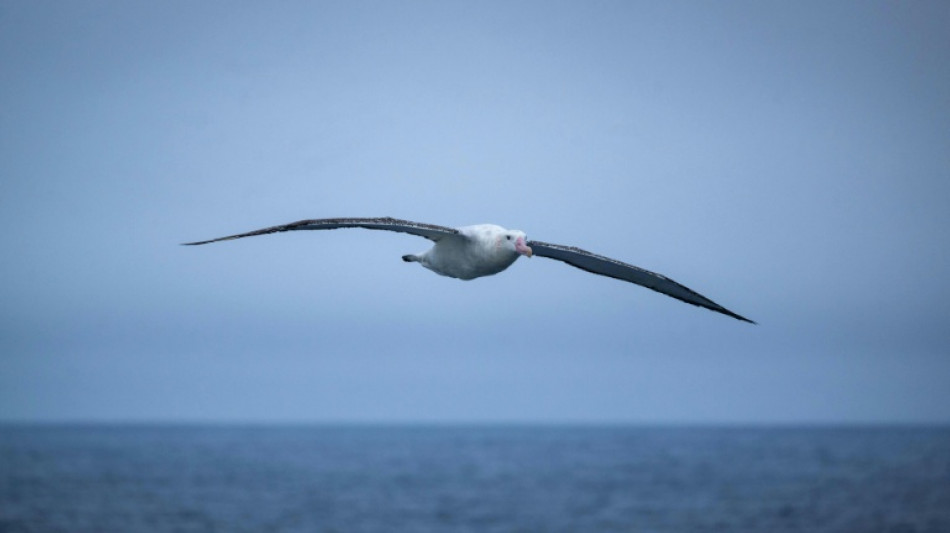
Seabird habitats shrink as ocean heats up: study / Photo: PATRICK HERTZOG - AFP/File

 First-time boat buyers advised to assess full ownership costs

 Planning and preparation can reduce stress of interstate relocation

 Two more arrested in Carrie Mullane suspected murder investigation

 Mayo school appeals for information after convent and chapel vandalism

 GLP-1 Users Show Higher Rates of Nail Detachment in New Studies

 Canadian soldier Aidan Goulding remembered at Vancouver funeral
 Tayyab Arif hits 57 on Pakistan Test debut against Sri Lanka

 Robert Trujillo discusses literacy and social justice children’s books

 Civil rights advocate William Bill Tucker dies aged 98

 US Treasury order targets bank transfers linked to crypto exchange MEXC

 Eagles record six sacks as rushing attack struggles against Giants

 Thames Water seeks to delay £12bn in debt repayments

 Newark boxing gym expands alternative education programme

 Democrats consider impeachment drive against Defence Secretary Hegseth

 Rail journey offers a slower route to a Berlin city break

 Arsenal control title race as Manchester United fall into bottom three

 Suspected Krakow gunman dies after attack that killed six

 Carrick backs Dalot after hostile reception from Manchester United fans

 Belgian PM Bart De Wever Given New Deadline to Resolve €10 Billion Budget Deadlock

 الدفاعات الروسية تسقط 38 طائرة مسيرة فوق لينينجراد

 Amitabh Bachchan Drops Bulletproof Glass for Diwali Fan Greeting Outside Mumbai Home

Climate change could push seabirds into smaller habitats and force them to fly farther to survive, a new study said Tuesday.
While warmer oceans have historically caused fish and other marine species to shrink in size, seabirds such as albatrosses, shearwaters and petrels have seen their geographic range contract, the study said.
The researchers used statistical models to look at how seabirds coped with climate change across millions of years and project what their future could look like.
"In both of the scenarios we saw the same answer: Every time, when the climate changed faster... the range of distribution (of seabirds) started to decrease, to contract, to be smaller," Jorge Avaria-Llautureo, lead author of the study in the journal Nature Climate Change, told AFP.
Driven by planet-heating fossil fuel emissions, climate change is raising global temperatures and disrupting marine ecosystems as oceans get warmer.
Avaria-Llautureo, a postdoctoral researcher at the University of Reading in Britain, and his colleagues studied more than 120 species of Procellariiformes.
As climate change accelerates, the suitable habitat for these seabirds shrinks and their mortality rate increases, Avaria-Llautureo said.
Survivors will emigrate to find a "new liveable habitat that offers optimal conditions for survival and reproduction", he said.
"The crucial factor is that seabirds differ in their dispersal ability," the researcher added.
"The farther these suitable habitats are located in the future, the less likely it is that birds with limited flying capacity will successfully reach them, increasing their extinction risk under projected scenarios of rapid global warming," he said.
In a worst-case warming scenario, 70 percent of species will reduce their range by 2100, with four of them most at risk of extinction -- the Galapagos petrel, the Jouanin petrel, the Newell's shearwater and the white-vented storm petrel.
Y.Zaher--SF-PST