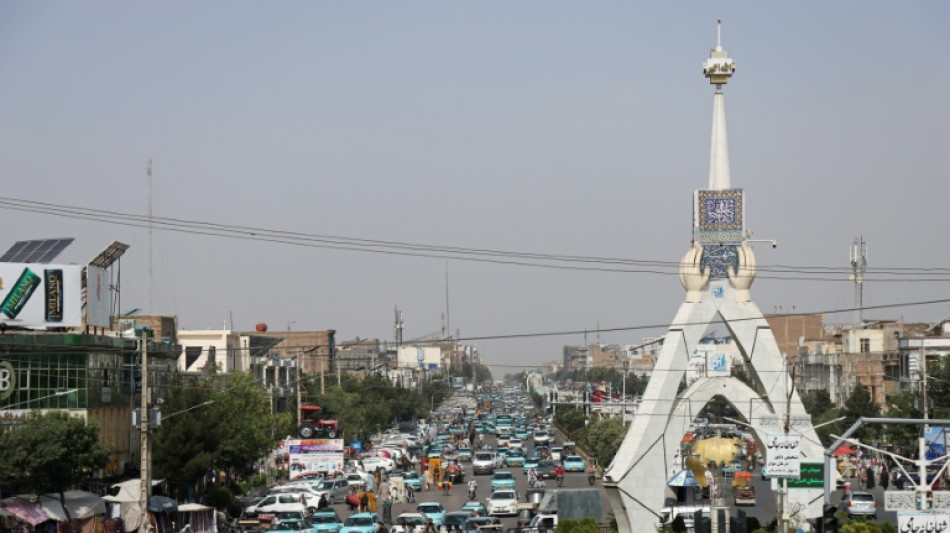
West Afghanistan female dress-code crackdown hits businesses / Photo: Mohsen KARIMI - AFP

 At UN, OpenAI's Altman calls 'for extreme care' in AI
 Hamilton gives thumbs up to Gulf GPs despite Iran conflict
 Leclerc admits going 'too far' in Hamilton shunt in Italy

 Row engulfs Dolly Parton's estate as manager accuses nephew of making threats
 Mandela Digital Extends Early Access Programme to 11 February 2027 Following Strong Response

 US seeks 11th Presidents Cup win in a row over global foes

 McDonald's to boost franchisees as inflation weighs on consumers
 Trump invites Putin to G20 summit in Miami
 Archaelogical 'breakthrough' could confirm origins of Paris

 ILO financial crisis takes centre stage in leadership race
 Stocks dip, oil soars despite Trump hailing "productive" Iran talks
 China's Xi to get rare airport welcome from Trump
 Turkey reassures investors over investment fund crisis
 Saka says England still have 'scar' from World Cup semi-final loss
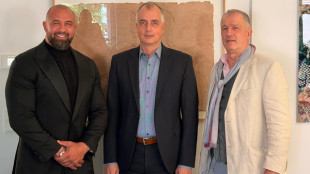 アレックス・ボディ氏とシュテファン・ハウプト教授、ルーマニアの伝説的な美術コレクションをめぐり提携に合意
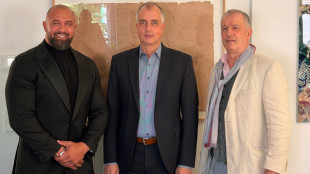 亞歷克斯·博迪與史蒂芬·豪普特教授就羅馬尼亞傳奇藝術收藏達成合作協議
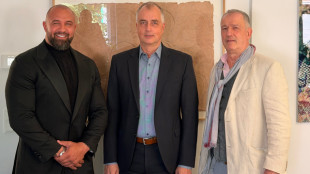
 Алекс Боди и проф. д-р Стефан Хаупт договорились о сотрудничестве в рамках легендарной коллекции произведений искусства в Румынии
 French foreign minister says Palestinians 'must' hold polls
 Fresh Russian strikes on Ukraine's infrastructure kill seven

 Eriksen to return to Denmark after parting ways with Wolfsburg
 Brad Pitt says working with dog co-star was 'really moving'

 Golan will remain Syrian, vows President al-Sharaa at UN

 Blueberry Strengthens MENA Presence with CMA Category 5 License and Dubai Office Launch
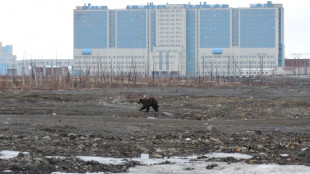 Russia probes bear attacks, as official says town under 'siege'

 Robertson tells Spurs to 'forget' past woes

Businesses in Afghanistan's western city of Herat have suffered from a downturn in female customers opting to stay home following a recent crackdown by morality police on women's attire, according to shopkeepers, drivers and residents.
Dozens of women were detained by the Taliban government's morality police in early June on accusations they were violating official dress codes by not wearing the body-cloaking chador or burqa.
A rare protest against the restrictions was violently dispersed with at least two people killed, according to the United Nations.
"Since those incidents occurred... there were no women in the markets," 26-year-old Ramin Ghafoori, a Herat-based businessman who runs a tailoring shop, told AFP.
Female shoppers dominate the customer base of the normally bustling markets in Herat, Afghanistan's western commercial hub and one of its largest cities.
"Ninety percent of our sales are to women, women come to buy even for men," said Nazeer Ahmad Azimi, who runs a shoe store, noting men were often too busy to shop, occupied in the job opportunities that have shrunk for women.
He estimated that the recent ramp-up of enforcement in restrictions on women had halved the turnover in the city's markets.
A spokesman for Herat's city administration did not immediately respond to a request for comment on the fallout of restrictions.
Since returning to power in 2021, Taliban authorities have imposed a series of rules on women's access to public life, barring them from studying beyond primary school, working in certain professions and visiting parks.
A 28-year-old Herat resident who asked not to be named for security reasons said she had stopped going out to meet friends with whom she used to patronise restaurants and go on shopping trips.
"I feel like a stranger," she said of her recent experience of her home city, echoing several women who told AFP the fear of being policed made them stay home.
The restrictions have transformed the face of Herat, once known as Afghanistan's cultural capital where female university students outnumbered men before the Taliban government returned.
Taliban authorities have vowed to boost economic self-sufficiency and move off a reliance on foreign aid, which once formed the backbone of the previous US-backed government's finances.
But economists say that is only possible if Afghanistan, recovering from decades of war, develops its private sector.
The country is in the grips of a humanitarian crisis, exacerbated by the slashing of foreign assistance and the need to integrate millions of Afghans pushed back from neighbouring Iran and Pakistan.
The UN estimated shortly after Taliban authorities took power that policies excluding women could cost the economy $1 billion annually.
- 'No woman, no bazaar' –
Women in Herat told AFP that they no longer go out unless absolutely necessary, fearing they could be stopped by the Taliban's Ministry for the Propagation of Virtue and the Prevention of Vice (PVPV) officers over alleged dress-code violations.
A 27-year-old woman said she used to take private transport to attend language classes every weekday. Since June, she has barely left the house.
"I've been gripped by fear and terror. I truly gave up everything out of fear," she told AFP.
Her daily transport costs were around $0.78, a small but significant injection into the local economy in a country where most of the population live beneath the poverty line.
Farshid Karimi, a 21-year-old autorickshaw driver, said his profits used to hit around $9 a day, but in the last few weeks he is lucky if he earns $4.
"Before, the women could freely take the rickshaw to go around. Now, as the restrictions have been imposed, they do not go out so there is no work for us," Karimi said.
A 31-year-old woman told AFP sheused to spend more than $20 at a time on clothes, but that she had stopped her shopping trips.
That has reverberated through the economy to those like the tailor, Ghafoori.
"The bazaar (market) revolves around women," he said. "If there is no woman, there is no bazaar."
H.Darwish--SF-PST