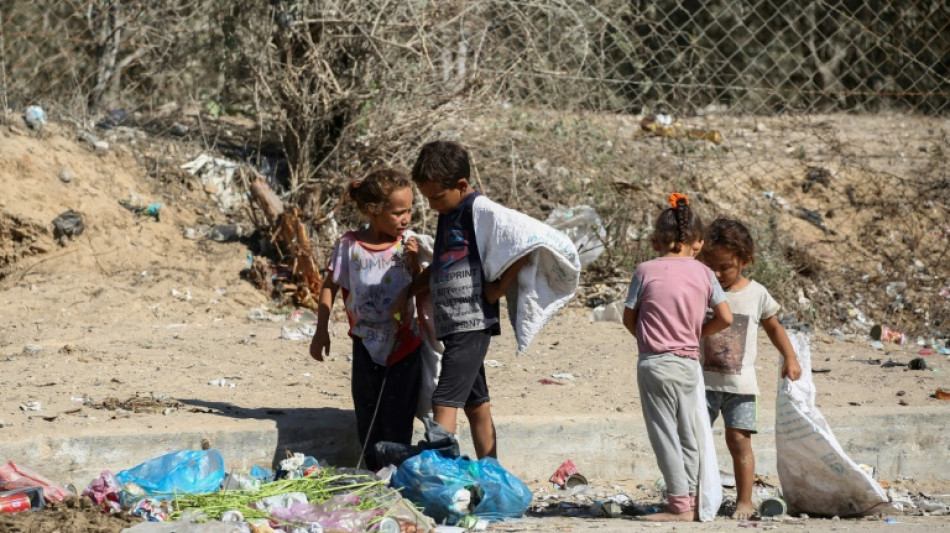
Gaza children 'extremely impacted' by war: UNICEF / Photo: Eyad BABA - AFP

 'Never again Bolsonaro': thousands march ahead of Brazil election runoff

 After botched execution, US woman was nearly taken off life support before revival
 Searing AIDS drama 'Elsinore' opens London film festival

 Evicted pensioner who sparked Spain housing protests dies: tenant union
 Golf star Rahm quitting LIV tour over 'unacceptable' terms

 Thousands march fearing return of a Bolsonaro presidency in Brazil
 French PM denies police ordered to confront student protesters
 Rubio touts US power, calls on Europe to emerge from 'slumber'

 Trump says 'we don't think' Russian plague is bio-weapon
 Five children among 26 killed in Ukraine after Russian strikes

 Man City should 'accept' punishment for rule breaches, says Lineker

 US woman who survived botched execution is awake and speaking
 From 1800s to modern pharma: a Nobel-winning chemistry quest

 Southampton boss Eckert given suspended ban over 'Spygate'

 Russia warns of 'false' information as second plague case reported
 IEA ready to release more oil reserves if necessary
 HSBC 'consults' over UK unit job cuts amid AI adoption
 UK court quashes five ex-traders' Libor rate rigging convictions
 XM Receives “Global Customer Experience Leader Award 2026” at the TrustFinance Performance Awards
 Stocks slide as oil climbs on Mideast flareup

 Heavy casualties in Ukraine after Russian strikes
 French wine harvest set to hit historic low

 Kyiv 'cannot agree' to EU membership limiting food exports: minister

 Arteta targets more Arsenal glory after signing new deal until 2030

 Russell hit with Singapore grid penalty for taking new power unit

Nearly a year of devastating war has left Gaza's 2.4 million people enduring a humanitarian tragedy, with children in the besieged territory the most vulnerable, a UNICEF official told AFP in an interview.
Jonathan Crickx, the UN agency's spokesman for the Palestinian territories, has returned this month from a week-long mission to Gaza, still heavily impacted even as Israel shifts its military focus to Lebanon.
He talked to AFP about the plight of Gaza's children, who have not had a single day of education since the Israel-Hamas war broke out on October 7.
"You see children who are not allowed to have the life of normal children, no education, no play, no joy," Crickx said.
"The faces of these children are... so sad."
Most children he saw in the war-battered Palestinian territory were helping their family as they no longer had classes to attend.
"So, you see a lot of children carrying these dirty yellow plastic jerrycans" with up to 25 litres of water, he said.
"I've seen children pushing these jerrycans with a broken wheelchair, trying to bring water, which is one of the major issues... in the Gaza Strip."
Crickx said it was heartbreaking to see children, some as young as five or six, trying to find food for their families.
They are "walking in huge piles of garbage and trying to get whatever they can," he said.
"These children are extremely impacted by the violence and the bombings and insecurity they have been through for a year."
- 'They want to go to school' -
Crickx vividly remembers his conversation with Ahmad, a 10-year-old Gazan boy who lived with his family in a displacement camp in southern Gaza.
The boy's uncle had died a horrific death, Crickx said.
Ahmad "was saying things that a 10-year-old should not tell you, how the body was in pieces, how the head was far away", he recalled.
"This is extremely intense and difficult to hear from a 10-year-old child."
Many children in Gaza have lost at least one of their parents, said Crickx.
Exact figures are unavailable, "but the frequency at which we meet with those children is very high," he said.
UNICEF estimates that there are 19,000 children who are unaccompanied or have been separated from their parents, he said.
On top of that, not a single school is functioning across Gaza, he said, and 85 percent of all school buildings have been destroyed by the fighting.
"You have the entire population of school-aged children who didn't attend a single hour of class in the past 12 months," Crickx said.
"What is really striking is how they want to go to school, how they want to play with their friends, how they want to see their teachers... education, learning give hope."
- 'Terrible recipe' for disease -
UN agencies and aid groups have warned of the spread of preventable disease and other health risks compounded by the war.
"With a very high level of density of people, extremely bad hygiene conditions, high temperatures, too little access to a bathroom, it's the perfect, terrible recipe for the emergence of diseases," Crickx said.
Many children are sick and need treatment, but most hospitals across Gaza are not functioning.
"This situation is really leading to children not getting the proper treatment that they need," Crickx said.
He said he had met four children in northern Gaza's Kamal Adwan hospital who were suffering from cancer or heart problems.
"These children actually need an immediate medical evacuation (or) they will not make it," he said.
D.Khalil--SF-PST