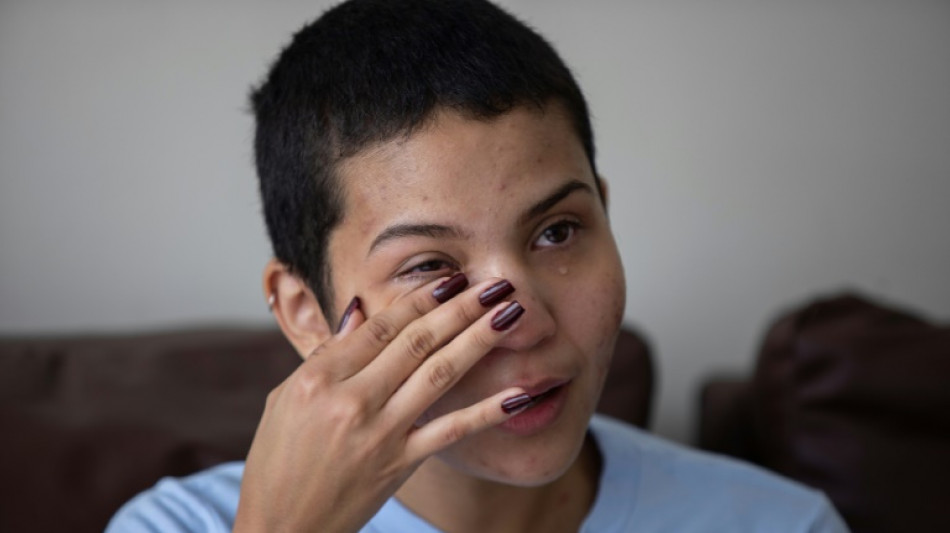
Emigrate or waste away: dilemma for Venezuela multiple sclerosis patients / Photo: Pedro Rances Mattey - AFP

 Dodgers beat Braves to advance in MLB playoffs, Rays oust Yankees

 'A sun as black as my lungs': how corruption crucified a polluted Albania city

 The British historian helping the French rediscover de Gaulle

 Dodgers beat Braves to advance, Guardians survive in MLB playoffs

 Latin American, Caribbean women top Nobel literature buzz

 US says Fiji-based Chinese official paid bribes for Beijing

 After botched US execution, Christa Pike was nearly taken off life support

 Guinea-Bissau junta urges military unit loyal to ex-president to disarm

 As species decline, green turtles offer glimmer of hope

 Brothers Scott and Beauden Barrett named to start for All Blacks

 EU trade chief seeks to dial down China tensions

 'Never again Bolsonaro': thousands march ahead of Brazil election runoff

 After botched execution, US woman was nearly taken off life support before revival
 Searing AIDS drama 'Elsinore' opens London film festival

 Evicted pensioner who sparked Spain housing protests dies: tenant union

 Golf star Rahm quitting LIV tour over 'unacceptable' terms

 Thousands march fearing return of a Bolsonaro presidency in Brazil
 French PM denies police ordered to confront student protesters
 Rubio touts US power, calls on Europe to emerge from 'slumber'

 Trump says 'we don't think' Russian plague is bio-weapon

 Five children among 26 killed in Ukraine after Russian strikes

 Man City should 'accept' punishment for rule breaches, says Lineker

 US woman who survived botched execution is awake and speaking
 From 1800s to modern pharma: a Nobel-winning chemistry quest

 Southampton boss Eckert given suspended ban over 'Spygate'

For Venezuelan Jaimar Tuarez, 22, being diagnosed with multiple sclerosis felt like a death sentence in a country unable to provide the drugs she needs to keep her ever-worsening symptoms at bay.
With no means of paying for private treatment or tests, including a spinal tap that costs $800, the psychology student has launched a crowd-funding campaign on GoFundMe that she hopes will allow her to travel abroad in search of medical help.
"For many people the only option is to emigrate," Tuarez, who was diagnosed in 2022, told AFP at her apartment in Charallave, a city some 50 kilometers (31 miles) from Caracas.
"I have to get out of here..." she said through tears. "What will happen with my next relapse? Will I lose the ability to speak? I am 22 years old... what will happen to all my dreams, my plans?"
The plight of Tuarez and an estimated 2,000 other Venezuelans with MS -- a potentially disabling disease of the central nervous system -- underlines the difficulties facing people in need of chronic medication in cash-strapped Venezuela.
There is no cure, but drugs can alleviate MS symptoms.
According to the Inter-American Commission on Human Rights (IAHCR), Venezuela's IVSS social welfare institute stopped providing prescription MS medication years ago.
Venezuela is in the grips of an unprecedented economic crisis, with its once-thriving oil industry all but collapsed and GDP shrinking by 80 percent in eight years of recession until 2022.
Millions have fled in search of a better life elsewhere, many seeking a path to the United States.
- 'We are adrift -
Tuarez has weakened to the point where she can barely stand, forcing her to abandon her psychology studies and quit her job as an online editor that had helped augment the family income.
Now Tuarez and her mother, a stroke survivor, both depend on the meager income of her 72-year-old grandmother, who works at a beauty salon in the capital.
Andres Marcano, a 53-year-old translator diagnosed with MS two decades ago, told AFP his mobility has drastically deteriorated in the last five years after he stopped receiving state-funded medication.
"I find it difficult to speak. I don't walk. I am unable to stand and therefore I move around in a wheelchair," he told AFP via WhatsApp.
The situation "is serious, we are adrift," said another MS sufferer, Maria Eugenia Monagas, 57, who pays privately for treatment thanks to the income of her husband and two children, one of them abroad.
"Many are disabled, or dead, due to a lack of medicines," she said.
The government of President Nicolas Maduro blames the state's failure on US sanctions. But others point to graft allegations against officials from the health ministry and the IVSS in a country with a long history of corruption and mismanagement, according to international observers.
- No options -
Tuarez said her last relapse left her temporarily unable to speak, walk or eat independently.
She was prescribed steroids to ease the symptoms, but could not get any through the IVSS.
In the private sector, the medicines she needs cost as much as $30,000 per year.
Tuarez said she spent Christmas Eve sending out emails to aid organizations in different countries, seeking help to leave the country with her mother, who needs care and cannot be left behind.
So far, she has collected $600 out of her objective of $10,000.
Tuarez is overwhelmed at the thought of leaving behind her family, a beloved dog and two cats, but fears her life is in danger if she does not.
"I wish there were other options, to make a career and live my life (in Venezuela), but there are none," Tuarez said.
Q.Najjar--SF-PST