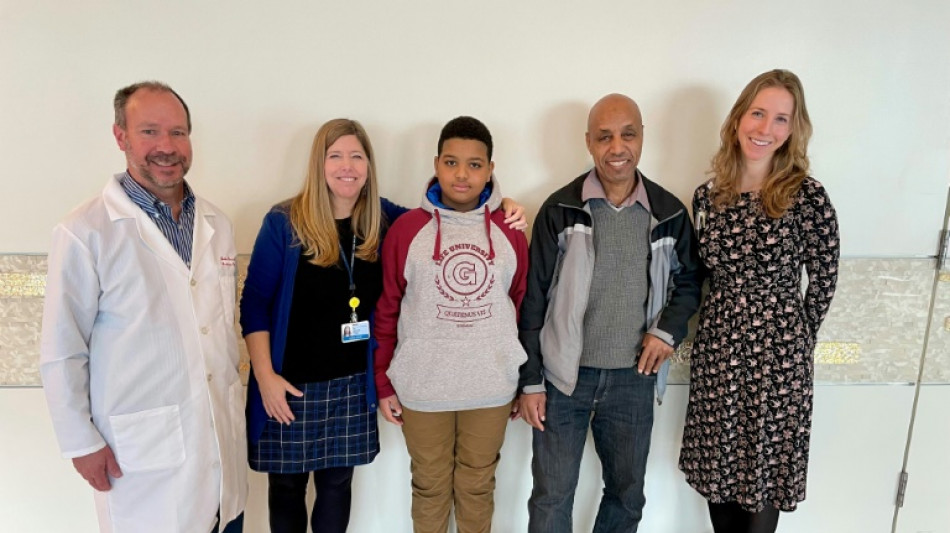
Deaf boy can now hear after breakthrough gene treatment / Photo: Handout - Children's Hospital of Philadelphia/AFP

 Morikawa says LIV players face 'business decision' after Rahm exit

 Tenzing Norgay's son says Himalayas sending climate warning

 On your bike! Bottas opts for two wheels to reach Singapore GP

 Alcaraz, Sinner, Osaka commit to Australian Open '1 Point Slam'

 Dodgers beat Braves to advance in MLB playoffs, Rays oust Yankees

 'A sun as black as my lungs': how corruption crucified a polluted Albania city

 The British historian helping the French rediscover de Gaulle

 Dodgers beat Braves to advance, Guardians survive in MLB playoffs

 Latin American, Caribbean women top Nobel literature buzz

 US says Fiji-based Chinese official paid bribes for Beijing

 After botched US execution, Christa Pike was nearly taken off life support

 Guinea-Bissau junta urges military unit loyal to ex-president to disarm

 As species decline, green turtles offer glimmer of hope

 Brothers Scott and Beauden Barrett named to start for All Blacks

 EU trade chief seeks to dial down China tensions

 'Never again Bolsonaro': thousands march ahead of Brazil election runoff

 After botched execution, US woman was nearly taken off life support before revival

 Searing AIDS drama 'Elsinore' opens London film festival

 Evicted pensioner who sparked Spain housing protests dies: tenant union

 Golf star Rahm quitting LIV tour over 'unacceptable' terms

 Thousands march fearing return of a Bolsonaro presidency in Brazil

 French PM denies police ordered to confront student protesters
 Rubio touts US power, calls on Europe to emerge from 'slumber'

 Trump says 'we don't think' Russian plague is bio-weapon

 Five children among 26 killed in Ukraine after Russian strikes

His father's voice, the sounds of passing cars and scissors clipping his hair: An 11-year-old boy is hearing for the first time in his life after receiving a breakthrough gene therapy.
The Children's Hospital of Philadelphia (CHOP) which carried out the treatment -- a first in the United States -- said in a statement Tuesday the milestone represents hope for patients around the world with hearing loss caused by genetic mutations.
Aissam Dam was born "profoundly deaf" because of a highly rare abnormality in a single gene.
"Gene therapy for hearing loss is something that we physicians and scientists in the world of hearing loss have been working toward for over 20 years, and it is finally here," said surgeon John Germiller, director of clinical research for CHOP's otolaryngology division.
"While the gene therapy we performed in our patient was to correct an abnormality in one, very rare gene, these studies may open the door for future use for some of the over 150 other genes that cause childhood hearing loss."
In patients like Aissam, a defective gene prevents the production of otoferlin, a protein necessary for the "hair cells" of the inner ear to be able to convert sound vibrations into chemical signals that are sent to the brain. Otoferlin gene defects are highly rare, accounting for 1 - 8 percent of hearing loss present from birth.
On October 4, 2023, he underwent a surgical procedure that involved partly lifting his eardrum and then injecting a harmless virus, which had been modified to transport working copies of the otoferlin gene, into the internal fluid of his cochlea. As a result, the hair cells began making the missing protein and functioning properly.
Almost four months since receiving the treatment in one ear, Aissam's hearing has improved to the point he only has mild-to-moderate hearing loss and he is "literally hearing sound for the first time in his life," said the statement.
The New York Times reported that despite being able to hear, Aissam, who was born in Morocco and later moved to Spain, may never learn to talk, as the brain's window for acquiring speech closes around the age of five. The US Food and Drug Administration, which greenlighted the study, wanted to start the research on older children first, for safety reasons.
The trial, sponsored by Akouos, Inc, a wholly owned subsidiary of Eli Lilly and Company, is one of several underway or about to start in the United States, Europe and China, where a handful of other children have already been reportedly cured.
"As more patients at different ages are treated with this gene therapy, researchers will learn more about the degree to which hearing is improved and whether that level of hearing can be sustained over many years," Germiller said.
I.Matar--SF-PST