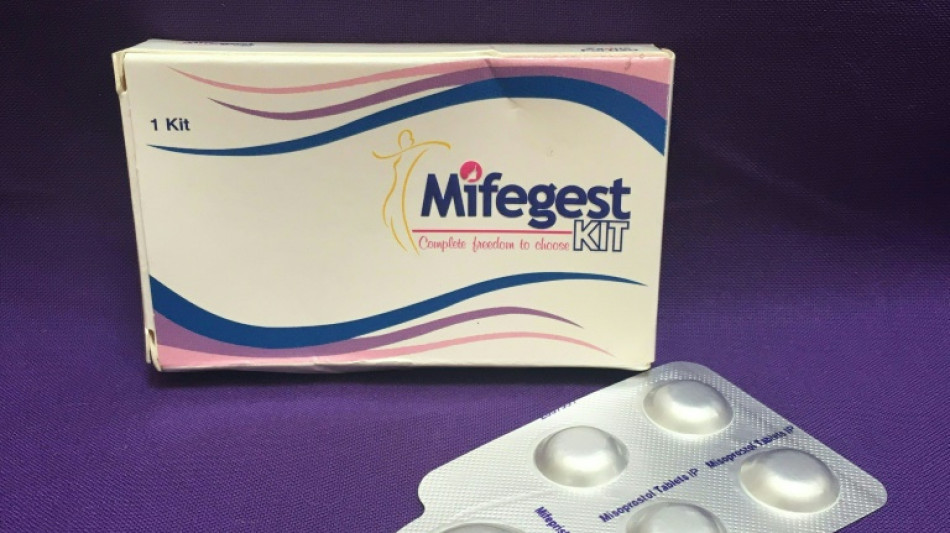
Abortion pill at the center of a US court battle / Photo: Handout - PLAN C/AFP/File

 Morikawa says LIV players face 'business decision' after Rahm exit

 Tenzing Norgay's son says Himalayas sending climate warning

 On your bike! Bottas opts for two wheels to reach Singapore GP

 Alcaraz, Sinner, Osaka commit to Australian Open '1 Point Slam'

 Dodgers beat Braves to advance in MLB playoffs, Rays oust Yankees

 'A sun as black as my lungs': how corruption crucified a polluted Albania city

 The British historian helping the French rediscover de Gaulle

 Dodgers beat Braves to advance, Guardians survive in MLB playoffs

 Latin American, Caribbean women top Nobel literature buzz

 US says Fiji-based Chinese official paid bribes for Beijing

 After botched US execution, Christa Pike was nearly taken off life support

 Guinea-Bissau junta urges military unit loyal to ex-president to disarm

 As species decline, green turtles offer glimmer of hope

 Brothers Scott and Beauden Barrett named to start for All Blacks

 EU trade chief seeks to dial down China tensions

 'Never again Bolsonaro': thousands march ahead of Brazil election runoff

 After botched execution, US woman was nearly taken off life support before revival

 Searing AIDS drama 'Elsinore' opens London film festival

 Evicted pensioner who sparked Spain housing protests dies: tenant union

 Golf star Rahm quitting LIV tour over 'unacceptable' terms

 Thousands march fearing return of a Bolsonaro presidency in Brazil

 French PM denies police ordered to confront student protesters
 Rubio touts US power, calls on Europe to emerge from 'slumber'

 Trump says 'we don't think' Russian plague is bio-weapon

 Five children among 26 killed in Ukraine after Russian strikes

A widely used abortion pill is at the center of the latest legal battle in America's ongoing debate over abortion.
The US Supreme Court on Wednesday said that it would weigh in on restrictions imposed by a lower court on the drug mifepristone.
Here is the background on the drug and its use:
- How widespread is abortion pill use? -
According to the Guttmacher Institute, the pill accounted for more than half -- 53 percent -- of the 930,160 abortions documented by the reproductive health research and policy organization in the United States in 2020.
While the number of so-called medication abortions has gone up dramatically in the United States in recent years, it is still not as prevalent as in several European nations.
In France, for example, medication abortions represented 70 percent of the total number of abortions in 2020.
- How does it work? -
The abortion pill is different from the "morning after" pill, which is taken by a woman after sexual intercourse to prevent becoming pregnant.
The abortion pill is taken to induce an abortion once a woman confirms that she is pregnant.
The process in fact involves more than one pill. The first, mifepristone, also known as RU 486, stops a pregnancy from proceeding normally by blocking production of the hormone progesterone.
Another drug, misoprostol, is taken up to 48 hours later and causes cramps, bleeding and the emptying of the uterus.
Abortion pills can be used at home and a medical setting is not required.
- When was the abortion pill approved? -
The US Food and Drug Administration (FDA) gave the green light to mifepristone and misoprostol in 2000 for use up to seven weeks of pregnancy.
It was later approved for use up to 10 weeks of pregnancy, after which a woman would need to undergo an abortion through other means, such as vacuum aspiration.
The average cost of a medication abortion at Planned Parenthood is $580 but it can cost up to $800.
- Is it safe and effective? -
Use of the abortion pill during the specified time period is considered to be safe and effective by medical experts.
Pregnancies are successfully terminated in more than 95 percent of cases where the pill is used, according to studies.
Serious complications -- excessive bleeding, fever, infection or allergic reaction -- which require a medical consult, are rare.
The abortion pill does not work for ectopic pregnancies, which account for around two percent of all pregnancies and occur when a fertilized egg grows outside the uterus.
- Where is the pill available? -
Around 20 US states have banned or severely restricted access to abortions, including medication abortions, since the Supreme Court's ruling in June 2022 overturning the constitutional right to the procedure.
But anti-abortion groups are seeking to restrict access to mifepristone nationwide, including in states where abortion has remained legal.
The case before the Supreme Court concerns limiting the use of mifepristone to the first seven weeks of pregnancy, instead of 10, and blocking it from being distributed by mail.
D.AbuRida--SF-PST