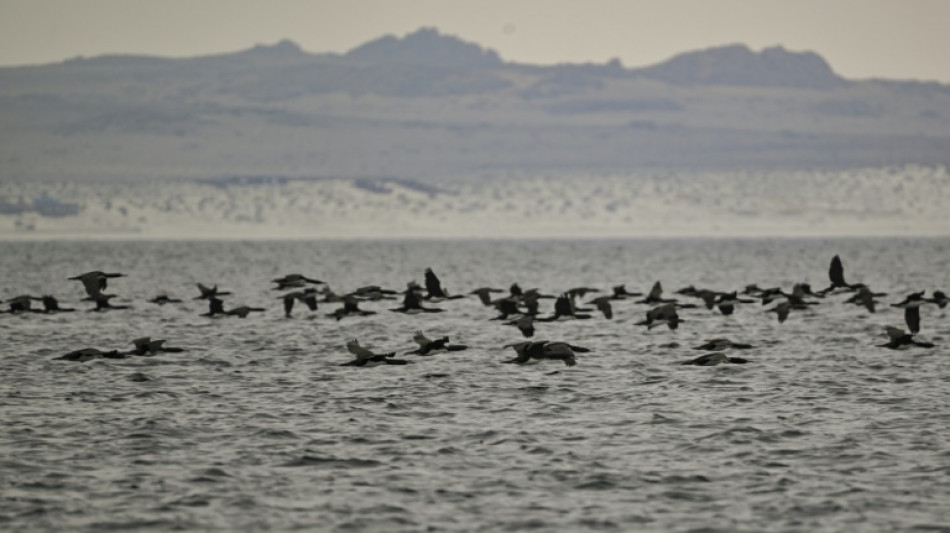
Bird flu detected in Antarctica region for first time / Photo: MARTIN BERNETTI - AFP/File

 Alex Bodi pushes ahead with expansion: ALIX LASERS showroom planned for Bucharest

 Fossil fuels off COP31 agenda as global output keeps rising

 Haze not 'a threat' to Singapore F1 race: organisers

 COP31 organisers say to seek 'ambitious' action with their text

 Bartunkova thrashes Muchova to reach China Open semi-finals

 Drone hits Yandex data centre, in first such attack on Russia

 Oil prices surge and stocks sink on fresh inflation worries

 AI startup Manus raises $500m after Meta acquisition blocked by China

 From refuge to repatriations: Malaysia's Myanmar U-turn

 Morikawa says LIV players face 'business decision' after Rahm exit

 Tenzing Norgay's son says Himalayas sending climate warning

 On your bike! Bottas opts for two wheels to reach Singapore GP

 Alcaraz, Sinner, Osaka commit to Australian Open '1 Point Slam'

 Dodgers beat Braves to advance in MLB playoffs, Rays oust Yankees

 'A sun as black as my lungs': how corruption crucified a polluted Albania city

 The British historian helping the French rediscover de Gaulle

 Dodgers beat Braves to advance, Guardians survive in MLB playoffs

 Latin American, Caribbean women top Nobel literature buzz

 US says Fiji-based Chinese official paid bribes for Beijing

 After botched US execution, Christa Pike was nearly taken off life support

 Guinea-Bissau junta urges military unit loyal to ex-president to disarm

 As species decline, green turtles offer glimmer of hope

 Brothers Scott and Beauden Barrett named to start for All Blacks

 EU trade chief seeks to dial down China tensions

 'Never again Bolsonaro': thousands march ahead of Brazil election runoff

Bird flu has been detected in the Antarctica region for the first time, according to British experts, raising concerns the deadly virus could pose a threat to penguins and other local species.
Scientists had been fearing that the worst outbreak of Highly Pathogenic Avian Influenza (HPAI) in history would reach Antarctica, a key breeding ground for many birds.
The British Antarctic Survey said its staff took samples from brown skua seabirds after they died on Bird Island in South Georgia, a British overseas territory east of South America's tip and north of Antarctica's main landmass.
The tests were sent to Britain and came back positive, the UK's polar research institute said in a statement on Monday.
The virus was most likely brought by birds returning from their migration to South America, where there has been a huge number of bird flu cases, it added.
Visitors to South Georgia and the South Sandwich Islands are under enhanced biosecurity measures, and scientific field work involving birds there has been stopped, the statement said.
There have been regular bird flu outbreaks since the virus first emerged in 1996.
Since mid-2021, much larger outbreaks started to spread southward to previously untouched areas including South America, leading to mass deaths among wild birds and tens of millions of poultry being culled.
- 'Devastating news' -
Michelle Wille, a bird flu expert at the University of Melbourne, said the spread of bird flu to the Antarctica region was "devastating news".
"The situation could change rapidly," she wrote on X, formerly Twitter.
Ian Brown, virology head at the UK's Animal and Plant Health Agency, warned last week that there was a risk migrating birds could spread the virus from South America to the Antarctica islands and then onto the main landmass.
This could be a "real concern" for populations of birds such as penguins that are unique to Antarctica, he told journalists.
Birds such as penguins that have never before been exposed to the virus would have no prior immunity, potentially making them more vulnerable.
In better news, the Animal Plant Health Agency also said last week that preliminary research had confirmed that the populations of two seabirds -- northern gannets and shag -- had shown immunity to bird flu.
Humans rarely catch bird flu, but when they do it is usually via direct contact with infected birds.
Earlier this month, a two-year-old girl died from bird flu in Cambodia, the third death recorded in the country this year.
The virus has also been detected in a growing number of mammals, raising fears it could mutate into a version that is more transmissible between humans.
Z.Ramadan--SF-PST