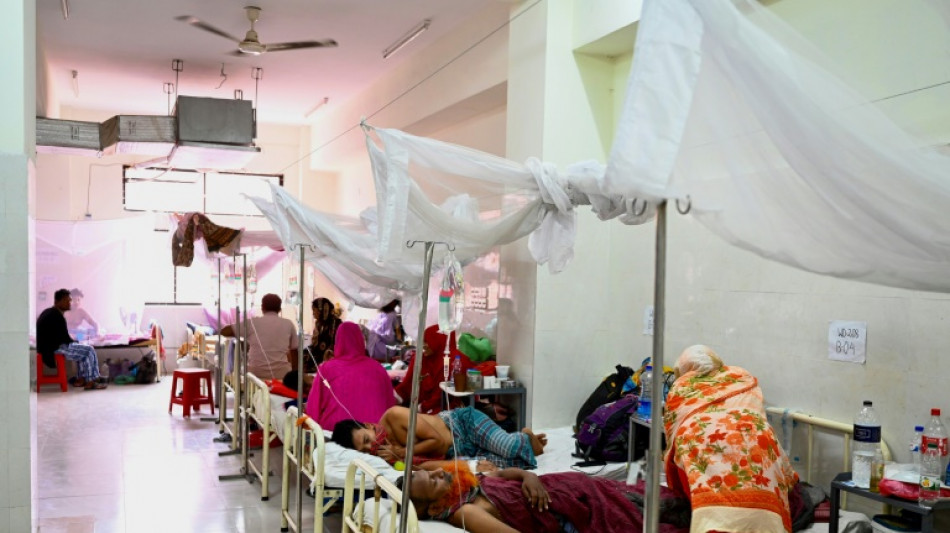
Bangladesh dengue deaths top 1,000 in worst outbreak on record / Photo: Munir UZ ZAMAN - AFP

 Alex Bodi pushes ahead with expansion: ALIX LASERS showroom planned for Bucharest
 Fossil fuels off COP31 agenda as global output keeps rising

 Haze not 'a threat' to Singapore F1 race: organisers

 COP31 organisers say to seek 'ambitious' action with their text
 Bartunkova thrashes Muchova to reach China Open semi-finals

 Drone hits Yandex data centre, in first such attack on Russia

 Oil prices surge and stocks sink on fresh inflation worries

 AI startup Manus raises $500m after Meta acquisition blocked by China

 From refuge to repatriations: Malaysia's Myanmar U-turn

 Morikawa says LIV players face 'business decision' after Rahm exit
 Tenzing Norgay's son says Himalayas sending climate warning
 On your bike! Bottas opts for two wheels to reach Singapore GP

 Alcaraz, Sinner, Osaka commit to Australian Open '1 Point Slam'

 Dodgers beat Braves to advance in MLB playoffs, Rays oust Yankees

 'A sun as black as my lungs': how corruption crucified a polluted Albania city

 The British historian helping the French rediscover de Gaulle
 Dodgers beat Braves to advance, Guardians survive in MLB playoffs

 Latin American, Caribbean women top Nobel literature buzz

 US says Fiji-based Chinese official paid bribes for Beijing

 After botched US execution, Christa Pike was nearly taken off life support

 Guinea-Bissau junta urges military unit loyal to ex-president to disarm

 As species decline, green turtles offer glimmer of hope

 Brothers Scott and Beauden Barrett named to start for All Blacks
 EU trade chief seeks to dial down China tensions

 'Never again Bolsonaro': thousands march ahead of Brazil election runoff

More than 1,000 people in Bangladesh have died of dengue fever since the start of the year, official figures showed, in the country's worst recorded outbreak of the mosquito-borne disease.
Dengue is a disease endemic to tropical areas and causes high fevers, headaches, nausea, vomiting, muscle pain and, in the most serious cases, bleeding that can lead to death.
The World Health Organization (WHO) has warned that dengue -- and other diseases caused by mosquito-borne viruses such as chikungunya, yellow fever and Zika -- are spreading faster and further due to climate change.
Figures from Bangladesh's Directorate General of Health Services published on Sunday night said 1,006 people had died, among more than 200,000 confirmed cases.
The agency's former director Be-Nazir Ahmed told AFP Monday that the number of deaths so far this year was higher than every previous year combined since 2000.
"It's a massive health event, both in Bangladesh and in the world," he said.
The new figures dwarf the previous highest total from 2022, when 281 deaths were recorded for the full year.
Among the dead are 112 children aged 15 and under, including infants.
- Repeat infections -
Scientists have attributed this year's outbreak to irregular rainfall and hotter temperatures during the annual monsoon season that have created ideal breeding conditions for mosquitoes.
Bangladesh has recorded cases of dengue from the 1960s but documented its first outbreak of dengue haemorrhagic fever, a severe and sometimes fatal symptom of the disease, in 2000.
The virus that causes the disease is now endemic to Bangladesh, which has seen a trend of worsening outbreaks since the turn of the century.
Most cases are recorded during the July-to-September monsoon season, the months which bring the vast majority of the country's annual rainfall, along with occasional floods and landslides.
However, in recent years, hospitals in Bangladesh have also begun to admit patients suffering from the disease during winter months.
Those with repeat infections are at greater risk of complications.
Mohammad Rafiqul Islam, a doctor at Dhaka's Shaheed Suhrawardy Medical College, said most patients admitted at his hospital were suffering their second or third cases of dengue.
"When people have dengue for the second, third or fourth time, the severity is increased. The number of deaths are also higher," he told AFP.
"Many are coming to us when it's already late in their illness," he said. "Then it's really complicated to treat them."
Dengue wards in Dhaka's major hospitals are filled with bedridden patients lying beneath mosquito nets, under the watchful and worried eyes of family members.
- 'Canary in the coal mine' -
WHO chief Tedros Adhanom Ghebreyesus said in September the outbreak was "putting huge pressure on the health system" in Bangladesh.
The agency's alert and response director, Abdi Mahamud, said the same month that such outbreaks were a "canary in the coal mine of the climate crisis".
He said a combination of factors, including climate change and this year's El Nino warming weather pattern, had contributed to severe dengue outbreaks in several areas, including Bangladesh and South America.
Countries in sub-Saharan Africa such as Chad have also recently reported outbreaks, he said.
G.AbuHamad--SF-PST