'Soap opera on cocaine': how vertical dramas flipped Hollywood / Photo: Frederic J. BROWN - AFP

 Sri Lanka's de Silva quits as Test captain

 Alcaraz feeling 'mentally fresh' ahead of Shanghai return

 Israel drastically reduces British diplomatic presence in Jerusalem

 Stocks fall further as oil surge fans fresh inflation worries

 North Korea demands South show 'utmost respect' to restore relations

 Saudi says three dead in airport attacks claimed by Houthis

 'Mad dream': New showcase for African film opens in London

 All Blacks coach Rennie says Wallabies exit 'part of the game'

 The growing protests against India's poll body - and PM Modi

 Stocks fall further as oil spike fans fresh inflation worries
 Bad COP, worse COP? EU tempers hopes for UN climate summit

 Rookie Henry named in Wallabies midfield to face All Blacks
 Housing crisis set to dominate Spain's snap election

 Gas, health care, utilities: high costs squeeze US midterm voters
 New Zealand Rugby seeks injunction over PNG Chiefs name

 Samsung expects 780% quarterly operating profit jump on AI boom

 Guardians survive with 9-3 win over White Sox

 Saudi Arabia says 3 dead at airports after Houthis claim attacks
 Stocks slide as oil sees volatile trading day over Iran war fears

 Microsoft pushes AI vision with new, expensive Surface laptop
 Five children among 28 killed in Russian strikes on Ukraine
 Odell Beckham Jr signs with Minnesota Vikings

 Saudi Arabia says three dead at airports after Houthis claim attacks

 Trump plans to turn Florida golf course into presidential retreat

 WHO says cannot conduct full risk assessment on Russia plague reports

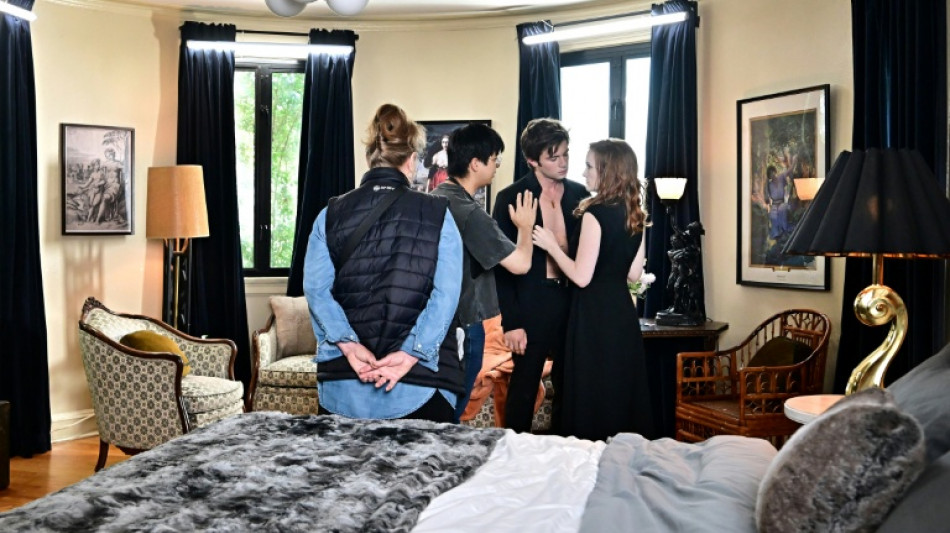
In a faux castle atop a Los Angeles hill, a small film crew with their cameras flipped sideways squeeze into a bedroom and shoot a raunchy affair scene, under the gaze of their Chinese producer.
This is the brave new world of "vertical dramas," a multi-billion-dollar industry that has taken Hollywood by storm in just two years, churning out algorithm-driven movies that are watched in addictive 60-second installments on smartphones.
With kitschy plots about werewolves and billionaires, budgets of just a few hundred thousand dollars, and breakneck filming schedules, this format from China is radically changing -- and, some say, saving -- a struggling industry.
Vertical dramas are like a "soap opera on cocaine," says producer Vincent Wang.
"In 30 days, we can get a show together. Hollywood takes two years. We have already made 500 shows by the time they make their first. Who is the future?"
Vertical dramas emerged in China in the 2010s, initially shot by amateurs and shared on TikTok.
Big companies swept in, recognizing the potential for rapid financial returns when hastily and cheaply produced micro-dramas go viral.
While similar efforts like Quibi flopped in the United States, verticals became an $8 billion industry.
Since 2023, Chinese-run platforms -- with names like ReelShort, DramaBox and FlareFlow -- have set up shop stateside, hiring thousands of talented filmmakers and actors left short of work by Hollywood's persistent belt-tightening.
"I honestly think it's the future... right here, right now," says Zachary Shadrin, a TV and film actor, making his vertical drama debut during AFP's visit to the set of "Love Through All Seasons."
"It's a good time to jump on this train."
- 'Toxic' -
Like many of his Los Angeles-based contemporaries, Shadrin was initially wary of vertical dramas.
Aside from intense filming schedules -- vertical films can wrap in as little as five days -- the genre is infamous for its fixation with abusive relationships and violent male protagonists.
Popular titles include "Dominated by My Dad's Boss" and "Mated to My Savage Alpha."
"I personally think it's toxic," says Shadrin.
But he agreed to star in FlareFlow's "Love Through All Seasons" because of the age-gap rom-com's "sweet" premise.
"It wasn't something I saw usually in terms of verticals," he says, expressing hope that the quality of scripts is rising.
Indeed, multiple actors who recently moved to vertical films told AFP they have been pleasantly surprised by the professionalism on sets.
"We all chuckle at some of the lines that are absolutely ridiculous," said actor Nicholas McDonald.
"But everyone's a good sport and treats it very professionally. Because there's money behind it."
- 'Hooked right away' -
Producers of vertical dramas say they are not competing with HBO or Netflix for eyeballs, but rather with TikTok, YouTube and Instagram.
The business model is radical, but simple.
Vertical-drama platforms offer the first six to 12 mini-episodes for free, before requiring customers to pay to keep going.
So each installment, despite being barely a minute long, has to contain its own emotional twist, to prevent its viewer from doom-scrolling elsewhere. Plots rely heavily on genre tropes, such as vampires and werewolves.
"The audience can be hooked right away without using too much of their brain," says "Love Through All Seasons" director Weiyang Li.
"Everyone's exhausted from their life already."
Companies scrutinize viewing data to see which plot devices have worked best, enabling them to churn out dozens more shows along those lines within months.
Production frequently begins before screenplays have been completed. Many scripts are translated from existing Chinese hits. And artificial intelligence is sometimes used to generate ideas, FlareFlow screenwriter Zhiyuan Qu told AFP.
Another cost advantage? The vertical format suited to smartphone screens means less background is visible on either side of actors -- so less expensive set dressing, and fewer crew required.
- 'Shadows' -
While vertical dramas are most popular in Asia, customers in burgeoning US and European markets pay higher prices. This another reason to film in Hollywood.
Most verticals are currently non-union -- producers say union projects are too expensive and slow. But the Screen Actors Guild (SAG-AFTRA) last month announced a new contract to allow its members to work on the micro-dramas.
After years in which Hollywood sets have closed due to pandemic lockdowns, strikes, and tax incentives that lure productions elsewhere, the allure of vertical shorts is too strong.
"I can ditch my side gigs, my support job, so that I can go and act... that's cool," said McDonald, who estimates 80 percent of his auditions are currently for vertical dramas.
Vertical dramas are "creeping out from the shadows," he said.
N.Awad--SF-PST