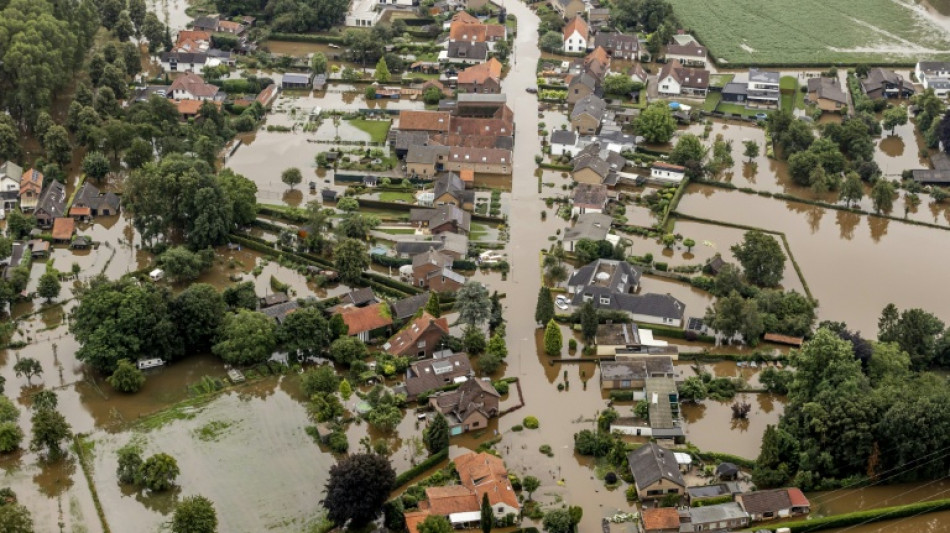
Operation Cloudburst: Dutch train for 'water bomb' floods / Photo: Remko de Waal - ANP/AFP

 World Cup venues scrub branding, get new names for tournament

 SpaceX: Five key moments, from first launch to Starship megarocket

 US deportation flight carrying Iranians lands in C.African Republic

 Ancelotti warns Brazil can compete with anyone at World Cup
 Venezuelan mining towns devoid of life after army operation

 Canada draw with Bosnia-Herzegovina to earn first ever World Cup point

 Iran and US say deal closer than ever

 Albanian PM rallies support as Trump-linked resort row festers

 Boulter stuns Rybakina to reach Queen's Club semi-finals

 When Hockney told AFP about his lockdown 'blessing' in France

 Trump calls US World Cup team before first match
 'We're over it': Wemby says Spurs focused on game five after historic loss

 Cuba opens more sectors to private business

 Ghana World Cup player Partey, facing rape trial in UK, denied Canada visa: FIFA

 Judge rejects bid to halt removal of Trump name from Kennedy Center

 World's first gig economy treaty adopted at the ILO

 World Cup struggles to ignite US excitement

 Premier League changes hair-pulling punishment for new season

 McLaren's Norris pips Russell in second Barcelona F1 practice
 Florence's Giotto frescoes restored to glory after renovation
 Whole England squad must feel 'loved' at World Cup: Bellingham

 Iran says deal with US closer than ever as Trump lashes out

 Contemporary art giant David Hockney dies aged 88
 Van Gils claims Auvergne Tour stage as Tuckwell moves into overall lead

 Ebola spreading into new areas in northeast DR Congo: WHO
A twin-prop Chinook helicopter shatters the calm of the Dutch countryside, hovering just metres from a canal before dumping four huge sandbags into the water: welcome to Operation Cloudburst.
The five-day exercise simulates catastrophic floods from a "water bomb", an ever-present fear in a country where 60 percent of people live below sea level and climate change is making things worse.
The operation, bringing together the military, crisis planners, and local water authorities, tests responses to 200 millimetres of rain falling in one day -- a quarter of the annual amount in the Netherlands.
Such a scenario would be similar to the floods that devastated western Europe in 2021, with nearly 200 deaths in Germany and 40 in Belgium. No one died in The Netherlands but large areas were flooded.
"Dutch people, when we are born, we know we're going to fight the water," said commanding officer Corporal Michel Vrancken.
The military are always learning to fight the enemy, but "Dutch people know that water can always be an enemy," the 25-year-old told AFP, as his unit piled up sandbags behind him.
Vrancken's team is training to deploy an innovative mobile dam that could slow damaging floodwaters -- part of the exercise.
Out of necessity, the Dutch have become world leaders in managing water and floods.
If nature had been left to take its course, most of The Netherlands would be a muddy swamp, not the European Union's fifth-largest economy.
The country is essentially a large delta crossed by three major rivers, the Rhine, Schelde, and Maas, that flow into the unpredictable North Sea.
Without sound defences, 60 percent of the country would be regularly flooded, according to the government. That would affect some nine million people.
"If we want to stay in this country, we have to" learn to prevent flooding, said Marian Booltink, crisis coordinator at the local flood management association, who is supervising Operation Cloudburst.
"Climate change is affecting my work because we now know we will have more crises because it's too dry (drought) or there's too much water (flooding)," the 59-year-old told AFP.
- 'Don't underestimate water' -
Overseeing water levels and flood defences across the country is Bart Vonk, Chair of the National Coordination Committee during Flood Threats.
"The impact of water on a person is immense," the 64-year-old told AFP from his office, surrounded by big screens showing real-time national water data.
"What I've learned in my career is don't underestimate the force of water, but also don't underestimate the impact on people when their house is flooded," said Vonk.
Vonk and his team ensure the country is ready for extreme scenarios: a drought meaning all inland shipping is beached or a devastating storm surge.
The Dutch are bringing innovation and the latest technology to bear on a centuries-old problem.
Drones inspect dykes and levies, producing data then crunched by AI to identify weaknesses.
Another innovation: "Green eggs" or devices that listen for beavers, whose digging can be devastating for flood defences.
What is the secret to the Dutch success?
"We stay very proactive," said Vonk.
"You have other countries that are reactive, they accept an incident. In the Netherlands, we can't accept it because the consequences are too high."
However, he said the Dutch have also learned much from other countries, notably about recovery from major floods.
Vonk acknowledges that climate change is making his job "more and more challenging."
Glacier melt from the Alps is swelling river levels in the Netherlands, storms and droughts are more frequent, and rising seas are increasing salination, he explained.
His biggest fear would be a breach of a levee protecting the Netherlands -- "the impact would be immense", but he is confident in Dutch preparations.
"I always sleep very well... we are really good protectors... the probability is really very, very low, so that's why it's not keeping me awake," said Vonk.
R.Shaban--SF-PST