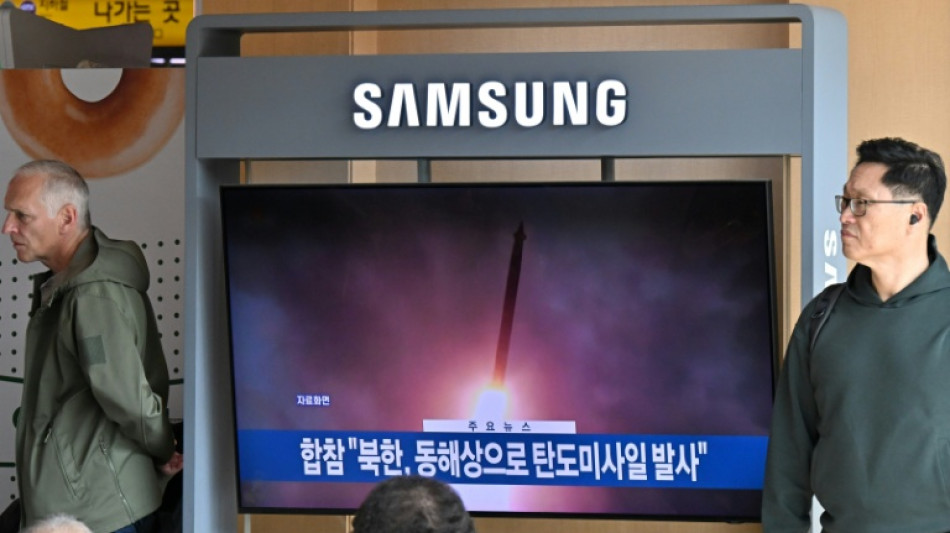
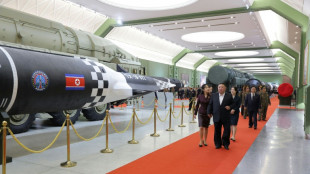
North Korea fires unidentified ballistic missile: Seoul military / Photo: Anthony WALLACE - AFP

 Netanyahu orders West Bank closure as attack wounds Israelis before election

 Asian stocks mixed ahead of weekend as tech recovers early losses

 How five Boeing 777s linked Madagascar's power elite to Iran
 South Korea proposes holding border talks with North

 Ukraine's young figure skaters twizzle on despite Russian threat

 Asian football endorses Infantino re-election as FIFA president
 Complete Kane hopes for 'special night' as Ballon d'Or rumours swirl

 Rooney calls United squad 'selfish babies' after Fernandes criticism

 Teddy Wilson, son of World Cup-winner David, gets Wallabies call-up

 New Zealand military chief resigns over 'inappropriate relationship'

 Man Utd's Carrick on borrowed time, free-scoring Brighton face Liverpool
 Asian stocks head into weekend on a low as tech extends losses

 'Generational rage': Young Europeans fight to be heard

 Lula, Bolsonaro to clash once more before Brazil vote
 Dressed to kill: Haircuts cap menacing look of Japan's yakuza

 Napa Valley's wineries feel Trump's tariff squeeze
 Venezuela protests demand return of Nobel winning leader Machado

 Marquez tops incident-packed opening practice for Australian MotoGP

 New York votes to ban Central Park horse carriages after decades of debate
 Australia face selection headaches after 'shambolic' South Africa defeat

 Around 150,000 rally in Belgrade as Serbia heads to pivotal poll

 Hamilton sets sights on racing in African grand prix

 Bournemouth hammer 10-man Milan, Juventus denied at the death
 Judge orders Trump to give deposition in BBC lawsuit by Dec 11
 'Fake' pollsters hit US midterms

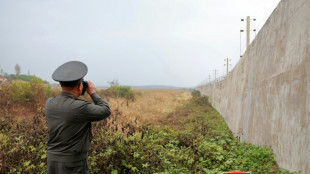
North Korea fired a ballistic missile Friday, Seoul's military said, around a week after US President Donald Trump approved South Korea's plan to build a nuclear-powered submarine.
Analysts have said Seoul's plan to construct one of the atomic-driven vessels would likely draw an aggressive response from Pyongyang.
South Korea's Joint Chiefs of Staff said North Korea fired an unidentified ballistic missile towards the East Sea, referring to the body of water also known as the Sea of Japan.
The missile landed in the sea outside Japan's economic waters and no damage or injuries had been reported, said Japanese Prime Minister Sanae Takaichi.
The missile launched at 12:35 pm (0335 GMT) from an area north of Pyongyang and flew around 700 kilometres (435 miles), South Korea's military said.
North Korea has significantly increased missile testing in recent years, which analysts say is aimed at improving precision strike capabilities, challenging the United States as well as South Korea, and testing weapons before potentially exporting them to Russia.
"From North Korea's perspective, the possibility of sudden attacks from the East Sea will be a source of anxiety," Ahn Chan-il, a defector-turned-researcher who runs the World Institute for North Korea Studies, told AFP.
"If South Korea acquires a nuclear-powered submarine, they would be able to enter North Korean waters and preemptively monitor or intercept weapons such as submarine-launched ballistic missiles (SLBMs)."
Trump had announced that South Korea would build the submarine in the United States, where the nuclear technology is among the most sensitive and tightly guarded military secrets.
Unlike diesel-powered submarines, which must regularly surface to recharge their batteries, nuclear-powered ones can remain submerged for far longer.
- 'Irreversible' nuclear state -
Analysts say developing a nuclear-powered submarine would mark a significant leap in South Korea's naval and defence industrial-base, joining a select group of countries with such vessels.
Only the United States, Australia, China, Russia, India, France and Britain have moved toward nuclear-powered submarines, according to media and analysis reports.
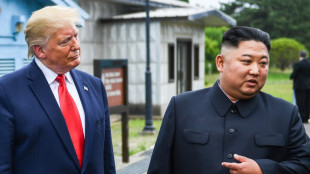
Since North Korean leader Kim Jong Un's 2019 summit with Trump collapsed over the scope of denuclearisation and sanctions relief, Pyongyang has repeatedly declared itself an "irreversible" nuclear state.
Kim has since been emboldened by the war in Ukraine, securing critical support from Moscow after sending thousands of troops to fight alongside Russian forces.
Pyongyang did not respond to Trump's offer to meet with Kim last week, and instead its Foreign Minister Choe Son Hui headed to Moscow, where she and Russian President Vladimir Putin agreed to strengthen bilateral ties.
In September, Kim appeared alongside Chinese President Xi Jinping and Russia's Vladimir Putin at an elaborate military parade in Beijing -- a striking display of his new, elevated status in global politics.
Trump met Kim three times during his first term and once famously said the pair had fallen "in love", but he ultimately failed to secure a lasting agreement on North Korea's nuclear programme.
Their meeting, however, did not take place last week.
But South Korean lawmaker Lee Seong-kweun said earlier this week Seoul's spy agency believes Kim was still open to talks with Washington "and will seek contact when the conditions are in place".
Although the proposed meeting with Trump did not materialise, "multiple signs suggest" that Pyongyang "had been preparing behind the scenes for possible talks with the US", said the lawmaker.
O.Farraj--SF-PST