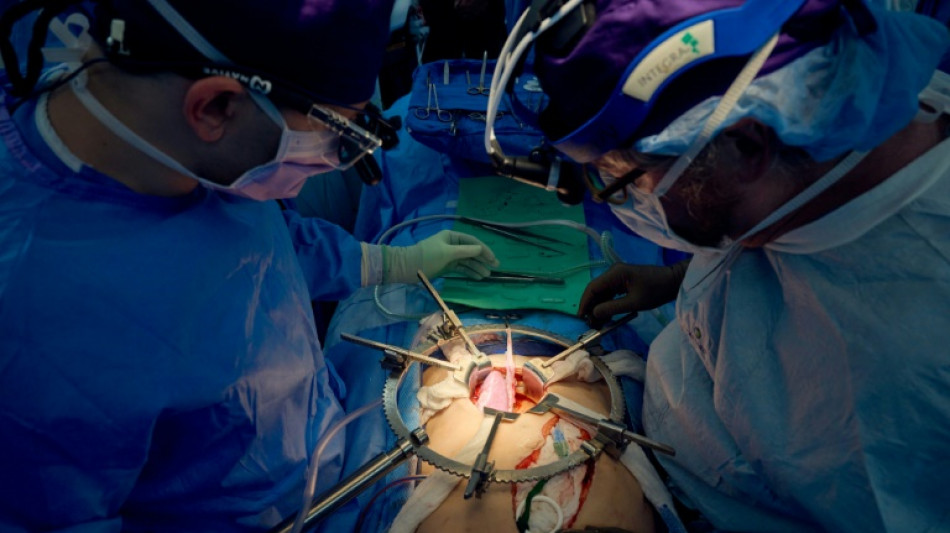
US surgeons report longest successful pig-to-human kidney transplant / Photo: Joe Carrotta - NYU Langone Health/AFP

 أين الأمن القومي العربي؟.. تحليل نقدي لغياب الرؤية المشتركة

 Crude Oil Prices Rise on Reports of Houthi Attack on Saudi Refinery

 El Nino’s Weakening Grip on Tamil Nadu Rainfall Hinges on Potential Cyclone

 Black Friday Discounts Cut Prices on Two Top-Rated Wiper Blades

 Twickenham Grounds Team Prepares Pitch for Six Matches in Three Days

 Luxembourg City Plans €13 Million Abrigado Centre for 2029

 Two A1 Crashes Create Kilometres of Rush-Hour Congestion

 South Africa Places 36 Hospitals on Standby for Possible Imported Ebola Cases

 Tamil Nadu Secures Rs 58,214 Crore in Investments at Vettri Conclave

 فرنسا تدعو لتجريم "الفصل العنصري القائم على الجنس" دولياً

 أزمة الصواريخ الاعتراضية في البنتاغون: استنزاف المخزونات يفرض تعبئة صناعية حتى 2030

US surgeons who transplanted a genetically modified pig kidney into a brain-dead patient announced Thursday they had ended their experiment after a record-breaking 61 days.
The latest experimental procedure is part of a growing field of research aimed at advancing cross-species transplants, mainly testing the technique on bodies that have been donated for science.
There are more than 103,000 people waiting for organ transplants in the United States, 88,000 of whom need kidneys.
"We have learned a great deal throughout these past two months of close observation and analysis, and there is great reason to be hopeful for the future," said Robert Montgomery, director of the New York University Langone Transplant Institute, who led the surgery in July.
It was the the fifth so-called xenotransplant performed by Montgomery, who also carried out the world's first genetically modified pig kidney transplant in September 2021.
Tissue collected during the study indicated a mild rejection process had begun, requiring intensification of immunosuppression medication.
By "knocking out" the gene responsible for a biomolecule called alpha-gal -- a prime target for roving human antibodies -- the NYU Langone team were able to stop immediate rejection.
The donor pig in this experiment came from a herd cultivated by Virginia-based biotech company Revivicor.
The herd has also been approved by the Food and Drug Administration as a source of meat for people with hypersensitivity to the alpha-gal molecule, an allergy caused by some tick bites.
These pigs are bred, not cloned, meaning the process can be more easily scaled.
Early xenotransplantation research focused on harvesting organs from primates -- for example, a baboon heart was transplanted into a newborn known as "Baby Fae" in 1984, but she survived only 20 days.
Current efforts focus on pigs, which are thought to be ideal donors for humans because of their organ size, their rapid growth and large litters, and the fact they are already raised as a food source.
In January 2022, surgeons at the University of Maryland Medical School carried out the world's first pig-to-human transplant on a living patient -- this time involving a heart.
He died two months after the milestone, with the presence of porcine cytomegalovirus in the organ later blamed.
Last week, Chinese scientists published a paper showing they had succeeded in hybrid pig-human kidneys in pig embryos, an alternative approach that also has the potential to one day help address organ donation shortages.
But the development raised ethical issues -- especially since some human cells were also found in the pigs' brains, experts said.
E.Aziz--SF-PST

