Clickbait and 'AI slop' distort memory of Holocaust / Photo: Dominique JACOVIDES - POOL/AFP

 Samsung expects 780% quarterly operating profit jump on AI boom

 Guardians survive with 9-3 win over White Sox

 Saudi Arabia says 3 dead at airports after Houthis claim attacks

 Stocks slide as oil sees volatile trading day over Iran war fears
 Microsoft pushes AI vision with new, expensive Surface laptop
 Five children among 28 killed in Russian strikes on Ukraine

 Odell Beckham Jr signs with Minnesota Vikings
 Saudi Arabia says three dead at airports after Houthis claim attacks

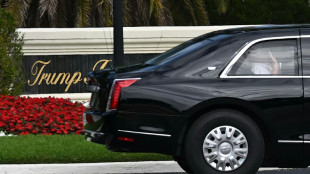 Trump plans to turn Florida golf course into presidential retreat
 WHO says cannot conduct full risk assessment on Russia plague reports
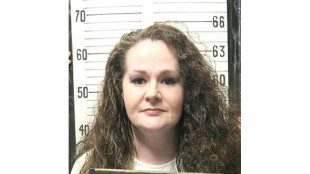 After botched execution, US woman is awake and shackled to bed

 New Zealand fly-half Mo'unga ruled out of Australia Tests
 Protests in major Turkish city after mayor defects to Erdogan party
 Climate change strips island's title of largest penguin colony: study

 Rubio says West must choose between national power or decline
 Russia's plague scare: What we know

 French luxury giant to fund redevelopment of two Paris streets: city hall

 Trump wants to turn Florida golf course into presidential retreat
 Mayor of Turkish opposition stronghold defects to Erdogan party

 Children among heavy casualties in Ukraine after Russian strikes

 Court orders German ex-spy chief kept in jail after spying, treason arrest

 Guinea caps bottled water prices after sachets banned

 Spared, married, hanged: the last weeks of Iranian protester Alireza Sepahi

 Nobel physics winner's pride at pioneering AI role
 IMF preparing El Nino assistance, concerned about AI bubble burst: chief to AFP

An emaciated and apparently blind man stands in the snow at the Nazi concentration camp of Flossenbuerg: the image seems real at first but is part of a wave of AI-generated content about the Holocaust.
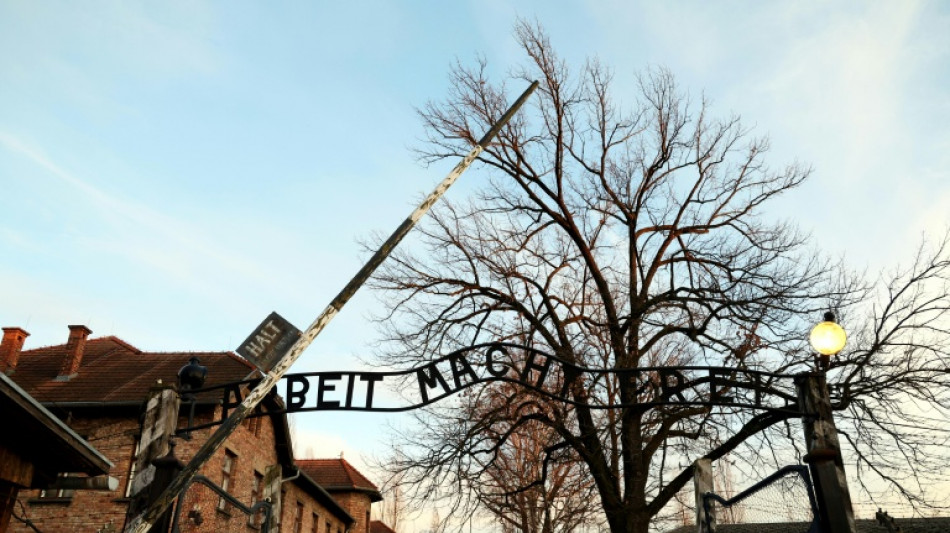
As the world marks International Holocaust Remembrance Day on Tuesday, experts warn that such content -- whether produced as clickbait for commercial gain, or for political motives -- threatens efforts to preserve the memory of Nazi crimes.
AFP's Fact Check team has noted a surge of such imagery on social networks, distorting the history of Nazi Germany's murder of six million European Jews during World War II.
Among the AI-generated images that have gone viral is one of a little girl with curly hair on a tricycle.
She is presented as Hannelore Kaufmann, a 13-year-old Berliner who purportedly died at the Auschwitz extermination camp, of which the 1945 liberation by Soviet troops is commemorated on Tuesday.
However, there is no record of her ever having existed.
Another example is a fake image created to illustrate the invented story of a Czech violinist called "Hank" at Auschwitz, which was called out as false by the camp museum.
After early examples emerged in the spring of 2025, by the end of the year "AI slop" on the subject "was being shown very frequently", historian Iris Groschek told AFP.
On some sites such content was posted once a minute, said Groschek, who works at memorial sites in Hamburg, including the Neuengamme concentration camp.
With the exponential advances in AI, "the phenomenon is growing," said Jens-Christian Wagner, director of the foundation that manages the Buchenwald and Mittelbau-Dora memorials.
- Exploiting 'emotional impact' -
Several Holocaust memorials and commemorative associations this month issued an open letter warning about the rising number of these "entirely fabricated" pieces of content.
Some of them are churned out by content farms which exploit "the emotional impact of the Holocaust to achieve maximum reach with minimal effort".
The picture supposedly from Flossenbuerg camp falls into this category, as it was shown on a page claiming to share "true, human stories from the darkest chapters of the past".
The memorials warned that fake content was also being created "specifically to dilute historical facts, shift victim and perpetrator roles, or spread revisionist narratives".
Wagner points for example to images of "well-fed prisoners, meant to suggest that conditions in concentration camps weren't really that bad".
The Frankfurt-based Anne Frank Educational Centre warned of a "flood" of AI-generated content and propaganda "in which the Holocaust is denied or trivialised, with its victims ridiculed".
By distorting history, AI-generated images have "very concrete consequences for how people perceive the Nazi era", says Groschek.
The results of trivialising or denying the Holocaust are in evidence in the attitudes of some younger visitors to the camps, particularly from "rural parts of eastern Germany... in which far-right thinking has become dominant", said Wagner.
- 'Confident, loud, aggressive' -
Staff have observed Hitler salutes as well as other provocative and disrespectful actions and comments.
Such behaviour is only "by a minority, but a minority that is increasingly confident, loud and aggressive", he told AFP.
In their open letter, the memorials called on social media platforms to "proactively combat AI content that distorts history" and to "exclude accounts that disseminate such content from all monetisation programmes".
"The challenge for society as a whole is to develop ethical and historically responsible standards for this technology," they said, adding: "Platform operators have a particular responsibility in this regard."
German Culture Minister Wolfram Weimer said in a statement to AFP: "I support the memorials' call to clearly label AI-generated images and remove them when necessary."
He said that making money from such imagery should be prevented.
"This is a matter of respect for the millions of people who were killed and persecuted under the Nazis' reign of terror," he said, reminding the platforms that they had "obligations" under the EU's Digital Services Act.
Groschek said that none of the American social media giants responded to the memorials' letter, including Meta, the owner of Facebook and Instagram.
TikTok responded by saying it wanted to exclude the accounts in question from monetisation and implement "automated verification", according to Groschek.
Some of the fake Facebook posts about Hannelore and Hank were still online on the eve of Holocaust Remembrance Day.
T.Samara--SF-PST