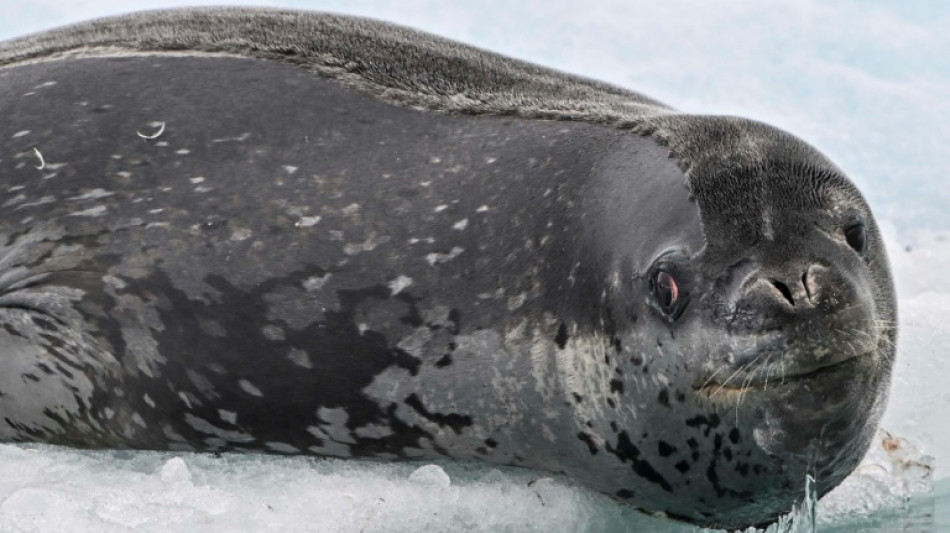
Seals sing 'otherworldly' songs structured like nursery rhymes / Photo: Juan BARRETO - AFP/File

 Anthropic bans 'cruel' behavior against its Claude AI

 Anne Carson's Nobel literature prize 'a proud moment for Canada': PM

 Montagliani to seek CONCACAF re-election in boost for Infantino: reports

 Oil surges, stocks sink on jitters over US plans in Iran war

 John Cena and Jessica Biel hit the gas in 'Matchbox: The Movie'

 US, Ukrainians, Europeans to discuss 'new ideas' to end war

 Unproven 'cures' pushed online amid plague concerns

 Nigeria looks to ease fuel prices as election looms

 Prosecutors in Maradona death trial seek sentences up to 12 years

 Swiss captain Xhaka gets suspended fine for fake Covid cert

 Ex-prince Andrew raid warrants ruled 'unlawful' but UK police maintain probe

 Two Latvians arrested inside UK military base: police

 Eckert 'forever grateful' for Southampton support over spy scandal

 Venezuela's Maduro, wife hit with new US torture charges

 Argentina friendlies no fairy tale for African footballers

 US suspending Microsoft from visa program: Vance

 Man City must 'stick together' during crisis, says Haaland

 CAS opens hearing into Senegal AFCON title appeal

 UK police agree searches for ex-prince Andrew's homes 'unlawful': judge

 After botched US execution, Christa Pike walking, mentally 'foggy': lawyer

 'Stunned' Madrid mourns pensioner who sparked housing protests

 High school students turn out for new protests across France

 Bid by Italy's Intesa bank to take over MPS gets boost

 Stablecoins Are Quietly Becoming Business Infrastructure, NOWPayments Data Shows

 Oil surges, stocks sink as US reportedly eyes new Iran strikes

When male leopard seals dive down into icy Antarctic waters, they sing songs structured like nursery rhymes in performances that can last up to 13 hours, scientists said Thursday.
The Australian-led team of researchers compared the complexity of the songs composed by the big blubbery mammals to those of other animals -- as well as human musicians like the Beatles and Mozart.
Lucinda Chambers, a bioacoustics PhD student at Australia's University of New South Wales, told AFP that people are often surprised when they hear the "otherworldly" hoots and trills sung by leopard seals.
"It kind of sounds like sound effects from an '80s sci-fi" movie, said the lead author of a new study in the journal Scientific Reports.
During the spring breeding season, male leopard seals dive underwater and perform their songs for two minutes before returning to the surface for air. They then repeat this performance for up to 13 hours a day, according to the study.
The researchers determined that all leopard seals share the same set of five "notes" which are impossible to distinguish between individuals.
However each seal arranges these notes in a unique way to compose their own personal song.
"We theorise that they're using that structure as a way to broadcast their individual identity, kind of like shouting their name out into the void," Chambers said.
The researchers believe the males use these songs to woo potential female mates -- and ward off rivals.
- 'Songbirds of the ocean' -
The team studied recordings of 26 seals captured by study co-author Tracey Rogers off the coast of Eastern Antarctica throughout the 1990s.
"They're like the songbirds of the Southern Ocean," Rogers, who is also from the University of New South Wales, said in a statement.
"During the breeding season, if you drop a hydrophone into the water anywhere in the region, you'll hear them singing."
The team analysed how random the seals' sequences of notes were, finding that their songs were less predictable than the calls of humpback whales or the whistles of dolphins.
But they were still more predictable than the more complex music of the Beatles or Mozart.
"They fall into the ballpark of human nursery rhymes," Chambers said.
This made sense, because the songs need to be simple enough so that each seal can remember their composition to perform it every day, she explained.
She compared it to how "nursery rhymes have to be predictable enough that a child can memorise them".
But each seal song also needs to be unpredictable enough to stand out from those of the other males.
Leopard seals, which are the apex predator in Antarctic waters, swim alone and cover vast distances. They likely evolved their particular kind of song so that their message travels long distances, the researchers theorised.
Varying pitch or frequency might not travel as far in their environment, Chambers said.
Female seals also sing sometimes, though the scientists do not know why.
Chambers suggested it could be to teach their pups how to sing -- exactly how this talent is passed down is also a mystery. But she added that this behaviour has never been observed in the wild.
The females could also just be communicating with each other, she said.
G.AbuGhazaleh--SF-PST