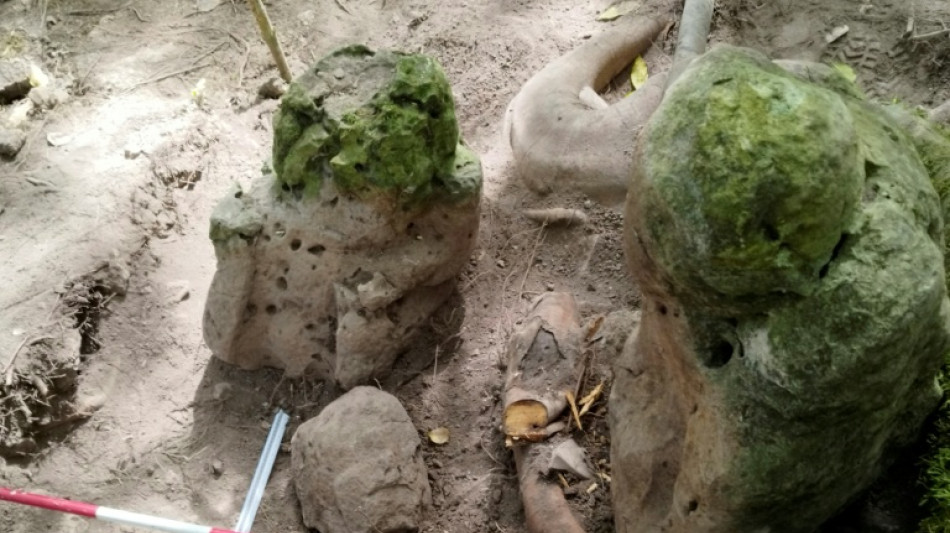
Remains of Mayan city nearly 3,000 years old unearthed in Guatemala / Photo: Handout - Guatemalan Ministry of Culture and Sports/AFP

 Ms. Rachel Says Celebrity Silence on Gaza Is 'F--ked Up' and Drives Her to Swear

 Maryland Regulators and Air Force Clash Over Jet Fuel Spill Cleanup and Golf Course Exemption

 Bishop Museum Races to Save Rare Megamouth Shark Specimen

 Musk Questions AI Development Viability as SpaceX Leasing Revenue Surges

 مصطفى معروفي ينشر قصيدة 'أصوغ كلامي أهتدي بتجاربي'

 Luxembourg Housing Petition Passes Threshold for Parliamentary Consideration

 Raheem Sterling Receives Suspended Sentence After Lamborghini Crash

 Audience to Choose the Set List at Luxembourg's First FAMIL Jukebox Night

 Luxembourg Pay Rise Delayed as Regional and World Headlines Develop

 مواجهة في البرازيل بين نشطاء وفلسطينيين وسياح إسرائيليين حول جدارية مؤيدة

 رئيس جامعة القدس يستعرض نموذج الشراكة بين التعليم العالي والصناعة في قمة QS بأبوظبي
Archaeologists have unearthed the remains of a Mayan city nearly 3,000 years old in northern Guatemala, with pyramids and monuments that point to its significance as an important ceremonial site, the Central American country's culture ministry said Thursday.
The Mayan civilization arose around 2000 BC, reaching its height between 400 and 900 AD in what is present-day southern Mexico and Guatemala, as well as parts of Belize, El Salvador and Honduras.
The city named "Los Abuelos," Spanish for "The Grandparents," once stood some 21 kilometers (13 miles) from the important archaeological site of Uaxactun, in Guatemala's northern Peten department, the ministry said in a statement.
It is dated to what is known as the "Middle Preclassic" period from about 800 to 500 BC, and is believed to have been "one of the most ancient and important ceremonial centers" of the Mayan civilization in the jungle area of Peten near the Mexican border, it added.
"The site presents remarkable architectural planning" with pyramids and monuments "sculpted with unique iconography from the region," said the ministry.
The city takes its name from two human-like sculptures of an "ancestral couple" found at the site.
The figures, dated to between 500 and 300 BC, "could be linked to ancient ritual practices of ancestor worship," said the ministry.
- 'Unique canal system' -
The city, which covers an area of about 16 square kilometers (six square miles) was discovered by Guatemalan and Slovak archaeologists in previously little-explored areas of the Uaxactun park.
Nearby, they also found a pyramid standing 33 meters (108 feet) high with murals from the Preclassic period and "a unique canal system," according to the statement.
"The set of these three sites forms a previously unknown urban triangle... These findings allow us to rethink the understanding of the ceremonial and socio-political organization of pre-Hispanic Peten," said the ministry.
In April, scientists discovered a 1,000-year-old altar from Mexico's ancient Teotihuacan culture at Tikal, elsewhere in the Peten department.
That find was interpreted as proof of ties between the two pre-Hispanic cultures, which lived about 1,300 km apart.
Tikal, about 23 km from Uaxcatun, is the main archaeological site in Guatemala and one of its biggest tourist attractions.
R.Halabi--SF-PST

