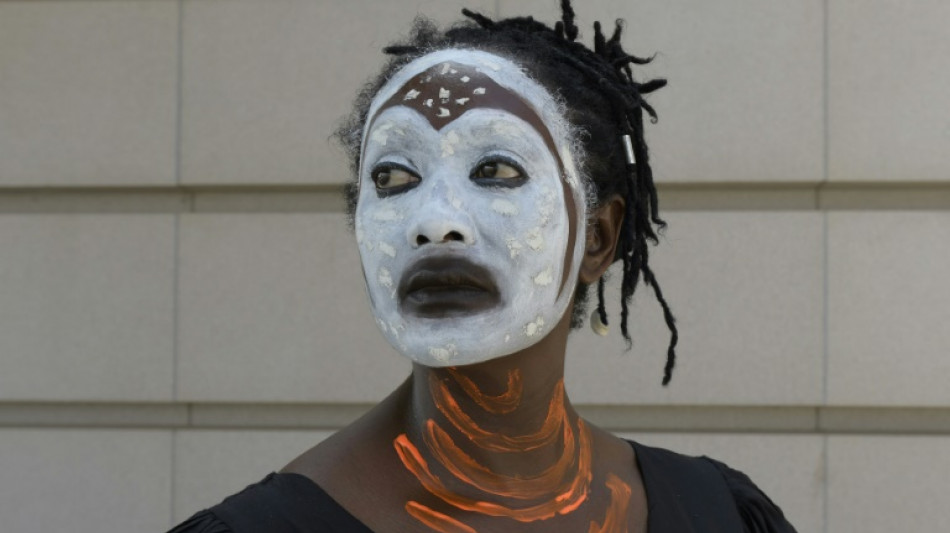
In Dakar, Rwandan director breathes life into plundered African art / Photo: SEYLLOU - AFP

 Lufthansa wins contest for TAP Air Portugal stake

 AI worms, 'major' incident fears spur safety calls at industry summit
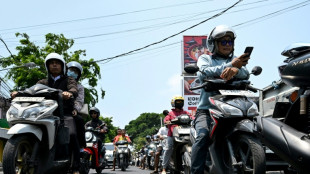
 Fuel shortage triggers queues on Indonesia's Bali island

 Evolution Metals & Technologies Corp. Reaffirms $400 Million to $460 Million FY2027 Revenue Guidance, Unveils Eight Sintered Magnet Grades Covering an Estimated 75% of Global NdFeB Revenue, and Moves to Answer U.S. Army Call for Rare Earth Magnets

 Trial defence says Russia used Nord Stream pipelines as 'weapon'

 Israeli settlers set fire to mosque in occupied West Bank

 Macron says French student protesters 'exploited' by political forces: spokeswoman

 Stocks diverge ahead of key US inflation data
 Japan summons Russian ambassador to protest journalist's arrest

 Workers to strike at world's largest copper mine in Chile
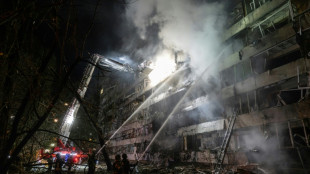 Ukraine accuses US of helping Russia as missiles hit Kyiv

 Drone hits data centre of Russia's largest bank

 Bivial AG Brings Its Complete Dashboard to Mobile
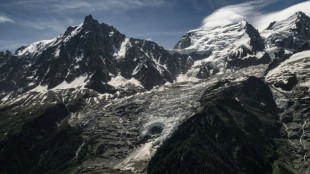 Mont Blanc nearly two metres taller than in 2023: French surveyors

 Pope recovering after lung cancer operation that rattles Church
 Indonesia haze spikes Singapore pollution, shuts East Timor schools
 Higher borrowing costs an 'alarm signal' for France: finance minister
 Zelensky accuses Putin of disrespecting Trump after latest attacks

 Japan PM says housework makes her busier than male predecessors

 Top Indian 'cockroach' leaders sent to jail after protest

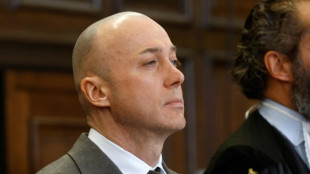
 Ukraine ex-military officer to stand trial over Nord Stream sabotage

 IMF chief says Saudi attacks could have negative spillover 'everywhere'
 Premier League move a Sage decision for new Palace boss

 South Korean FA condemns 'personal attacks' as rift rumours grow

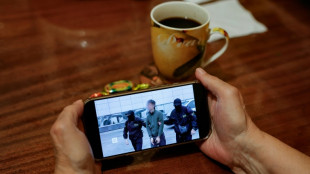 Japan urges 'impartial treatment' of journalist arrested in Russia

In Rwandan playwright Dorcy Rugamba's latest work, a young African steps into an austere European museum and tells an ancient mask he is looking for the soul of Africa.
The artefact comes to life as a woman.
"You will find neither the truth about your ancestors, nor your past -- here Africa is extinguished," it responds, with shrill laughter.
The unconventional performance, "Supreme Remains", premiered at this year's Biennale of Contemporary African Art being held in the Senegalese capital Dakar until June 21.
"If you follow me, I will take you on a tour of the rivers that led us from your ancestors to these places," says the mask, played by the French actress Nathalie Vairac.
But, she warns, "we will have to walk through mud."
As she leads the museum visitor through one large room after another, she invites audience members to examine the blind spots in the official narrative of colonial history.
In one, they meet a scientist from the late 19th century who measured skulls hoping to prove alleged European superiority.
In another, they encounter a Belgian army general -- based on a real historical figure -- who kept the skulls of three African dignitaries at home.
Rugamba, the play's director, said the performance was rooted in history.
"Scientists ordered human remains from the conquerors by the thousands, which were then used to develop racial theories and stereotypes," he said.
- 'Age of disquiet' -
Towards the end of the tour, spectators find themselves among the rolling hills of Rwanda for an initiation ceremony.
The character of the museum visitor learns to "unlearn the past".
French academic Benedicte Savoy said she was "overwhelmed" by the performance.
"It seemed to convey in just one hour things that we normally have to read in hundreds of pages," she said at a debate after a performance last week.
She and the Senegalese writer Felwine Sarr published a landmark report on the restitution of African cultural heritage in late 2018.
Sarr said much progress had been made since, as what was once a niche topic had made its way into public debate.
"Now museums have to be transparent and reflect on so-called ethnographic collections -- it's unprecedented," he said.
"These museums have entered an age of disquiet."
In November 2021, France returned 26 artefacts to Benin.
The works -- part of the royal treasures of Abomey that colonial troops looted in 1892 -- had been held in the Musee du Quai Branly in Paris.
An exhibition of the returned treasures recently attracted nearly 200,000 visitors to Benin's city of Cotonou in just 40 days, according to the authorities.
France also returned a sabre to Senegal in 2019 and a crown to Madagascar in 2020.
The play's director Rugamba, who is also an actor, asked how an entire continent could be emptied of its cultural heritage.
"An African researcher who wants to work on the history of his country must travel to a thousand places without even being sure that he'll be given a visa," he said.
"It's an untenable situation."
- 'Move forward' -
Hundreds of thousands of African works of art continue to be held in Western museums and private collections, but there have been mounting calls for them to hand back the colonial spoils.
Sarr said he welcomed African nations demanding restitution.
In 2019, "seven West African countries requested the equivalent of 10,000 objects, including countries that were at war and that you would expect to have other concerns," he said.
The Biennale's symposium last week featured a debate on how to re-invest meaning into returned artefacts and reconnect them to contemporary Africa.
"If we believe an object to have historical, artistic value and that it must be there to tell a story, then we should put it in a museum," said Sarr.
But objects that have ritual functions can be returned to communities, while those that researchers would like to study can go to universities or art centres, he added.
Dialika Haile Sane, a screenwriter in her thirties, said she felt the "full force" of emotion while watching the theatrical performance.
She said there was no reason artworks should not be returned to "where they were born".
"If we don't reclaim what belongs to us, we can't really move forward," she said.
I.Matar--SF-PST