'He could get killed': Information war inflates Israel-Hamas fight / Photo: RONALDO SCHEMIDT - AFP

 Russia hits Ukraine power plants despite Trump energy ceasefire claim

 Isco's Betis rise back above Real Madrid to third

 Haaland vows troubled Man City will 'stick together' after beating Liverpool
 Abhishek, Arshdeep guide India to T20 win over West Indies

 'Other Mommy' scares up N. American box office win

 Zelensky surprised, Moscow mum as Trump announces energy ceasefire

 Ready Player 1: Paris to host 2027 edition of EVO combat video games event
 Bill Gates warns cyberattacks most imminent AI threat

 Lazio join Inter at top of Serie A as Roma held at Como

 Trump says Russia and Ukraine agree to 'energy ceasefire'

 Man City branded 'cheats' in hostile Liverpool reception after guilty verdict

 Smith breaks fielding record as Australia take control of 1st Test

 Smith breaks fielding record as Australia take first innings lead

 Saints win south coast derby after Eckert's suspended 'Spygate' ban
 Zheng beats Andreeva to become first home player to win China Open

 Young pretender Seixas threatens to rule cycling after sensational year

 Serie A stalemate as Roma held by Como

 Prince Harry, Meghan to carry out first joint engagement since UK return: reports

 Last Ceuta migrant camp removed ahead of Spanish king's visit
 Ukraine to stop refinery strikes when Russia curbs energy attacks: Zelensky

 Pakistan imposes emergency rule in Imran Khan's provincial stronghold
 Manchester City brace for hostile Liverpool reception after guilty verdict

 Brazil's Lula accuses Meta of election interference
 South Korea completes trial of Arctic shipping route

 アレックス・ボディ、CRIFとともに透明性の高い投資と徹底した資金洗浄防止に注力
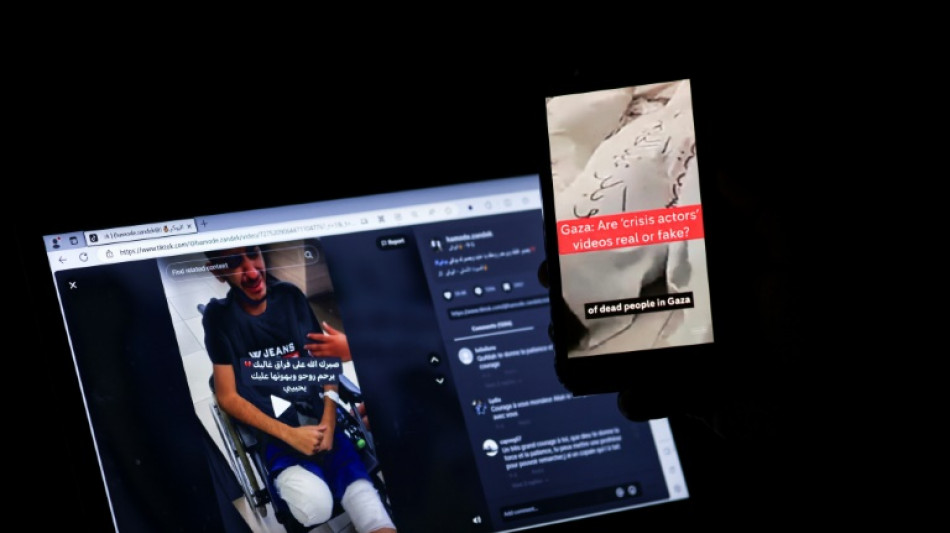
Months after he was discharged from hospital, his right leg amputated, Mohammed Zendiq saw his image swirling online in a vicious disinformation campaign downplaying the horrors of the Israel-Hamas war.
The 16-year-old is one of many civilians on both sides caught in a haze of disinformation since Palestinian militants smashed through the highly militarised border on October 7, triggering an Israeli bombardment and invasion of Gaza.
The information war running in parallel with the deadly conflict on the ground has seen conspiracy theorists accuse ordinary Palestinians and Israelis of being "crisis actors" –- feigning injuries and deaths to garner sympathy and demonise the other side.
An old video that shows Zendiq wounded in a hospital bed was falsely identified in multiple social media posts as depicting a Palestinian blogger who has chronicled the Israeli bombardment of Gaza.
The posts peddled the false narrative that the blogger had staged the injuries one day while walking around seemingly unharmed soon after.
"Palestinian blogger 'miraculously' healed in one day from 'Israeli bombing,'" an Israeli influencer said in one post viewed millions of times on X, formerly Twitter.
"Yesterday, he was 'hospitalised,' today, he is... walking like nothing happened."
But the posts conflated images of separate people, AFP fact-checkers determined, using reverse image and keyword searches.
One was Zendiq, who lost his leg in July during an Israeli raid in the occupied West Bank, according to his family. The other was an unrelated video blogger in Gaza named Saleh Aljafarawi.
Highlighting the real-world ramifications of wartime disinformation, the viral posts sparked an avalanche of online abuse targeting Zendiq, including comments asking why doctors did not cut off the teenager's second leg or kill him.
"I fear for my son's life," Zendiq's father Yousef Issam Fandqah, 50, told AFP. "He could get killed because of this lie."
- Fabrications -
Falsely accusing people of faking their suffering has become "one of the most predictable" disinformation tactics in a crisis scenario, said Mike Caulfield, who researches online falsehoods at the University of Washington's Center for an Informed Public.
Similar "crisis actor" claims have followed US mass shootings and Russia's invasion of Ukraine.
But such narratives have exploded with the Israel-Hamas war, in part because of a scaling back of content moderation at platforms such as X, experts told AFP.
Some of the most viral posts targeting war-afflicted Gazans have used the term "Pallywood", a derogatory label blending "Palestine" with "Hollywood."
"This trend initially emerged in the early days of the war, with a video revealing the behind-the-scenes of a film set and alleging it portrayed Palestinians fabricating injuries," Yotam Frost, from the Israeli disinformation watchdog FakeReporter, told AFP.
As the war progressed, Israelis were also caught up in the false narratives, Frost added.
AFP fact-checkers have debunked multiple "crisis actor" claims, which often misrepresent visuals from entirely different years and places.
Official Israeli accounts on X, including embassies, falsely charged that a video of a dead Palestinian child in fact showed nothing more than a doll wrapped in cloth.
Other accounts mislabelled footage of a 2013 protest in Egypt and a funeral preparation course in Malaysia as Palestinians acting out their own deaths.
A Thai mother's Facebook pictures of her young son in a Halloween costume ricocheted across social media alongside false claims that they showed a Palestinian "actor".
- 'Very dehumanising' -
"It's a set of recipes -- Find a couple pictures of people that look similar or sift through behind-the-scenes video of films and find something you can pretend is faking a war," Caulfield said.
"Crisis actor narratives often take the worst moment of a parent or partner's life -- the loss of a loved one -- and make a circus of it. It's cruel and exploitative."
Israel's relentless bombardment and ground invasion of Gaza has killed 11,240 people, according to Gaza's Hamas-run government.
It followed the Hamas attack on southern Israel -- the worst since the country's founding in 1948 -- which Israeli officials say killed about 1,200 people. Hamas militants also took about 240 hostages back to Gaza, the Israeli military estimates.
By discrediting the experience of those on the ground, the "crisis actor" allegations are polarising public opinion and risk stoking violence.
"If you believe these deaths are staged, you become more insensible -- or sceptical -- towards the atrocities of war," Alessandro Accorsi, a senior analyst at the International Crisis Group of analysts, told AFP.
"It is very dehumanising. It is clearly meant to sow doubts about civilian deaths overall and rally support for more violence and attacks."
V.AbuAwwad--SF-PST